TLDR;
MI Abaga reflects on his career as a Nigerian rapper, record executive and entrepreneur, discussing hip-hop’s influence, the challenges facing the music business, and how artists can build lasting careers. He also considers the changes brought by marriage and turning 40, and explains why he wants to help shape Nigeria’s creative industries.
- MI’s favourite projects include Illegal Music 3 and A Study on Self; he says the forthcoming The Wolf reflects two decades of adult life and personal growth.
- Nigerian hip-hop has contributed heavily to mainstream pop, even though it often receives less recognition than its influence merits.
- Fragmented rights and industry structures can leave artists without fair value or a clear understanding of their music rights.
- MI sees his next chapter in building creative businesses, supporting artists and contributing to Nigeria’s future.
Intro: MI on the Power of Nigerian Rap [0:00]
MI Abaga is a rapper whose work, from “Crowd Mentality” to his debut album Talk About It, helped shape Nigerian hip-hop. Alongside his music career, he has become an executive and entrepreneur, including through his work with Chocolate City and the creative platform Task. His influence now reaches beyond recording and performing into building opportunities for artists and the wider African creative industry.
Who Is Jude Abaga? The Man Behind the Legend [1:00]
Jude Abaga describes himself as someone who still experiences the world with the curiosity of a five-year-old, continually noticing things that fascinate him. He loves music, football, sport, community, friendship and being Nigerian. He also enjoys the challenge facing his generation: a difficult, unfinished puzzle that they must work out for themselves. Alongside making music, he is committed to building Task—and jokes that he is a great dancer, though he is trying to show appropriate respect for Nigeria and Nigerians.
Ranking MI’s Albums and Personal Favourites [3:00]
MI’s personal top five projects are Illegal Music 3, A Study on Self, MI 2, Talk About It and Illegal Music 2. He finds it difficult to rank them at the bottom because each project reached a point where he felt it was finished and ready to share. His lesser-known album Judah is a personal favourite: he sees it as melancholy and values the stronger storytelling and musical craft he developed with age. While some early fans may prefer African Rapper Number One, MI says he hears clear artistic growth in his later work.
The Albums That Transformed Him: A Study on Self and The Wolf [4:45]
A Study on Self explored what happens inside people’s hearts and minds, but MI says he was still too young at the time to fully understand mental health or how his own neurodiversity affected his life. His later project The Wolf takes a wider view of two decades of adulthood, including betrayal, disappointment, failure, success and personal growth. The title is an acronym for “To Humans Everywhere, Whatever Occurs, Look Forward”. MI hopes the album will change listeners, and says making it helped him understand himself more deeply.
Favourite Collaborations: Flavour, Jesse Jagz and Olamide [6:00]
MI’s favourite collaborations are shaped as much by the relationship and experience as by the finished song. “African Rapper Number One” was a three-way creative effort: Ice Prince first wrote the melody and the title line, and Flavour completed the chorus and bridge during a quick, easy studio session. Working with his brother Jesse Jagz is especially meaningful, whether they are making music or Jesse is producing. MI also recalls Olamide’s fast, straightforward contribution to a song: he agreed to take part, recorded his verse and returned everything needed for clearance within about 30 minutes. MI praises Olamide for making collaboration easy for the people around him.
The Song He Wishes He Hadn’t Released [8:00]
MI says he regrets releasing “The Chairman” in its final form, though he still values parts of the song. It was the only track he made to meet a label deadline, and he later found that its key was too low for him to perform comfortably. He also felt the recording was rushed and could have been improved with more time and a different key, despite the involvement of producer E-Kelly. The song was intended to frame the album The Chairman: it reflected MI’s journey from arriving in Lagos as an unknown young man in 2007 or 2008 to being addressed as “Chairman” in a 2013 meeting, while crediting God as the true chairman. Because the single came out first, he felt its reception overshadowed the story the album was meant to tell.
Why Rap Is Nigeria’s Most Underrated Subculture [10:45]
MI argues that Nigerian hip-hop has repeatedly been treated as a lesser genre, even when its artists perform well. He recalls that the same dismissive narrative surrounded earlier stars such as Ruggedman, Idris Abdulkarim and Modenine, persisted during his own era, and continues despite the success of newer artists such as Odumodublvck. He does not expect rap to become Nigeria’s biggest popular genre, because mainstream audiences tend to embrace pop, which combines influences from many styles. Yet hip-hop has helped shape pop’s beats, slang, clothing, rhyming and performance habits, often without receiving credit. MI sees Nigerian rap as a strong subculture with a substantial history of successful artists, and suggests that its underdog identity is part of its character.
Why Labels Fail in Nigeria [14:30]
MI says labels struggle partly because the music industry is structured in ways that make it hard for musicians—the writers and performers—to receive fair value. Music publishing, mechanical royalties, management and agency work are divided across different systems and organisations, leaving a fragmented market in which bad actors can take advantage. He compares this to other longstanding structural problems: when the foundations are wrong, the rest of the system is affected. He points to a history of artists challenging unfair arrangements, from Black musicians in earlier decades to Prince, Michael Jackson and Drake. MI believes Africa has an opportunity to build better systems from the ground up, rather than having to work around entrenched Western structures.
360 Deals and Africa’s Music Innovation [18:30]
A 360 deal gives a label a share of several parts of an artist’s income and brand, rather than earnings from recorded music alone. MI explains that these deals became more attractive to labels when physical sales declined and recorded music became widely available online. He says the pressure of operating in a difficult environment can also produce new business models: he notes that versions of the 360 approach were already being used in Nigeria before the model became prominent in the United States. He praises Empire and its founder Ghazi for helping independent artists access distribution, which allowed artists to keep ownership while a distributor marketed their music for a share of the proceeds. However, MI says the wider goal should be fairer systems that reward creators and give Africa a just share of its contribution to the global creative industry.
Rethinking the Artist–Fan Relationship and Ownership [22:45]
MI questions the idea that streaming platforms should determine the value of music for everyone. Artists cannot simply set a higher price for an album, and platform algorithms reward a growing volume of content, spreading revenue across more participants. He suggests that artists could build closer, smaller-scale economies with committed fans who pay for albums, vinyl, merchandise or live performances at prices that reflect what the music means to them. Technology, including Web3, may help make those direct relationships possible; he also points to a Jay-Z partnership with a South Korean company that lets fans invest in artists’ music.
Music rights themselves are divided. Publishing covers the lyrics and melody, while the master recording is the specific recorded version that a label may own or control. Although songwriters have publishing rights, many artists lack the knowledge and access needed to understand publishing, mechanical royalties, performance rights and other income streams. MI says artists often sign away rights while urgently seeking money, without seeing how the different parts of a deal fit together.
Balancing the Artist and the Executive [28:20]
MI admits that he has not found a perfect balance between being an artist and an executive. His focus on entrepreneurship has affected his music career, but he is proud of the work because he sees it as building towards something larger. He believes the creative mind that makes music can also identify and solve problems, even though people may underestimate artists as business thinkers. Music is a full-time occupation, and MI says his wife, his team and his ability to connect his music with his business work help him manage competing demands. He sees the process as continual management rather than a neat, fixed balance.
The World Was Telling Me: “Thank You, MI. You’re Done” [31:55]
After leaving his role as CEO of Chocolate City, MI briefly wondered whether the world was telling him to stop making music. He asked himself whether he had more to contribute, especially when younger rappers were ready to carry the genre forward. Two things convinced him there was still a reason to continue: he did not feel the story of MI was complete, and he believed his album-making could contribute something distinctive as global audiences discovered African music. He sees himself as someone able to make carefully constructed, artistic bodies of work, and believes Nigerian music benefits from having that kind of contribution. He also acknowledges that there are parts of being an artist he does not enjoy, but he remains committed to continuing.
STYL-PLUS, Joeboy and Letting Go of Ego [33:55]
Before MI became famous, he looked up to STYL-PLUS and hoped to get one of their members to listen to his song. In 2006, someone advised him that the group was “on the way out” while MI was “on the way in”; the remark changed how he thought about success and the handover between generations. He says maturity involves talking back to the ego and accepting that a career’s most celebrated moment is only one phase of life. Artists must be willing to reinvent themselves and accept that public attention and earnings can change, even when doing so feels exposing.
At a Joeboy show, MI noticed the contrast between his own quiet, work-focused visit and the crowds surrounding a current star. Instead of feeling deprived of his former status, he recognised that his priorities had changed and that his time now mattered more to him than a particular lifestyle. He says artists carry millions of expectations and can feel the weight of public reactions, which can trap them in an old image. Accepting change, he argues, is part of the beauty of an artist’s life.
Drake vs Kendrick: A Rap Culture Deep Dive [39:00]
MI is a fan of both Drake and Kendrick Lamar, but says he listens to more Drake because he finds more to learn from Drake as a creative, while he feels closer to Kendrick’s approach. He sees three forces behind their conflict: Drake’s extraordinary dominance, the resentment that can build towards a long-standing number one, and Kendrick’s more fundamental objections to what Drake represents in the industry. MI says Drake misjudged Kendrick by treating him as one more rival, rather than recognising the depth of Kendrick’s motivation.
MI considers Kendrick’s victory an important career milestone and says the battle strengthened Kendrick’s position among the greatest rappers. At the same time, he argues that Drake’s sustained output, influence and success over roughly 15 years cannot be dismissed. He believes Drake could turn the experience into a powerful comeback story by taking time away, reflecting honestly on his mistakes, and making an album about isolation, betrayal and what it means to be at the top. MI also compares their positions with those of Jay-Z and Michael Jackson, noting that Drake’s reach across the music industry is different from being the leading figure in hip-hop alone.
Is MI Appreciated Enough? A Reflection on Legacy [49:00]
MI feels respected by many Nigerian rappers and is grateful for the recognition he has received, but he does not want greater popularity for its own sake. He enjoys having enough recognition to be known in Lagos while still being able to observe life more quietly elsewhere. His focus is now on what comes next rather than measuring the value of his past career by public attention. He describes success as having become a label owner after being signed, helping his family and early collaborators become stars, and reaching the top of a genre across Africa. He believes he has received enough from that phase of music, while still having more work to do.
Marriage, Masculinity and Emotional Growth [55:00]
MI says marriage transformed him by giving him someone who observes his behaviour closely and can offer constant feedback. He had not realised how little attention he paid to his own reactions, particularly when upset; learning to treat criticism as useful information helped him understand himself and improve in business and daily life. He gives the example of his wife describing him as a slow learner. After considering what she meant, he recognised that he needs time to process new information and now asks people to explain things again rather than pretending he has understood immediately.
Marriage also changed his understanding of masculinity. MI says habits that seem assertive or traditionally masculine in male friendships do not necessarily help in a marriage, where listening, patience and sometimes waiting quietly are more important. He has also had to think again about what it means to provide when his wife can earn money herself. He concludes that there is no simple modern definition of manhood, and that men need space to learn and develop.
The Unfair Burden of Being a Man in Today’s World [1:03:00]
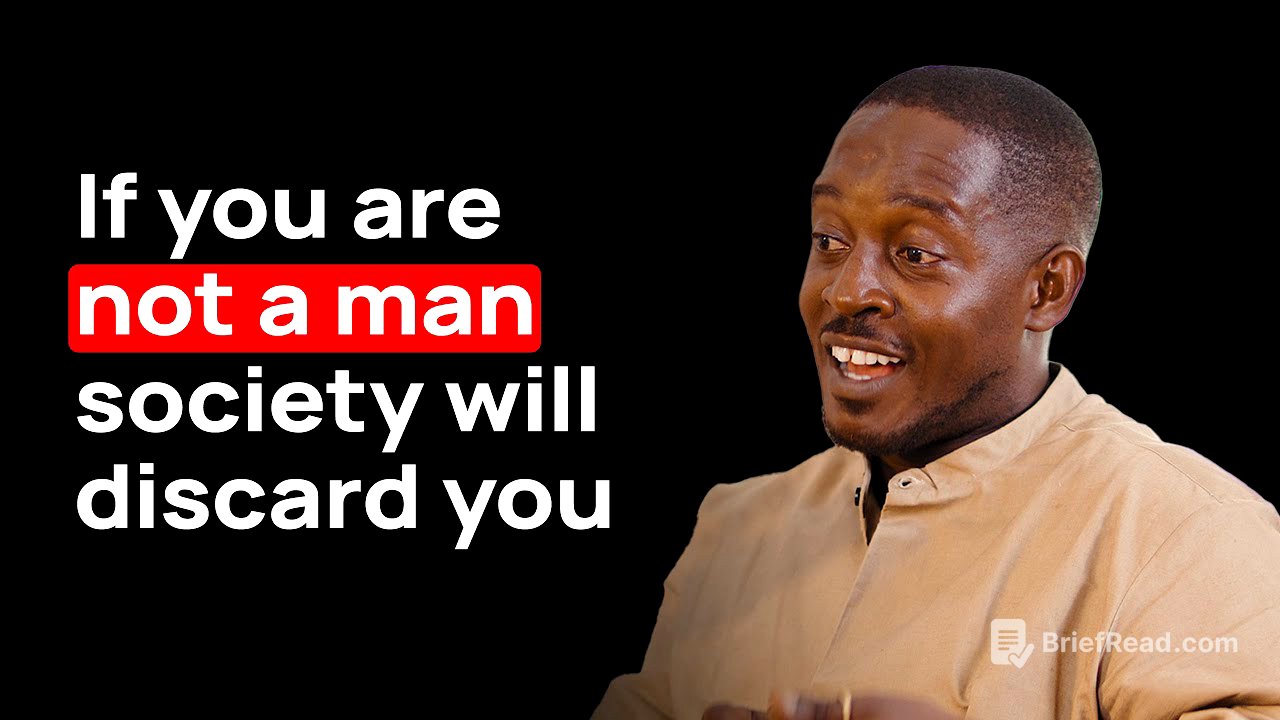
MI says men can be discarded by society if they are seen as unproductive, and many receive little guidance on how to handle adult life. He believes some men grew up with fathers who were away working or travelling, leaving them to face major life decisions without examples or instruction. Many are still trying to answer questions about how to act and feel as they encounter them. He asks women to show men patience as they learn, while also acknowledging that relationship conversations can become difficult when a man’s emotional response is judged differently because he is expected to stay calm.
MI describes the pressure on men to provide, contain their emotions and keep working, even as their health suffers. He contrasts men his age who may feel they are only now hitting their stride with women around the same age who are reassessing their lives through exhaustion. He argues that men and women can face different forms of unfair pressure, and that understanding each other’s experiences requires grace and empathy on both sides.
On Turning 40 and Becoming an Elder [1:08:00]
As he enters his 40s, MI is looking forward to becoming an elder and taking responsibility for what his generation leaves behind in Nigeria. He sees the country as exceptionally diverse, culturally rich and full of people who have achieved great things despite hardship and trauma. He wants his work to help connect Nigeria’s regions and make the country’s potential real for future generations. After previously feeling powerless as a young person, he now feels able to approach decision-makers, offer help and build institutions. He is encouraged by African founders and organisations willing to take on ambitious projects, even when the challenges are difficult.
Advice for Young Creatives on Longevity [1:13:00]
MI urges young artists to prepare for their whole lives, not only for the years when their careers are most active. He says that learning to write a song is proof that a person can become skilled at something they could not do before, and that this ability can carry them into future careers. A creative career can be brutal, and the entertainment industry often undervalues people whose first attempt does not make them famous. MI compares artists to startup founders, who understand that success and failure can depend on small, unpredictable differences.
He calls creatives change agents for Africa because they know how to try, fail, build, gather people and create an audience. His central advice is not to give up on yourself, whatever happens or whoever else gives up on you. People who know how to make beautiful things can bring that ability to whatever they do next.
What MI Wants to Be Remembered For [1:15:00]
MI hopes to be remembered as a husband, friend, Nigerian and builder. He likes the term “industrialist” because it suggests the work of creating an industry rather than making a single successful product. He wants to keep contributing to organisations and systems that help Nigeria’s creative sector grow. Above all, he wants to have been a good person, while keeping room for the parts of himself that love football and dancing.
Who MI Thinks Should Be on the Podcast Next [1:17:00]
MI recommends Dixon, the chief executive of Kora, as a future guest. He believes Dixon’s story of building the company would be valuable, especially because Dixon has also helped other founders in the African technology and business community. MI describes him as a catalyst for other entrepreneurs and says his journey deserves to be told.