TLDR;
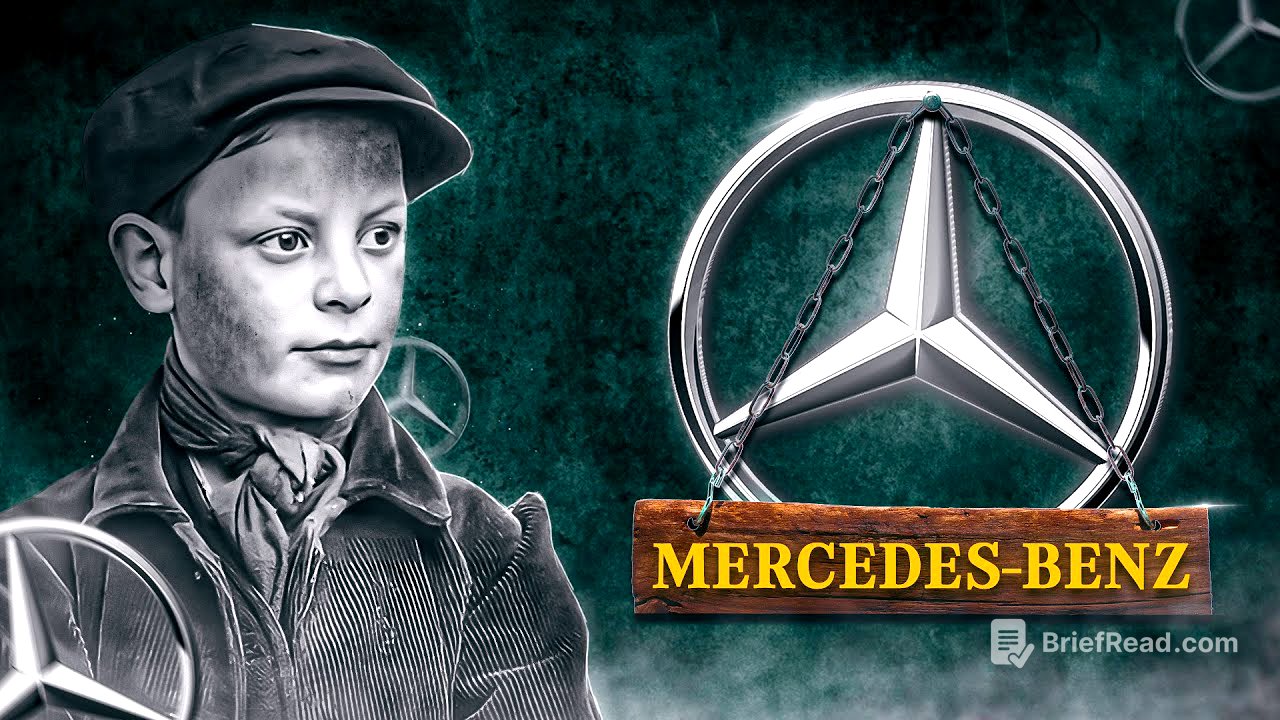
This video tells the story of Mercedes-Benz, from its humble beginnings with Karl Benz, a poor engineer who invented the first automobile, to its rise as a global luxury car brand. It also covers the company's dark period during World War II, when it profited from supplying military vehicles to the Nazis using forced labour.
- Karl Benz's early struggles and determination to invent the automobile.
- The rivalry between Benz and Daimler and their eventual merger.
- Mercedes-Benz's involvement with the Nazi regime and use of forced labour.
- The company's recovery after World War II and its rise to global success.
Prologue [1:14]
Mercedes-Benz is a luxurious car company with a value of around $80 billion, but it had humble beginnings. Karl Benz, a poor engineer, faced doubts and failures while building the first horseless carriage. He proved everyone wrong and turned his venture into the world's first and biggest production car company in the late 19th century. The company later profited from supplying military vehicles to the Nazis, using forced labourers. The video will cover the story of Mercedes-Benz and Karl Benz, the man who brought automobiles to life.
Humble Begininngs [6:11]
Karl Benz was born in 1844 in Germany, into a low-class household. His father, a locomotive driver, died when Karl was two, leaving the family in financial difficulty. Despite poverty, his mother ensured he had a good education. He showed brilliance in chemistry and mechanics and, at 15, decided to study mechanical engineering at the University of Karlsruhe. There he met Ferdinand Redtenbacher, who believed steam engines were becoming outdated. Benz's interest in horseless carriages grew, and he experimented with his bicycle to create a motorised vehicle. He realised the need for a different concept than steam engine technology. After graduating, Benz worked various engineering jobs and started his own venture in 1871. He partnered with August Ritter to run an iron foundry and mechanical workshop while developing a motorised carriage. Ritter proved unreliable, but Karl met Bertha Ringer, who later became his wife. Bertha used her dowry to buy out Ritter's share, giving her and Karl full control of the business. During this time, Karl made breakthroughs, developing a gasoline two-stroke engine in 1879 and patenting inventions like an engine speed regulation system, ignition system, spark plug, carburetor, clutch, gearshift, and water radiator. However, rising production costs forced him to incorporate, reducing his shares to 5% and sidelining him from decision-making, leading him to leave the corporation.
Benz & Cie [9:19]
After leaving his company, Karl Benz partnered with Max Rose and Friedrich Wilhelm, who owned a bicycle repair shop, to establish Benz & Cie. They focused on manufacturing industrial machines and stationary gas engines. This venture was profitable, allowing Benz to focus on building an automobile using his gas engine. Instead of simply adding a motor to a carriage, Benz built the carriage around the motor, creating what is considered the first true automobile, the Benz Patent Motorwagen, in 1885. This two-seater vehicle ran on three wire wheels and was powered by a gasoline four-stroke motor, producing 2/3 of a horsepower and reaching 7 mph. Benz drove his car out to the public in 1886, receiving mixed reviews. Some admired it, but many were skeptical and feared it might explode. His business partners were also unhappy, as his obsession with the automobile kept him away from his work. Despite this, Carl Benz began manufacturing cars for sale in 1888, the first person in the world to do so. His wife was his biggest supporter, but even with improvements, people struggled to see Carl's vision. The cars were expensive and only accessible to the rich, who often found them too loud and messy.
The Trip That Shaped The Future [13:38]
In the summer of 1888, Bertha Benz took her husband's car without his knowledge and embarked on a 66-mile journey to visit her mother in Pforzheim, accompanied by her two sons. This was a significant journey, as no car had ever attempted such a long trip before. Bertha faced many challenges, including rough roads, needing to get more gas from a pharmacy, and performing mechanical repairs. The trip took over 12 hours, but they made it safely to Pforzheim. The trip achieved its goal of making people notice the automobile. The Benz Motorwagen became the talk of the town and received great publicity. Benz & Cie expanded quickly, becoming the second-largest engine manufacturer in Germany by 1890. With the addition of new business partners, Benz focused on engineering and patented new car innovations. In 1893, he launched the Benz Victoria, a more luxurious two-passenger vehicle with a 3-horsepower engine. Its follow-up, the cheaper Benz Velo, became the world's first large-scale production car, making Benz & Cie the largest automobile company in the world during the 1890s and early 1900s.
The Rivalry [19:05]
While Benz & Cie enjoyed success, they faced pressure from Daimler Motoren Gesellschaft, headed by Gottlieb Daimler and Wilhelm Maybach. Daimler was competitive and knowledgeable about running a business, something Carl Benz lacked. The first Daimler car appeared in 1892, followed by a two-cylinder car in 1894, and their first front-engine model, the Daimler Phoenix, in 1897. The Daimler company was catching up to Benz, with more appealing vehicles. After Daimler's death in 1900, Maybach designed the Mercedes 35 horsepower in 1901, which resembled modern cars. It had a powerful gas engine, a wider body, a tailored steel chassis, and a low centre of mass. Built for racing, it was named after Emil Jellinek's daughter, Mercedes. The car won races and Hill Climb events, drawing attention to the Daimler company, who rebranded their vehicles as Mercedes. Carl Benz's partners wanted to counter their competition and brought in French designers to help with a new faster model without Benz's approval. Benz, who disliked auto racing, was angry and upset. The car built by his team was not a success, damaging the Benz company. Benz left his company but remained on the board of directors. His cars' racing successes eventually rescued his company. By 1908, Benz had a 120-horsepower racer, and in 1909, the 200-horsepower Blitzen-Benz broke the absolute speed record, reaching over 140 mph in 1911. This placed Benz alongside Daimler as one of the most desired cars.
A New Direction [24:26]
Both Benz and Daimler enjoyed good sales until World War I, which caused an economic recession. To survive, the two companies signed an agreement in 1924 to combine production and marketing while retaining their names. In 1926, they merged completely, creating Daimler-Benz. The company rebranded their vehicles as Mercedes-Benz and released models like the Mercedes-Benz type 630 and models S, SS, and SSK. Ferdinand Porsche helped develop these vehicles. Carl Benz remained on the Daimler-Benz board and saw the success of his automobiles. He died in April 1929 at the age of 84. After his death, the company continued to grow, becoming one of the best performance car makers. When Hitler rose to power in 1933, he wanted to showcase German engineering and provided subsidies to Daimler-Benz to get involved in Grand Prix races. From 1934 to 1939, Mercedes dominated Grand Prix races, driving as fast as 200 mph. They were challenged by Auto Union, another German automaker. These successes put Germany on top of the world in Motorsports, and Mercedes-Benz became Hitler's preferred car brand. During World War II, Daimler-Benz manufactured military vehicles, submarines, tanks, and aircraft engines for the Nazi military. By 1942, they stopped producing public cars and used forced labour to handle increased production. These prisoners of war and concentration camp detainees were forced to work long hours under inhumane conditions. By 1944, almost half of Daimler-Benz's employees were forced labourers. After the war, the company lost its foreign subsidiaries and had to start over. They obtained a production permit in 1946 and focused on producing ambulances, police patrol vehicles, and delivery vans. By 1947, they were back to producing passenger vehicles. By the 1950s, Mercedes-Benz regained its influence, making a comeback in Motorsports and achieving successful sales worldwide. Over the years, Mercedes has shifted its image and become one of the most valuable car brands in the world, thanks to Carl Benz's courage and determination.