TLDR;
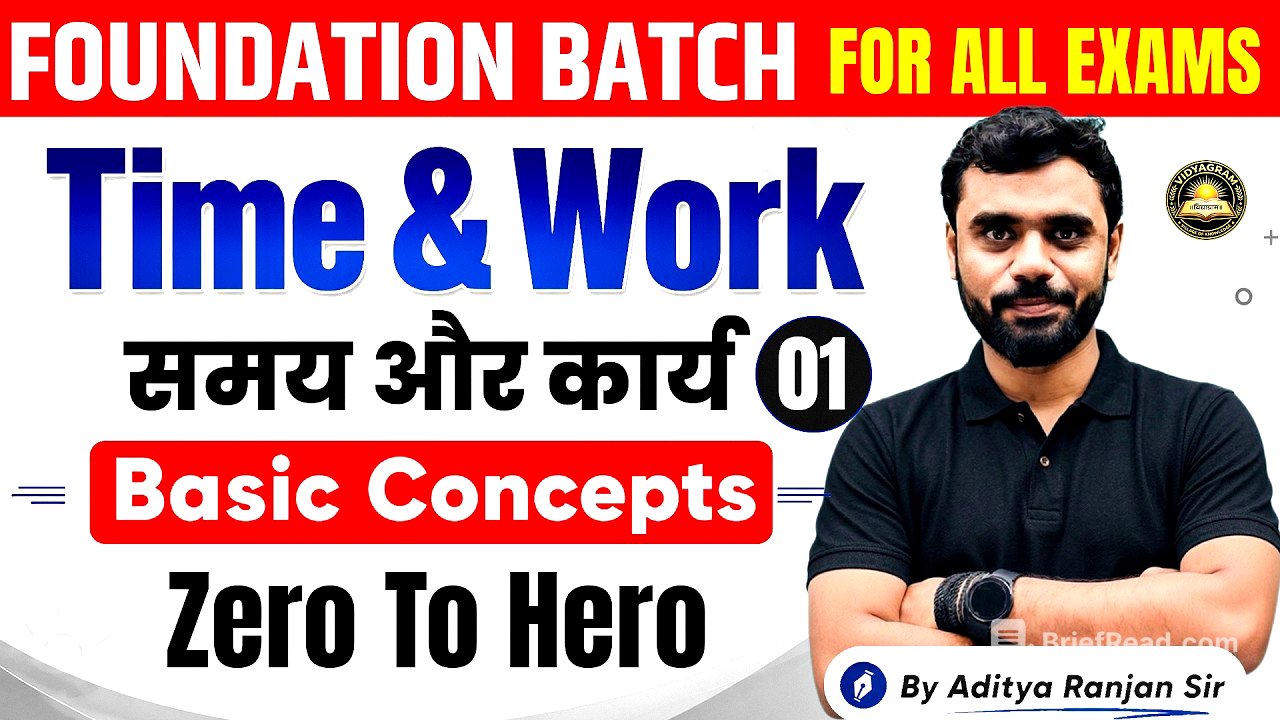
This YouTube video by Vidyagram provides a comprehensive guide to solving Time and Work problems, focusing on fundamental concepts and efficient methods. It covers LCM methods, formula-based approaches, and variations involving fractions and percentages. The session aims to build a strong foundation, starting from basic principles and progressing to advanced problem-solving techniques.
- Covers Time and Work, Pipe and Cistern, and Work and Wages.
- Teaches LCM and formula methods for efficiency.
- Includes problems with fractions and percentages.
- Emphasises practical application and quick problem-solving.
Introduction to Time and Work [0:28]
The video introduces the topic of Time and Work, highlighting its significance in competitive exams. It outlines the three main areas: Time and Work, Pipe and Cistern, and Work and Wages. The speaker notes that Time and Work problems were frequently asked in recent exams, sometimes appearing four to five times in a single shift. The approach will be from basic to advanced, ensuring everyone, regardless of their background, can understand and solve these problems effectively.
Understanding LCM for Time and Work [2:48]
The discussion moves to the importance of understanding the Least Common Multiple (LCM) for solving Time and Work problems. The speaker explains how to calculate the LCM of two or more numbers, providing examples such as finding the LCM of 10 and 20, and then 12, 15, and 20. The method involves finding a number that is divisible by all given numbers and using prime factorisation to simplify the process.
Basic Concepts and Formulae [6:27]
The speaker introduces the core concepts of Time and Work, explaining the relationship between time, efficiency, and work. He uses an example where A completes a task in 10 days and B in 20 days. The total work is determined by finding the LCM of the time taken by each individual. Efficiency is then calculated by dividing the total work by the time taken. The fundamental formula, Time × Efficiency = Work, is introduced, along with its variations for calculating efficiency and time.
Type 1: LCM and Formula Methods [10:01]
The video transitions to Type 1 problems, demonstrating how to solve them using both the LCM method and a formula. An example is given where A completes a task in 12 days and B in 15 days. The LCM method involves finding the total work and individual efficiencies, while the formula method uses (A × B) / (A + B) to find the combined time. The speaker encourages viewers to use either method based on their preference and the specific problem.
Practice Problems: Method Application [14:59]
Several practice problems are presented to reinforce the concepts learned. The speaker solves each problem using both the LCM method and the formula, showing how to efficiently find the answers. He also shares tricks for quickly calculating LCMs and simplifying fractions. Viewers are encouraged to solve the problems along with the speaker and provide answers in the comment box.
Problems Involving Fractions [22:34]
The session addresses problems where individuals complete a fraction of the work in a given time. The speaker explains how to find the total time required to complete the entire work by setting up proportions. Several examples are provided, and viewers are encouraged to solve them quickly. The speaker emphasises the importance of understanding the basics to tackle more complex problems.
Problems Involving Percentages [33:13]
The video transitions to problems involving percentages. The speaker explains how to approach these problems by focusing on the amount of work done in a specific time frame. He uses an example where A completes 20% of a work in 7 days and B completes 25% in 7 days. The key is to add the percentages to find the total work done when they work together.
Problems with Remaining Work [36:26]
The session covers problems where individuals work together for a certain period, and then the remaining work needs to be calculated. The speaker explains how to find the total work, calculate the work done in the given period, and then determine the fraction of work left. He emphasises the importance of understanding the question and using the LCM method for these types of problems.
Three Variable Problems [1:02:21]
The video introduces problems involving three variables (A, B, and C). The speaker explains how to find the total work by calculating the LCM of the time taken by each individual. He also presents a formula for solving these problems but notes that the LCM method is generally more efficient. Several examples are provided to illustrate the concepts.
Advanced Three Variable Problems [1:16:28]
The session continues with more complex three-variable problems, including those where only a fraction of the work is completed. The speaker demonstrates how to find the total work, calculate the work done by each individual, and then determine the remaining work. He also shares tips for quickly solving these problems and avoiding common mistakes.
Coupling Problems [1:38:44]
The video introduces "coupling" problems, where tasks are done in pairs (A and B, B and C, C and A). The speaker explains how to solve these problems by doubling the LCM and then finding individual efficiencies. He emphasises the importance of avoiding decimals to simplify calculations. Several examples are provided to illustrate the method.
Advanced Coupling Problems [1:47:59]
The session continues with more advanced coupling problems, including those where the time taken by all three individuals working together is given. The speaker demonstrates how to find individual efficiencies and then solve for the required time. He also shares tips for quickly solving these problems and avoiding common mistakes.
Conclusion and Practice Tips [1:54:36]
In the concluding segment, the speaker summarises the key concepts covered in the session and provides tips for effective practice. He recommends using type-wise books for focused practice and solving previous year's questions to build confidence. He also advises viewers to avoid getting discouraged by difficult problems and to focus on understanding the underlying concepts. The session ends with a thank you and a reminder about the next class.