TLDR;
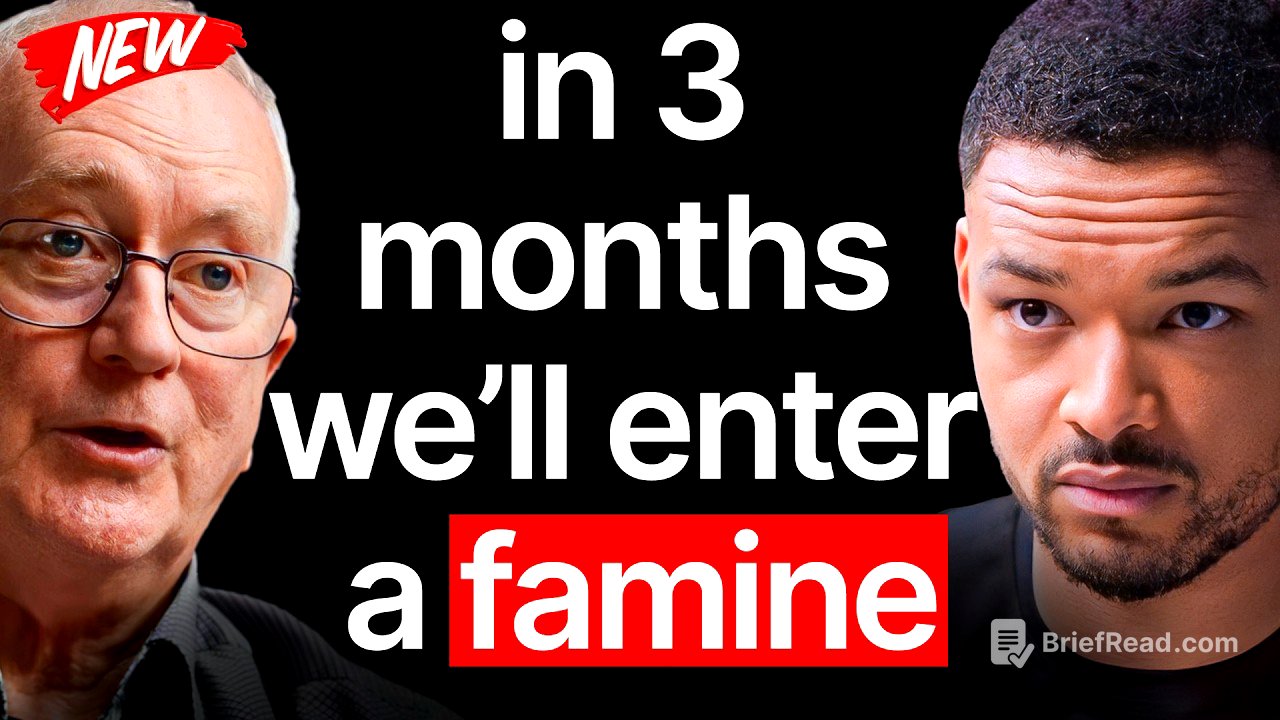
This episode of The Diary Of A CEO features Professor Steve Keen, who discusses the escalating tensions between the US, Israel, and Iran, and the potential global consequences. He outlines five possible scenarios, ranging from the destruction of Iran to a best-case scenario where America recognises its losses and negotiates for peace. Keen highlights the fragility of global production systems, the potential for economic collapse due to overinvestment in AI, and the need for self-sufficiency and a shift away from short-term competitive capitalism.
- The war between Iran and Israel is threatening global stability due to the region's importance in oil, fertilizer, and helium production.
- Trump's actions are seen as a "pump and dump" scheme to manipulate oil prices for personal gain.
- The global economy is more fragile than most people realise, with potential for famine and economic collapse.
- AI is creating a boom-and-bust cycle that could lead to a significant financial crash.
- Self-sufficiency and community are vital for surviving potential future crises.
Intro [0:00]
Professor Steve Keen joins the show to discuss the potential outcomes of the escalating conflict involving the US, Israel, and Iran. He suggests that Trump's actions are driven by personal gain and that the situation is more dangerous than many people realise. The discussion covers five possible scenarios and their potential global consequences.
Why Does Your Perspective Matters Now [2:35]
Professor Keen introduces himself as a specialist in the history of economic thought, financial instability, and the dynamics of money. He notes that his focus on money makes him a minority in economics, as most economists tend to disregard it.
What’s Really Driving Tensions Between The US, Israel, And Iran [3:01]
The discussion begins with the assertion that the US has essentially elected a "mafia don" as president, leading to actions driven by shakedowns rather than political necessity. The American deep state's long-standing anti-Iran stance and Israel's desire to defeat Iran are key factors. Trump is portrayed as someone easily manipulated but also cunning enough to pursue Israel's goal of destroying Iran, underestimating Iran's preparedness. Trump's narcissistic personality disorder is mentioned as a factor influencing his decisions, with a desire to be the centre of attention.
Why Israel Might See Iran As An Existential Threat [7:46]
Israel's desire to destroy Iran stems from religious elements and an expansionist agenda. Iran is seen as a major rival in the region. Israel, historically militarily dominant, views Iran as too large to take on alone and sought American assistance, underestimating Iran's preparedness. Iran has broken its military into 31 divisions, each with its own fail-safe systems and resources, making it difficult to defeat without resorting to widespread destruction.
The Strait Of Hormuz—And What Happens If It Closes [12:46]
The Strait of Hormuz is a critical choke point for the passage of oil, fertilizer, and helium. Iran's control over this strait allows them to dictate which countries can pass through based on their political stance. A closure of the strait would have significant consequences, including a potential global famine due to the disruption of fertilizer supplies and a halt in semiconductor production due to the loss of helium.
Where Fertilizer Comes From—And What A Shortage Would Trigger [16:40]
20 to 30% of the world's fertilizer passes through the Strait of Hormuz. Fertilizer is essential for growing food, and without it, the planet could only support between one and two billion people. A loss of 20% of the world's fertilizer would lead to a global famine, an unprecedented event.
Why Oil Still Controls Everything—And The Cost Of Running Out [18:27]
Energy is critical for production, and a loss of 20% of the world's liquefied natural gas and a substantial proportion of its oil could lead to a 5 to 10% fall in global gross world product. The concentration of oil in Iran, Saudi Arabia, and Iraq makes the region particularly important. The type of oil in this region is unique and cannot be easily replaced. A war with Iran could cut off 20 to 30% of global production of oil and food.
What Happens If This War Doesn’t End Quickly [21:29]
If the war doesn't end quickly, India will run out of fertilizer, leading to famine. Food production could fall by 10 to 25%, resulting in widespread starvation. Even wealthy countries like Australia, with only 30 days of oil supply, are vulnerable.
The Real Cause Behind The Global Cost Of Living Crisis [22:13]
The rising cost of living is highlighted through the example of a man working three jobs to support his family. The conversation touches on the detachment that can occur from the struggles of ordinary people when one is in a privileged position. The potential for prices to rise by 20% due to the conflict could push many people over the edge.
Do Wars Widen The Gap Between Rich And Poor [25:38]
Wars are often created when inequality is high. The aftermath of World War II led to a focus on equality and fairness, but this has been forgotten over time, leading to massive inequality once more. Venezuela and Iran, countries with the largest oil reserves, have been targets of US intervention. The motivation behind the conflict with Iran may be related to controlling global oil supplies.
Five Scenarios That Could Shape What Happens Next [29:58]
Professor Keen outlines five possible scenarios for the conflict.
Scenario 1: What Happens If Iran Is Destroyed [30:10]
The destruction of Iran, which Israel desires, would require the use of nuclear weapons, leading to global catastrophe. The hope is that Iran can neutralise Israel's nuclear weapons. The probability of this scenario is estimated at 5%, but it remains a terrifying possibility.
Scenario 2: The Fallout If Gulf Infrastructure Collapses [33:21]
Iran destroying the Gulf power infrastructure is considered highly likely. This would render countries like Saudi Arabia, Qatar, and Dubai uninhabitable. Attacks on Saudi Arabian power systems have already disrupted liquefied natural gas production. Dubai could lose $1.4 billion a day due to an unplanned emergency shutdown of its airport. The fragility of the region is highlighted, with a reminder of how dependent it is on foreign workers.
Scenario 3: The Samson Doctrine—And When It’s Used [37:51]
The Samson Doctrine refers to Israel unleashing destruction on the rest of the world if it faces an existential defeat. Iran has threatened Israel, and Israel has been pushing the Palestinians out. If Israel faces defeat, this scenario could mean the destruction of civilisation.
Scenario 4: Could Iran Neutralize Israel’s Nukes [44:53]
Professor Keen hopes that Iran disables Israel's nuclear weapons, removing the nuclear option. He believes that if Iran had nuclear weapons, it would create a safer world by deterring Israeli aggression. The fact that the US president has sole authority to launch a nuclear weapon is a concern.
What Trump Really Wants—And The Fear Behind It [51:41]
Trump is seen as gaming the markets, using the conflict to manipulate oil prices for personal gain. His pattern of behaviour involves making threats and then blackmailing the other party to negotiate. He wants to win the war and is likely projecting his own behaviour onto the situation in Iran. Trump's greatest fear is tarnishing his legacy, and being stuck in a war would be detrimental to that.
Will The US Put Troops On The Ground [53:32]
Professor Keen believes there is a more than 50% chance that Trump will send ground troops into Iran, which he considers a suicide mission. America has not won a war since World War II, and this conflict is seen as another potential American failure.
What The Best-Case Scenario Actually Looks Like [56:31]
The best-case scenario involves America recognising its losses and negotiating for peace. Iran's proposed terms are reasonable, including America leaving the region and this becoming an Iranian protectorate. The conflict is partly a religious war between Sunni and Shiite Muslims. The hope is that Muslims will stick together and not cooperate with the US.
Scenario 5: What Changes If Iran Goes Nuclear [59:23]
Professor Keen would prefer Iran disabling Israel's nuclear weapons over Iran developing its own. If Iran is destroyed, it could lead to every potential rival of America developing nuclear weapons, resulting in a nuclear war-dominated world.
Why Self-Sufficiency Might Be The Only Safety Net [1:01:00]
People should invest in solar energy to become less dependent on oil. Self-sufficiency is key to surviving global chaotic events. Having physical resources close by is more important than money if products are no longer available.
What Could Trigger The Next Financial Crash [1:03:59]
AI is creating a classic economic boom-and-bust cycle. Massive overinvestment in AI is occurring, with companies spending far more than they are earning. This is unsustainable and will lead to a slump. The failure rate of AI-specific startups has already hit 90%.
How To Survive Another Boom-And-Bust Cycle [1:08:17]
It is difficult to insulate oneself from the coming downturn. Professor Keen is more concerned about the long-term consequences of AI, which could virtually eliminate the need for labour.
Universal Basic Income—And Who It Really Helps [1:09:45]
Universal Basic Income (UBI) is a necessity given what robotics and AI can do to employment. UBI would provide everyone with enough money to survive, regardless of whether they have a job.
How AI Is Quietly Rewriting The Job Market [1:12:45]
Up to 50% of working-class jobs could be wiped out because of AI and robotics. Entry-level positions are already declining. Employers are starting to replace candidates with AI agents. The types of people being hired are changing, with a focus on those with deep expertise, AI proficiency, and strong human-to-human skills.
Is Bitcoin Headed To Zero [1:21:46]
Professor Keen believes Bitcoin is going to zero due to its reliance on energy. He believes that at some point, energy consumption will need to be cut, and cryptocurrencies will be among the first things to go.
What Kind Of Leaders Do We Actually Need [1:26:35]
The current system panders to narcissists and megalomaniacs. Instead of electing leaders, a system of random number generators could be used to select intelligent people to fulfil essential roles.
What A Better System Could Look Like [1:28:34]
China's system, which has a collective focus as well as an individual focus, is seen as a step in the right direction. The West should adopt a system that reflects the need for a cohesive society.
What’s Broken In Capitalism—And Can It Be Fixed [1:30:37]
Capitalism is too focused on competition and ignores cooperation. A successful society combines both. The current system is too short-term focused. The balance is extremely wrong.