TLDR;
This video provides a detailed overview of different exercise categories, focusing on pushing movements and lower body movements. It explains how to categorise exercises based on movement patterns, lever involvement, and biomechanical analysis. The video also covers specific exercises like hip thrusts, deadlifts, lunges, box jumps, and squats, breaking them down into phases and sub-phases for effective coaching and training.
- Pushing movements are categorised into vertical and horizontal pushes.
- Lower body movements are categorised based on hip, knee, or combined dominance.
- Exercises are analysed using a structured approach integrating movement, functional anatomy, and coaching science.
Pushing Movements: Vertical and Horizontal [0:17]
Pushing movements involve pressing weight, and they are categorised by direction: vertical and horizontal. Vertical pushes involve pressing weight overhead, occurring in the sagittal plane with a vertical axis. Horizontal pushes involve pressing weight away from the chest, such as in a bench press or push-up, occurring in the transverse plane with a horizontal axis.
Lower Body Movements: Lever Involvement [2:28]
Lower body movements are categorised based on lever involvement: hip dominant, knee dominant, or hip and knee combined. Hip dominant exercises, such as hip thrusts, heavily involve the hip joint. Knee dominant exercises primarily use the knee joint as the main lever. Some exercises combine both hip and knee dominance.
Hip Dominant Movement: Hip Thrust [3:34]
Hip thrusts are a hip dominant exercise where the hips are thrust upwards. Major muscles involved are the hamstrings and glutes, with movement occurring in the sagittal plane. Coaching considerations include ensuring the shoulders are supported on a bench and driving through the hips, focusing on hip extension.
Hip Dominant Movement: Hip Hinge (Deadlift) [6:13]
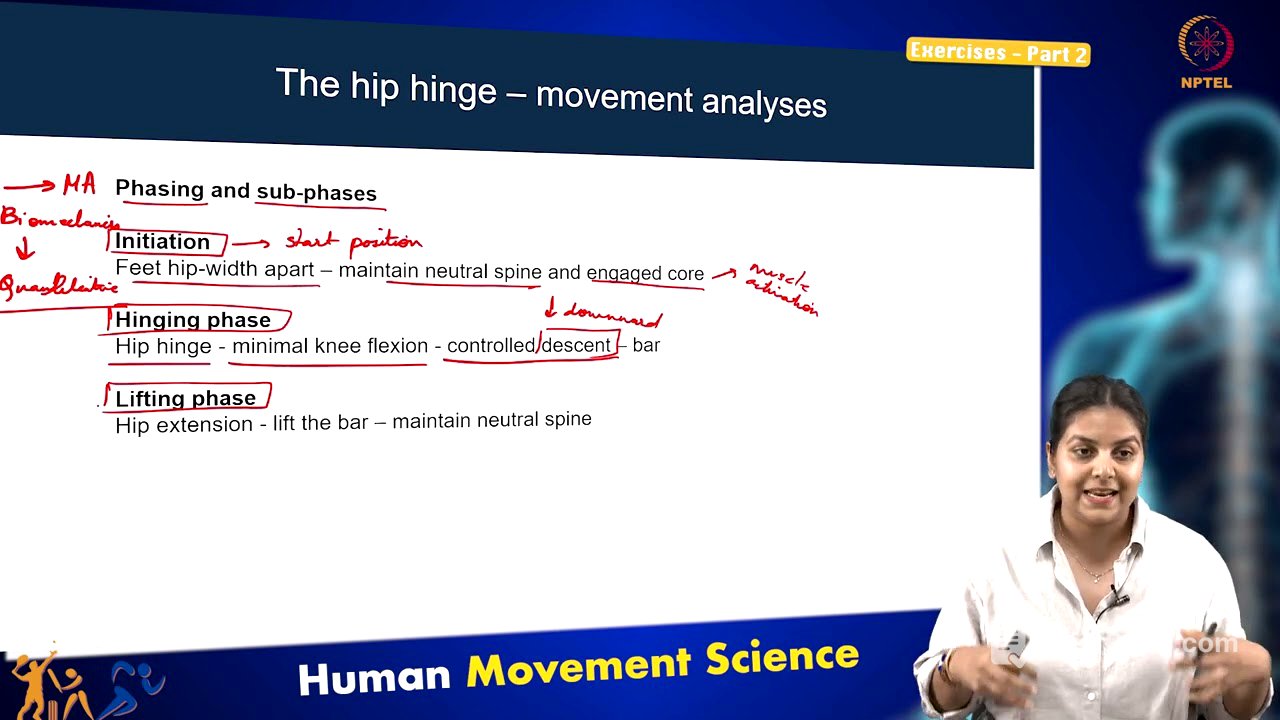
The hip hinge, exemplified by the deadlift, involves a hinging movement at the hips with minimal knee flexion. Major muscles include the posterior chain, glutes, and hamstrings, with movement in the sagittal plane. Coaching cues include maintaining a neutral spine and engaging the lats while hinging at the hips before bending the knees.
Movement Analysis: Phasing and Sub-Phasing of the Deadlift [7:48]
Movement analysis involves breaking down skills into phases and sub-phases for qualitative analysis. For the deadlift, phases include the initiation (start position), hinging phase (descending with minimal knee flexion), lifting phase (hip extension while maintaining a neutral spine), and descending phase (controlled lowering of the bar). Key variables to analyse include hip hinge mechanics, posture, and bar path trajectory.
Hip Hinge in Sport and Coaching Cues [12:23]
Hip hinge movements are crucial in sports requiring hip power and posterior chain strength, such as weightlifting and sprinting. Coaching cues include keeping the bar close to the body, maintaining a neutral spine, and engaging the core. Teaching progressions involve starting with lighter weights or equipment like wooden sticks before moving to barbells or kettlebells.
Knee Dominant Movement: Single Leg Squat [14:21]
Single leg squats are knee dominant exercises requiring balance, coordination, and control. Major muscles involved are the quadriceps, glutes, and hamstrings, with movement in the sagittal plane. Coaching cues include maintaining balance, controlling ascent and descent, and ensuring the non-working leg is extended.
Knee Dominant Movement: Lunge [16:14]
Lunges are a common and important exercise for daily activities and sports. Major muscles include the quadriceps, glutes, hamstrings, and core (as stabilisers), with movement in the sagittal plane. Coaching cues involve stepping forward with good balance, maintaining a stable trunk, and ensuring a right-angled front knee.
Movement Analysis: Phasing and Sub-Phasing of the Lunge [17:35]
The lunge can be broken down into phases: initiation (preparing with core activation), descending phase (controlled knee flexion with eccentric contraction of quadriceps and glutes), lowest position (full depth of the lunge with balance and control), and ascending phase (returning to start with concentric contraction of quadriceps and glutes). Key variables include stride length, knee tracking over toes, and trunk stability.
Lunges in Sport and Coaching Cues [21:12]
Lunges are essential for sports requiring single leg stability and explosive movements, such as badminton, tennis, and soccer. Coaching cues include maintaining a neutral spine, controlled descent and ascent, proper knee alignment, and gradual progression with weight and complexity. Teaching progressions involve starting with bodyweight lunges and advancing to forward, reverse, walking, and weighted lunges.
Combined Hip and Knee Movements: Box Jump [22:54]
Box jumps are a plyometric exercise combining hip and knee movements. Major muscles involved are the quadriceps, glutes, and hamstrings, with movement in the sagittal plane. Coaching cues include soft landing, knee tracking over toes, and engaging hip and knee extensors during takeoff.
Combined Hip and Knee Movements: Squat [24:43]
Squats involve hinging at the hip and are another example of combined hip and knee movement. Major muscles include the quadriceps, glutes, and hamstrings, with movement in the sagittal plane. Coaching cues include maintaining a neutral spine, proper knee alignment, and equal weight distribution.
Movement Analysis: Phasing and Sub-Phasing of the Squat [26:32]
The squat can be broken down into phases: initiation (feet shoulder width apart, core engaged), descending phase (controlled descent with eccentric contraction of quadriceps and gluteus maximus), lowest position (achieving the desired depth of the squat), and ascending phase (returning to start with concentric contraction of quadriceps and glutes). Key variables include hip hinge mechanics, knee tracking over toes, and overall posture.
Squats in Sport and Coaching Cues [30:19]
Squats are important for developing lower body strength and power in various sports, including wrestling, powerlifting, and tennis. Coaching cues include maintaining a neutral spine, controlled ascent and descent, and appropriate knee alignment. Teaching progressions involve starting with bodyweight squats and advancing to goblet squats, front squats, and back squats, gradually increasing weight.






![ILLSLICK - แค่ฉัน [Official Video]](https://wm-img.halpindev.com/p-briefread_c-10_b-10/urlb/aHR0cDovL2ltZy55b3V0dWJlLmNvbS92aS96RHc5Y18wTkVkQS9ocWRlZmF1bHQuanBn.jpg)