TLDR;
This documentary explores the archaeological evidence behind three famous Bible stories: the destruction of Nineveh, Noah's Great Flood, and the Exodus. Through excavations and analysis of ancient texts, experts uncover the historical context and potential origins of these enduring legends.
- Nineveh's fall was a brutal end to a feared empire, not divine retribution.
- The story of Noah's flood may stem from recurring floods and climate change in ancient Mesopotamia.
- The Exodus narrative reflects the complex relationship between the Israelites and Egypt, drawing on historical events and cultural memories.
Nineveh - City of Sin [0:00]
Archaeologists in Iraq are unearthing new evidence about the final days of Nineveh, a city infamous in the Bible for its wickedness. Discoveries at the Nergal Gate, including human remains buried under a collapsed building, suggest a violent end to the city. The Bible's Book of Jonah warns of Nineveh's destruction due to its sinful ways. Archaeological teams are using advanced technology to uncover the truth about Nineveh and the reasons for its downfall.
Nineveh, one of the oldest cities on Earth, was once the capital of the Assyrian Empire. Drone surveys reveal that the city was enormous, covering over 1,800 acres with walls stretching for seven and a half miles. The Bible describes Nineveh as a wicked place, and the Assyrians are often mentioned. Reliefs carved for King Sennacherib depict the Assyrians as mighty conquerors, contrasting with the Bible's depiction of their wickedness.
The Assyrians had a reputation for violence, which may have led cities like Megiddo to surrender without a fight. Bronze panels depict acts of unspeakable violence, reinforcing their fearsome image. The newly exposed gateway ruins at the Nergal Gate contain inscribed bricks from King Sennacherib, who significantly expanded the city. The Nergal Gate was a monumental checkpoint, one of 15 protecting the city.
Historical records show that the Assyrian kings stopped going on military campaigns around the time of the Book of Jonah. The Assyrians had a colonial policy of forced migration, deporting residents of captured cities to distant lands. The discovery of skeletons at the Nergal Gate, along with evidence of a major fire, suggests the city was destroyed in a catastrophic event. The skeletons are believed to be those of citizens who died during the conquest of Nineveh in 612 BCE. The city was besieged by a coalition of enemies, who destroyed and burned it, killing its population.
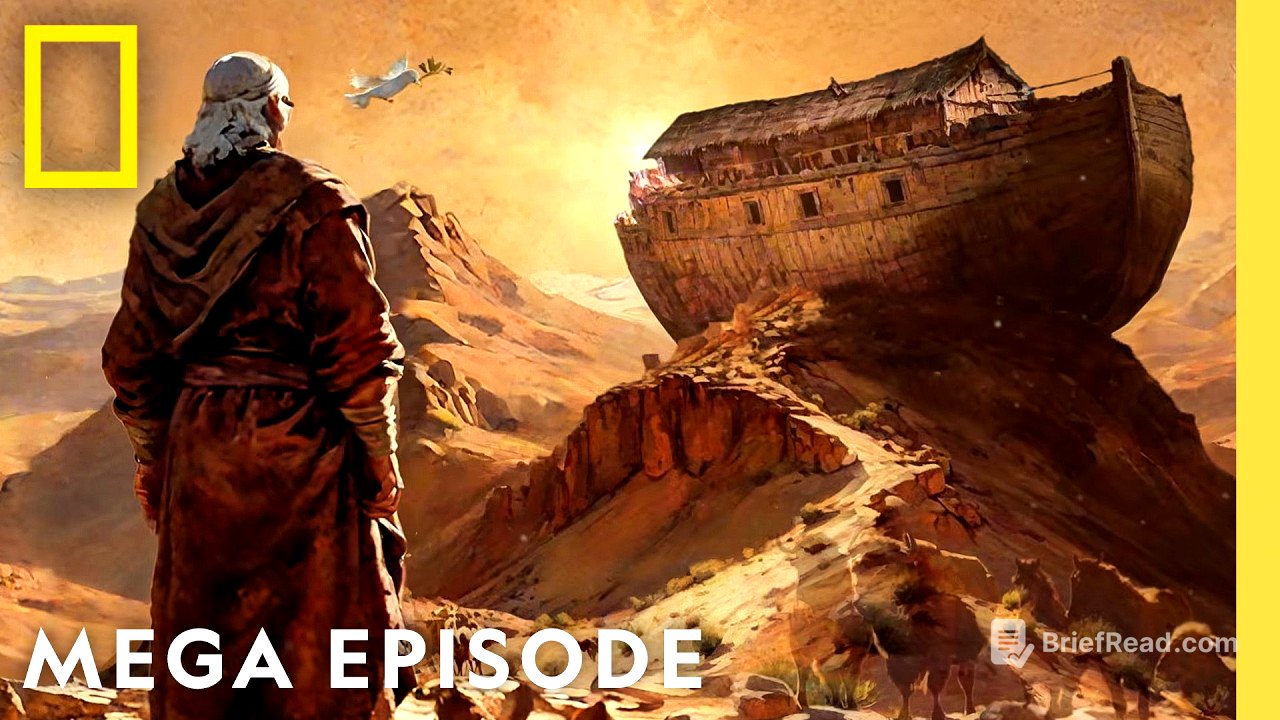
Noah's Great Flood [44:03]
Archaeologists are searching for traces of an ancient catastrophe in Southern Iraq, seeking to uncover the truth behind the biblical story of Noah's Great Flood. Aerial investigations reveal an enormous canal network, suggesting advanced water management in the region. The Bible places the flood in an ancient land called Shinar, modern-day Southern Iraq. Geo-archaeologist Jaafar Jotheri is exploring the ancient site of Uruk, known as Erech in the Old Testament, to determine if a flood could have occurred before the city's founding.
Uruk was founded around 3,500 BCE and became the largest city on Earth, with a population of at least 40,000. The city relied on the Euphrates River for water, which Jaafar believes once ran right by the city. Ancient writing expert Lara Bampfield investigates texts that tell of world-changing floods in the region's past. The "Epic of Gilgamesh" contains a flood story similar to the Bible's, with a man, a boat, and a great flood.
Maritime archaeologist Alessandro Ghidoni in Oman investigates how the ancient Sumerians built their boats, examining a cuneiform tablet dating to around 1,700 BCE that provides instructions for building a gigantic boat. At Uruk, Jaafar examines evidence from a nearby quarry, revealing layers of sediment that show multiple floods occurred in the area. The Sumerian king's list records the Great Flood as a historical fact. Alessandro and Ayaz in Oman test ancient Sumerian boat-building techniques, using reeds and bitumen to construct a sample section of an ark.
Jaafar surveys the landscape around the ancient Sumerian city of Eridu, discovering a maze of ancient canals that formed the oldest-known irrigation network in the world. Mark Altaweel analyzes sediment samples from Uruk, finding evidence of a marshy wetland environment around 4,000 BCE. Alessandro's experiments reveal that reeds can form a strong and waterproof hull, and bitumen can be used as an effective sealant. Mark studies stalagmites from a cave in Northern Iraq, finding evidence of the wettest century in Iraq's history around 3,500 BC.
The immense rainfall in Northern Iraq swelled the Euphrates River, turning areas of Southern Mesopotamia into lush wetlands. The Sumerians developed complex irrigation systems to manage the water, giving their kings power and status. The Sumerian flood stories may have been a metaphor for the vulnerability of early civilization. The Sumerians' greatest invention, cuneiform writing, spread across Mesopotamia, and each civilization embellished the flood story.
Mysteries of the Exodus [1:28:06]
Investigators are unearthing treasures in the east of Egypt's Nile Delta, uncovering the remains of a mega-city that some believe matches a city in the Bible's Book of Exodus. The story of Exodus tells how Moses leads the Israelites out of captivity in Egypt. Archaeologist Jay Silverstein explores if there's any archaeological evidence for an event like the Exodus in Egyptian history. The Old Testament tells how the Israelites lived in Egypt for over 400 years and were forced into slavery.
Paintings in the tomb of Rekhmire depict foreigners, possibly from Canaan, enslaved by the Egyptians. Henning Franzmeier investigates the ancient site of Pi-Ramesses, once the capital of ancient Egypt, to unearth the real city buried beneath the soil. The team's excavation reveals faint outlines of mudbricks, and they piece together the pattern to reveal a series of walls nearly 7 feet wide, indicating a royal palace. The archeologists believe they've unearthed a long-lost royal palace that covers more than 240,000 square feet.
The team unearths belongings of the people that lived here, including a sherd of a Canaanite jar, suggesting people from Canaan were trading and living in Pi-Ramesses. A sculpted figurine of the Canaanite deity Baal provides further evidence that people from Canaan were living in Pi-Ramesses. Bioarcheologist Iwona Kozieradzka-Ogunmakin investigates a relief from a temple complex in Egypt, showing what appear to be Bedouin tribespeople seeking refuge in Egypt. The story of the 10 plagues may be a remnant of folk memories from periods of disease and unrest.
Conservator Alexandra Winkels discovers painted wall plaster in the palace, which may provide clues to when this huge ancient metropolis was built, and by whom. The traces of magnificent colours are hard to see and could have been easily missed in the dust of the excavation site. The use of lime plaster is another sign that it might be a high official, and maybe even palatial building. A small plaque carved with the royal name "Ramesses II" is strong evidence that he is the pharaoh that built this palace and the city of Pi-Ramesses.
Jay heads to the mortuary temple of Ramesses' son, Pharaoh Merneptah, where a stele contains the earliest written reference to the Kingdom of Israel ever found. The inscription says that the seed of the Israelites is no more, that it's been laid to waste. Jay thinks it's possible that the Israelites crossed a waterlogged area to escape a pursuing Egyptian army. The pharaohs and battles remembered within these walls may have influenced the writers of the biblical story. The Exodus story is a valuable reflection of the world in which it was written.