TLDR;
This video provides a comprehensive overview of William Shakespeare's play, "The Tragedy of Julius Caesar," tailored for BCA third-semester students. It covers Shakespeare's background, key characters, a detailed act-by-act summary, and significant quotes, exploring themes of power, loyalty, betrayal, and the conflict between fate and free will.
- Introduction to William Shakespeare and the historical context of "Julius Caesar."
- Detailed summaries of each act, highlighting key plot points and character developments.
- Analysis of important quotes and their relevance to the play's central themes.
Introduction to William Shakespeare and Julius Caesar [0:36]
The session introduces William Shakespeare, a renowned English playwright, poet, and actor, born on 23 April 1564 and died on the same day in 1616. He is celebrated as the Bard of Avon, having written 39 plays, 154 sonnets, and two long narrative poems. His works have been translated into every major living language and are the most performed in theatre history, exploring universal human emotions and the significance of life. The play "Julius Caesar", written in 1599, is a historical tragedy based on real events in Rome, exploring themes of power, loyalty, fate versus free will, and betrayal.
Key Characters in Julius Caesar [2:39]
The key characters in "Julius Caesar" are introduced, including Julius Caesar himself, a Roman general, and Brutus, Caesar's friend who becomes a conspirator. Other significant characters include Cassius, the leader of the conspiracy; Mark Antony, Caesar's loyal supporter; Calpurnia, Caesar's wife; Portia, Brutus's wife; a Soothsayer who warns Caesar; and Octavius, Caesar's heir. These characters are central to the unfolding drama and its exploration of power and betrayal.
Act 1 Summary [3:20]
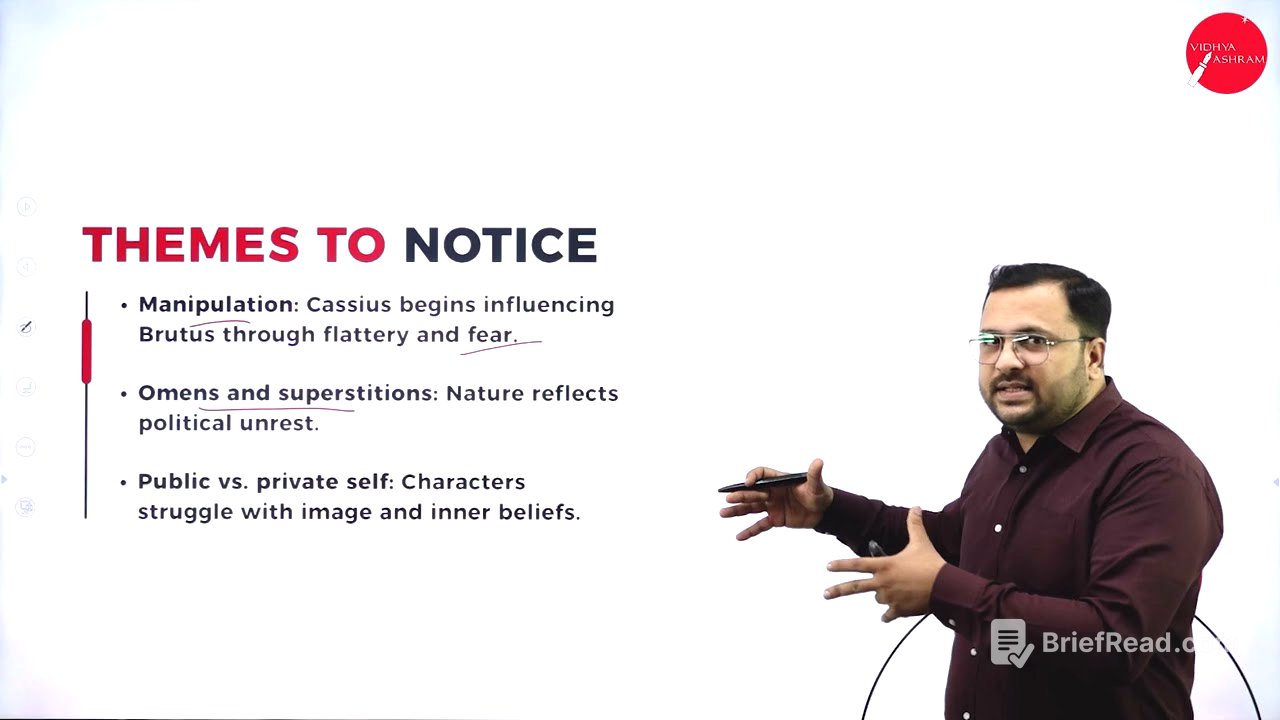
Act 1 begins with tribunes Flavius and Marullus scolding Roman citizens for celebrating Caesar's triumph, reminding them of their past loyalty to Pompey. In scene two, a soothsayer warns Caesar to "beware the Ides of March," while Cassius manipulates Brutus to turn against Caesar, exploiting Brutus's concern over Caesar's growing ambition. Cassius recounts incidents to show Caesar's weaknesses and questions his strength. The act concludes with Cassius finalising plans for the conspiracy, aiming to involve Brutus through persuasive letters.
Act 2 Summary [11:09]
In Act 2, Brutus grapples with his conscience and decides that Caesar must die for the good of Rome, officially joining the conspiracy after reading the letters planted by Cassius. Calpurnia begs Caesar to stay home due to troubling dreams, but Decius interprets the dream positively, persuading Caesar to go to the Capitol. Artemidorus prepares a letter warning Caesar about the conspirators, hoping to save him, while Portia, anxious about Brutus's behaviour, sends a messenger to observe events at the Senate.
Act 3 Summary [18:12]
Act 3 sees Caesar arriving at the Capitol, where he is stabbed by the conspirators, including Brutus. Antony, after initially fleeing, returns and cleverly gains permission to speak at Caesar's funeral. Brutus gives a logical explanation for the assassination, but Antony's passionate speech sways the crowd by appealing to their emotions, turning them against the conspirators. The enraged mob, now out of control, kills the innocent poet Cinna, simply for sharing a name with one of the conspirators.
Act 4 Summary [25:45]
In Act 4, Antony, Octavius, and Lepidus form an alliance and plot the elimination of their enemies, though Antony questions Lepidus's worth. Brutus and Cassius meet, and rising tensions hint at cracks in their friendship and leadership. A fierce argument erupts between them, but they reconcile after sharing personal sorrows, including Portia's death. Brutus is later haunted by Caesar's ghost, foreshadowing future events.
Act 5 Summary [27:55]
Act 5 begins before the battle of Philippi, where the leaders exchange sharp words, and Brutus and Cassius emotionally prepare for possible death. Brutus orders a surprise attack, hoping to gain an upper hand against Octavius's weakened forces. Cassius, misinformed about the battle's outcome, tragically kills himself, and Titinius follows suit. Defeated and weary, Brutus takes his own life, and even his enemies acknowledge his nobility and honourable intentions.
Important Quotes from Julius Caesar [31:07]
The video highlights several important quotes from "Julius Caesar," emphasising key themes such as betrayal, fate, power, and rhetoric. These include Cassius's statement that "The fault, dear Brutus, is not in our stars, but in ourselves," the Soothsayer's warning to "Beware the Ides of March," and Caesar's famous last words, "Et tu, Brute?" Brutus's justification, "Not that I loved Caesar less, but that I loved Rome more," and Antony's powerful "Friends, Romans, countrymen, lend me your ears," are also discussed for their dramatic impact and thematic significance.