TLDR;
This video explains how to draw and use free-body diagrams to analyse systems in both linear and rotational motion, and then applies these principles to understand muscle forces in human anatomy during a bicep curl. Key points include simplifying objects, defining coordinate systems, identifying forces, and applying Newton's laws to calculate acceleration and forces.
- Free-body diagrams simplify complex systems for analysis.
- Newton's laws can be applied to both linear and rotational motion.
- Understanding force and distance is crucial for calculating torque in biomechanics.
Introduction to Free-Body Diagrams [0:00]
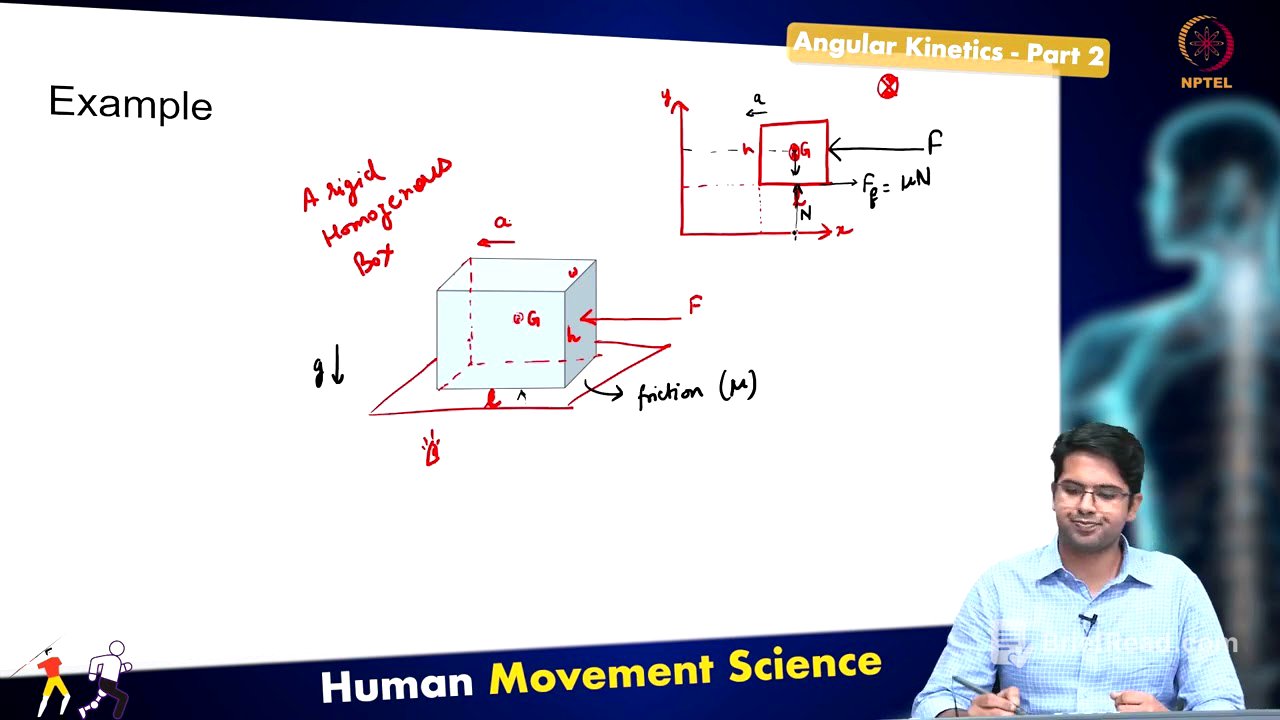
The video introduces the concept of free-body diagrams using a box on a surface as an example. A force applied to the box causes it to move with acceleration. The process involves simplifying the object to its most basic form, assuming the force acts parallel and through the centre of the body. The presenter looks at the box from a specific perspective to create a 2D representation for easier analysis.
Setting Up the Coordinate System and Identifying the Centre of Mass [2:12]
To properly analyse the system, a coordinate system must be defined to locate the object in space, similar to how position is measured in kinematics. The origin is established, and the object's position is determined relative to this origin. The next step involves marking the centre of mass (G) of the object, assuming it is rigid and homogeneous, meaning it doesn't deform and has uniform density throughout. For a uniform box, the centre of mass is located at its geometric centre.
Identifying and Indicating External Forces [5:19]
The process involves drawing and indicating all external reaction forces and moments of forces acting on the object. These forces include an applied force, gravitational force due to Earth's gravity, and the normal reaction force from the floor, which opposes the gravitational force. Additionally, friction from the surface is considered, with the friction force acting opposite to the direction of motion and calculated as the coefficient of friction (mu) times the normal reaction force.
Applying Newton's Laws for Linear Motion [8:28]
Newton's second law (sum of external forces equals mass times acceleration) is applied to analyse the linear motion of the box. The forces are treated as vector quantities, and the equation is written along the x-axis, considering the direction of the applied force and friction. By also writing an equation along the y-axis, the normal reaction force is found to be equal to the weight of the body. This allows for the calculation of acceleration based on the applied force, coefficient of friction, and mass.
Analysing Rotational Motion with Free-Body Diagrams [11:56]
The video transitions to analysing rotational motion using a box with an axis through it, where a force applied at a distance causes rotation. The viewer is encouraged to pause and draw the free-body diagram. The system is simplified by viewing it from the top, defining a coordinate system, and marking the centre of mass. The external forces, including the applied force and the reaction force from the pole preventing linear translation, are identified.
Calculating Angular Acceleration [16:38]
The analysis of the system involves considering both linear and rotational motion. For linear motion, the sum of forces equals zero, indicating no translation of the centre of mass. For rotational motion, the moment of the external force (or the couple formed by the applied force and reaction force) is equal to the moment of inertia (I) times angular acceleration (alpha). The angular acceleration is then calculated as FD/I, where F is the force and d is the distance. The video notes that calculating the moment of inertia for different geometries can be looked up and will be provided within the scope of the course.
Forward vs. Inverse Dynamics [20:40]
The presenter discusses the difference between calculating acceleration using kinematics (displacement values) versus using forces. If position data is known, acceleration can be calculated from that and used to find the net force. Conversely, if the force is known, acceleration can be calculated directly. Knowing forces to calculate acceleration is called forward dynamics, while calculating forces from known accelerations is called inverse dynamics.
Application to Human Anatomy: Bicep Curl Analysis [22:50]
The principles of free-body diagrams are applied to analyse a bicep curl. The bicep curl involves rotation about the joint axis, induced by the linear contraction of the muscle. The system is simplified by assuming the upper arm is stationary. The muscle attaches at a certain distance from the joint axis, creating a force. The torque applied by the muscle is the force times the perpendicular distance from the axis of rotation.
Calculating Muscle Force During a Bicep Curl [26:31]
The video presents an exercise to calculate the muscle force (Fm) required to hold a dumbbell during an isometric bicep curl. Given the weight of the dumbbell (20 kgs), the weight of the forearm (2 kgs), and the distances from the joint to the dumbbell and the muscle attachment, a free-body diagram is used to calculate Fm. By summing the moments of each force about the joint, and setting the net moment to zero (since it's isometric), Fm can be calculated. The presenter walks through the calculations, equipping viewers with the tools to analyse loadings and torques in static and dynamic cases in human anatomy.