TLDR;
This video explores the life of Alfred Nobel, the inventor of dynamite and the founder of the Nobel Prize. It examines his motivations, the impact of his inventions, and his complex legacy.
- Nobel's invention of dynamite and other explosives had a transformative impact on both industry and warfare.
- The creation of the Nobel Prizes was influenced by a desire to change his public image and contribute to humanity.
- The video explores the ethical implications of his inventions and the unintended consequences of his work.
The Nobel Armament Factory [0:00]
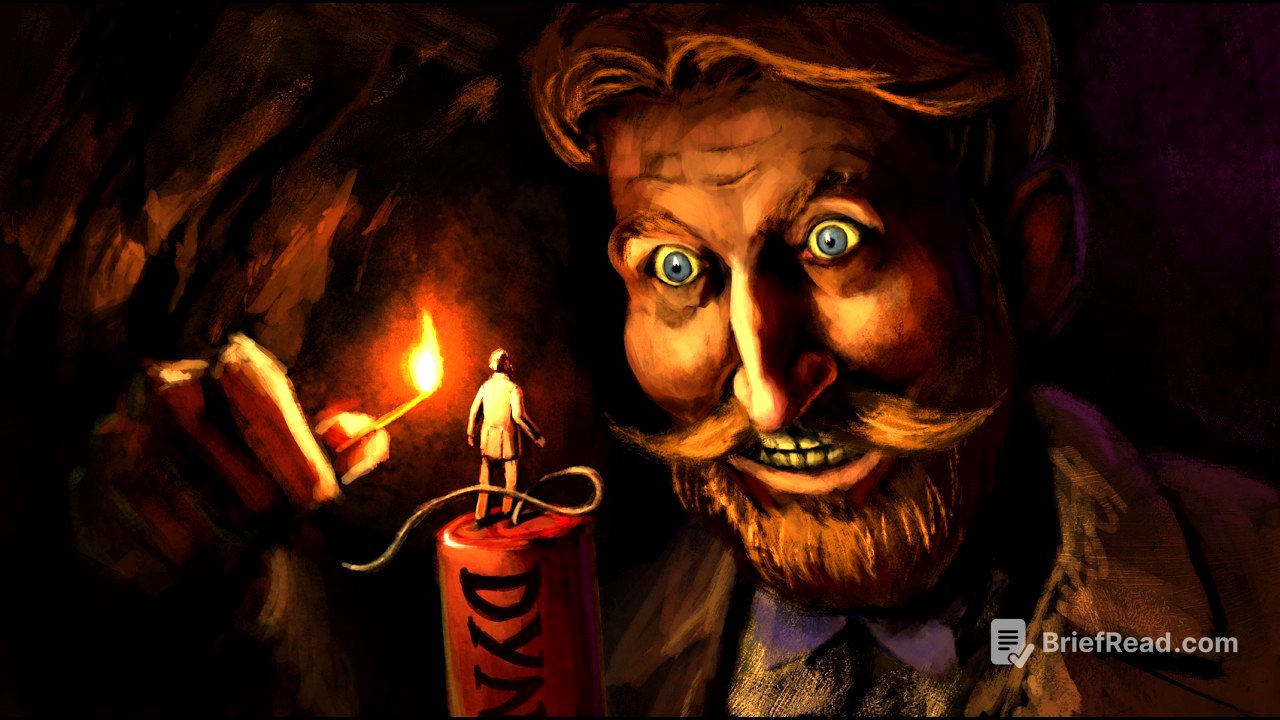
The video introduces Alfred Nobel and the story of how he came to be known as the "Merchant of Death" after a newspaper mistakenly published his obituary. This event prompted him to reflect on his legacy, which was largely built on nitroglycerin, a powerful but dangerous explosive. Nobel's father, Immanuel, was an inventor who moved to Russia and established a successful armaments factory producing sea mines for the Russian military. This success allowed him to invest in Alfred's education, leading him to study chemistry in Paris.
Gunpowder vs Nitroglycerine [4:18]
Alfred Nobel studied nitroglycerin, a new explosive material, under Ascanio Sobrero. The key difference between nitroglycerin and gunpowder lies in their composition. Gunpowder's ingredients are in separate grains, making the reaction slower, whereas nitroglycerin contains all necessary elements within the same molecule, resulting in a much faster and more powerful explosion. Experiments demonstrate nitroglycerin's superior destructive power compared to gunpowder, highlighting its unstable molecular structure and rapid decomposition.
How safe is nitroglycerin? [10:58]
Nitroglycerin is highly sensitive and dangerous due to its molecular structure. The weak bonds in the nitroglycerin molecule can easily break with a small amount of energy, leading to a rapid chain reaction and detonation. Sobrero, the discoverer of nitroglycerin, considered it too dangerous for practical use. However, Nobel saw its potential and sought to find a way to tame its power.
Blast Caps [14:50]
Alfred Nobel returned to Sweden and experimented with ways to reliably detonate nitroglycerin. He invented the blasting cap, a device using a small explosion to trigger a larger one. The blasting cap design was highly effective and remained virtually unchanged for decades. This invention made the use of nitroglycerin practical for industrial applications, such as mining and tunnel construction.
Why does nitroglycerin explode on impact? [19:09]
Nitroglycerin's sensitivity is due to the presence of tiny air and water vapour bubbles trapped inside the liquid. When a shockwave reaches these bubbles, they compress and create hotspots, which break the weak bonds in the nitroglycerin molecules, triggering a chain reaction. Even without existing bubbles, a strong impact can create new bubbles through cavitation, leading to the same explosive result.
The invention of dynamite [22:19]
Alfred Nobel sought to stabilise nitroglycerin by turning it into a solid. He discovered that mixing nitroglycerin with diatomaceous earth (kieselguhr), a porous silica powder made from fossilised algae, made it safer to handle. The kieselguhr absorbs the nitroglycerin, separating the molecules and preventing accidental detonation. This mixture, known as dynamite, could still be detonated with a blasting cap, making it a practical and safer explosive.
Dynamite vs TNT [26:56]
Dynamite is different from TNT (trinitrotoluene). TNT is more stable than nitroglycerin because the nitrogen atoms are bonded to carbons rather than oxygens. Dynamite was invented first and played a significant role in construction and infrastructure projects, such as the Trans-Siberian Railroad.
Explosive Cotton - Gelignite [27:53]
Despite the invention of dynamite, nitroglycerin still posed dangers, such as sweating, where it would seep out of the mixture. Nobel continued experimenting and discovered that mixing nitroglycerin with nitrocellulose (gun cotton) created a stable, moldable gel called gelignite. Gelignite solved the sweating problem and provided perfect yield, as the nitrocellulose itself was also explosive.
The Merchant of Death [32:43]
Alfred Nobel's success with dynamite and gelignite led to the establishment of factories worldwide. However, his personal life was marked by tragedy and loneliness. His father never recovered from the death of Emil and became jealous of Alfred's success. Despite his wealth, Alfred felt isolated and sought companionship, leading him to place an advertisement for a secretary and supervisor of his household.
Smokeless Guns [35:42]
Alfred Nobel developed ballistite, the world's first smokeless high-energy propellant, by mixing nitroglycerin with a higher concentration of nitrocellulose. This invention addressed the problem of smoke obscuring visibility on the battlefield, which had plagued armies for centuries. Ballistite allowed for more accurate aiming and reduced the "fog of war."
The Birth of Terror [38:04]
Alfred Nobel's inventions, particularly dynamite, were adopted by anarchist groups for acts of terrorism. Dynamite unlocked a new scale of destruction, making it possible for individuals to cause mass murder. The video cites the Bath School disaster of 1927 as an example of the devastating impact of dynamite used in a terrorist attack.
Why did Nobel start the prize? [42:08]
Haunted by the destructive potential of his inventions and the criticism he received, Alfred Nobel created the Nobel Prizes in his will. He allocated the majority of his fortune to establish prizes for those who conferred the greatest benefit on mankind in the fields of chemistry, physics, medicine, literature, and peace.
What happened to Nobel?
Alfred Nobel died in 1896, holding 355 patents and running a vast empire of factories. His legacy is complex, marked by both innovation and destruction. While he sought to make explosives safer, his inventions also contributed to warfare and terrorism. The Nobel Prizes serve as a testament to his desire to be remembered for his contributions to humanity.