TLDR;
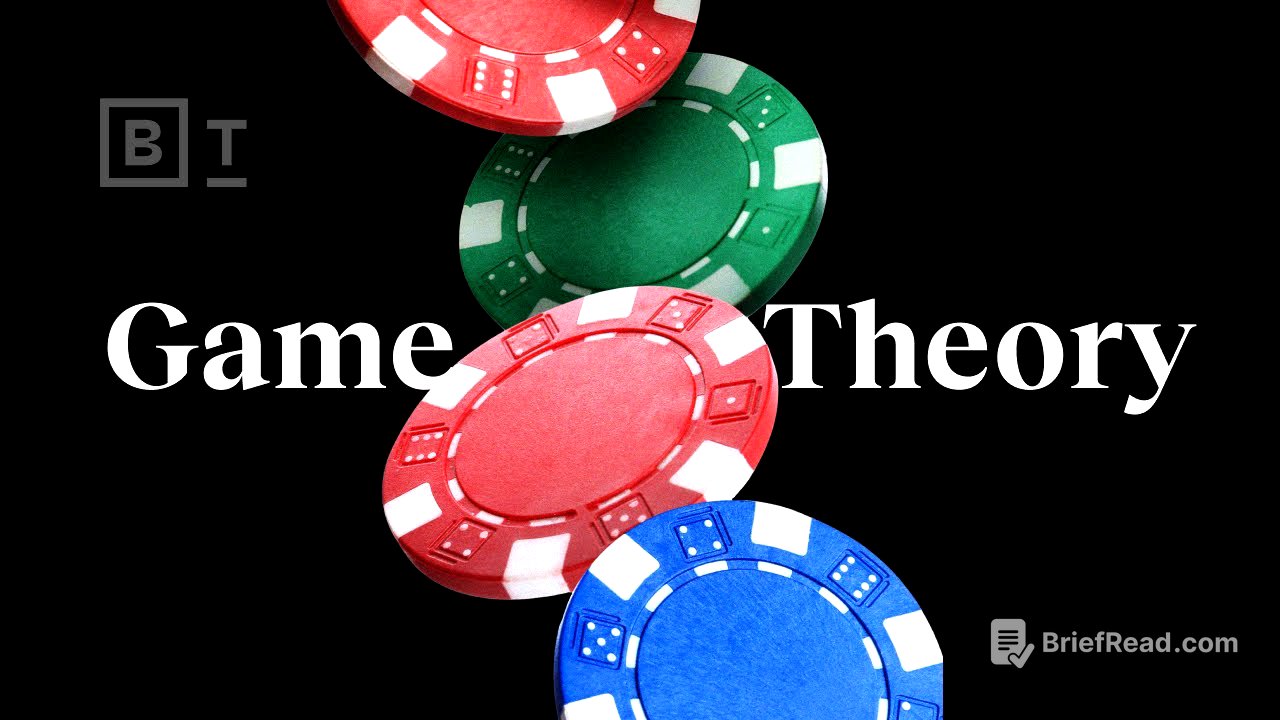
This video explores game theory, a mathematical approach to understanding strategic interactions. It covers its origins in economics and its applications to diverse fields like biology and international relations. The discussion highlights the potential for cooperation in seemingly competitive situations, as demonstrated by the Cold War arms reduction treaties. The video also examines the "sunk cost fallacy" using poker as an example, and introduces the "minimax strategy" for zero-sum games, which involves minimising potential losses.
- Game theory analyses strategic interactions between individuals or entities with their own interests.
- Cooperation can emerge even in competitive scenarios, transforming perceived win-lose situations into mutually beneficial outcomes.
- The sunk cost fallacy can lead to poor decisions by fixating on past investments rather than future prospects.
- The minimax strategy helps individuals minimise potential losses in zero-sum games by anticipating worst-case scenarios.
What is game theory? [0:00]
Game theory is a mathematical framework that seeks to understand how people interact in strategic situations, where each party's actions are influenced by the actions and interests of others. It was initially developed in economics to analyse behaviours such as consumer choices and wage negotiations. However, its applications have expanded to various fields, including biology, international relations, and interpersonal relationships. Game theory reveals that many interactions perceived as competitive, or zero-sum, actually contain opportunities for mutual cooperation.
War: Learn from Reagan and Gorbachev [1:08]
During the Cold War, despite the perceived zero-sum nature of the conflict, opportunities for cooperation emerged. The U.S. and the USSR realised they could mutually benefit from arms reduction by saving resources. The START Treaty negotiations between Reagan and Gorbachev faced the challenge of ensuring both sides were genuinely eliminating nuclear weapons. To address this, they broke down the process into smaller, verifiable steps. This approach of dividing a large interaction into smaller parts can transform a negative situation into a positive one. By considering outcomes beneficial to all parties, seemingly competitive scenarios can evolve into mutually beneficial ones.
Poker: The sunk cost fallacy [2:58]
Game theory is based on a simplified version of poker, where uncertainty and decision-making are central. Poker teaches how to make optimal decisions amidst uncertainty, a skill applicable to various life situations. A key principle is to maximise gains with strong hands and minimise losses with weak hands, even without complete certainty. A significant bias in poker, and in life, is the "sunk cost fallacy," where individuals continue investing in a losing situation due to prior investments. Overcoming this fallacy involves recognising when further investment is unwise, regardless of past efforts. Recognising the sunk cost fallacy can lead to better decisions, from abandoning unproductive books to changing career paths. Acknowledging sunk costs can be painful, but it allows for choices that lead to better future outcomes.
Zero-sum games: The minimax strategy [5:56]
Early game theory focused on zero-sum games, where one party's gain is another's loss, aiming to identify the best strategy. In zero-sum games against sophisticated opponents, the optimal strategy is to minimise the maximum potential loss, known as the "minimax strategy." This involves anticipating the worst-case scenario and determining the best response to it. By minimising the maximum loss, one can guard against the worst possible outcome, regardless of the opponent's sophistication. This strategy ensures the best possible outcome in zero-sum games.
![[Doku] Abrechnung mit Afghanistan [HD]](https://wm-img.halpindev.com/p-briefread_c-10_b-10/urlb/aHR0cDovL2ltZy55b3V0dWJlLmNvbS92aS9OaXFoTE9reDUyVS9ocWRlZmF1bHQuanBn.jpg)