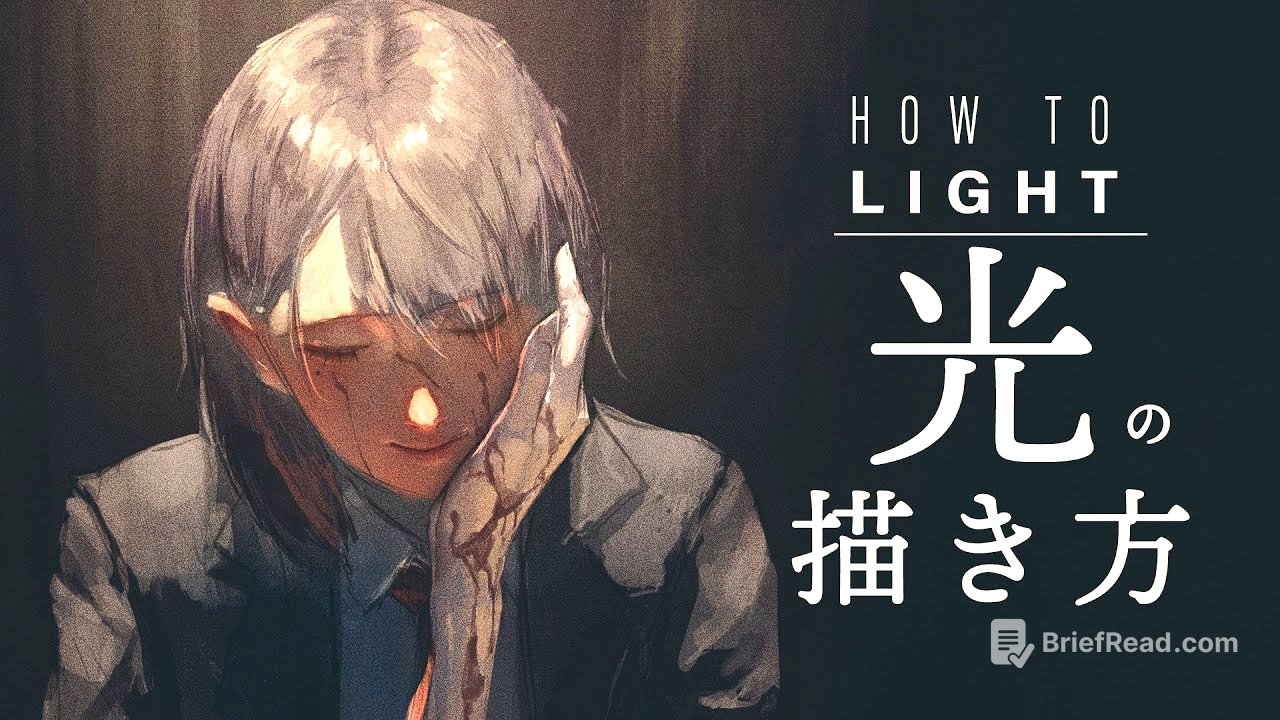
TLDR;
This video explains the principles of hard and soft light in illustrations, emphasizing how understanding light sources can enhance realism and guide the viewer's eye. It covers the differences between hard and soft light, how they interact, and practical tips for depicting them effectively in digital art, including color choices for reflected light.
- Hard light creates clear boundaries and strong shadows, ideal for guiding the eye and adding contrast.
- Soft light produces blurred shadows and is often seen indoors or as reflected light.
- The size of the light source determines whether the light is hard (small source) or soft (large source).
- Observing real-world lighting and understanding how light interacts with surfaces can greatly improve your coloring and rendering skills.
光の勉強について [0:00]
The video introduces the topic of light in illustrations, explaining how understanding light principles can improve coloring skills and add realism to paintings, especially for those interested in thick painting techniques. The knowledge of light is presented as a tool to enhance the understanding and application of techniques discussed in the illustrator's course.
ハードライトの絵 [1:13]
Hard light in illustrations is characterized by clear boundaries and strong shadows, making it effective for creating contrast and guiding the viewer's eye. It is particularly useful for depicting objects with complex shapes, such as bones or characters, and can add a powerful, eye-catching element to illustrations, even those with detailed backgrounds. Hard light is considered reliable in illustration for its ability to create a strong visual impact.
ソフトライトの絵 [2:11]
Soft light, commonly seen in indoor settings, creates blurred boundaries between light and shadow, making it more challenging to use for guiding the eye compared to hard light. In reality, hard and soft light are often depicted together, such as when hard light from above is reflected by a surface, creating a soft light effect on other areas. Understanding both types of light is essential for accurately depicting reflected light and creating realistic illustrations.
光の原理① [3:41]
The difference between hard and soft light lies in the area of the light source. Hard light occurs when the light source area is small, such as a spotlight or the sun, which, despite its size, is considered hard light due to its distance from the Earth. In illustrations, understanding this principle allows artists to create various hard light effects, with surfaces directly facing the light source appearing brighter. Increasing light output can create a gradation of light and darkness, simplifying the depiction of strong light.
光の原理② [6:06]
Soft light is characterized by blurred lines between light and shadow, with surfaces that would be in shadow under hard light now illuminated due to the large area of the light source. A cloudy sky serves as an example of a large area light source. To illustrate this, consider multiple point light sources illuminating a sphere, which demonstrates how increasing the number of light sources smooths out the gradation of shadows, mimicking the effect of a surface light source.
光を塗る [8:04]
In practice, objects are often illuminated from multiple directions, combining hard and soft light. For example, an object may be lit by hard light from above and soft light reflected from the floor below. When an object is illuminated by only one light source, the shadow areas appear darker due to the absence of reflected light. The process of painting light involves using the light source to create a three-dimensional effect, often starting with a dark base color and then adding light.
色 [9:58]
To learn about light expression, observe how light affects colors in photos. Areas strongly lit have lower saturation, while areas not directly hit by light have higher saturation. In illustrations, strong light from above is expressed with colors that are bright but not too vivid, while soft light from below uses colors with higher saturation. For instance, hard light can be depicted with warm white tones, and soft light with orange, applied with a soft brush to create the blurred boundaries characteristic of soft light.




![Polity Revision for UPSC Prelims | 50 Most Important Topics | How to revise for Polity [ Part -3]](https://wm-img.halpindev.com/p-briefread_c-10_b-10/urlb/aHR0cDovL2ltZy55b3V0dWJlLmNvbS92aS9KR3Fzb3o4UUZHZy9ocWRlZmF1bHQuanBn.jpg)