TLDR;
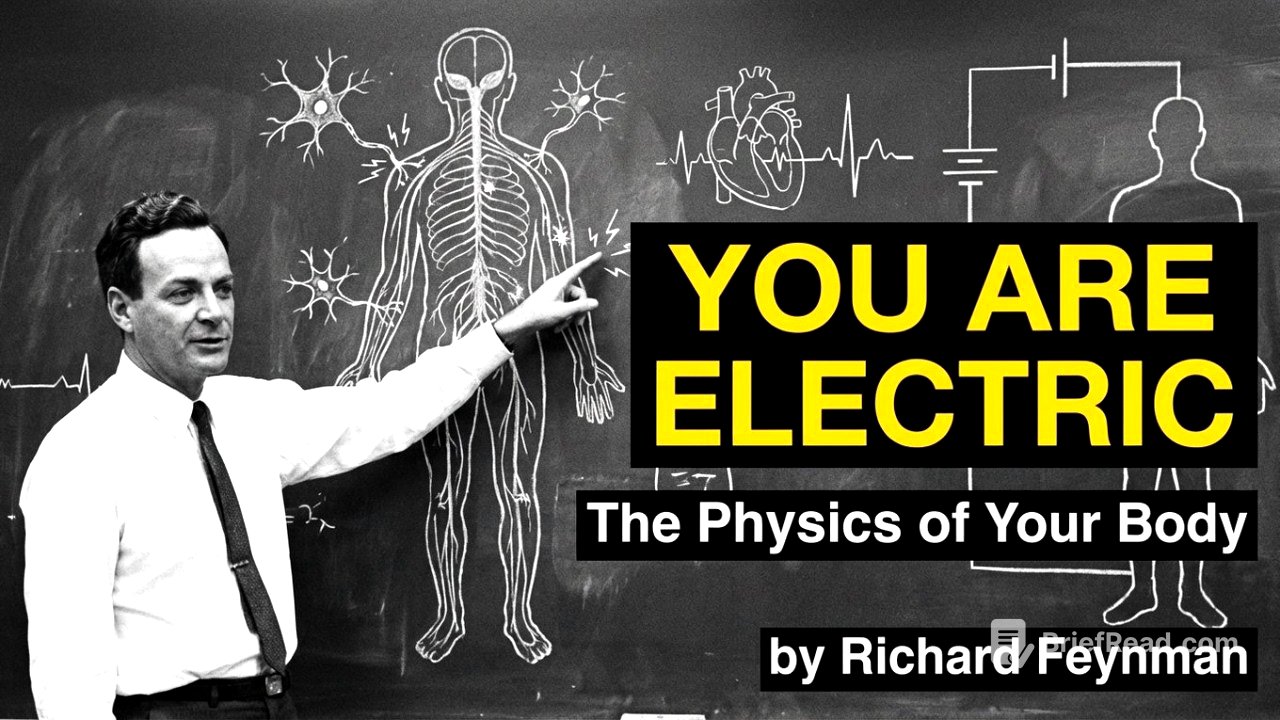
This video explains the intricate electrical system of the human body, detailing how cells maintain an electric charge, the role of ion gradients, and the mechanisms involved in signal transmission. Key points include:
- Each cell in the body functions as a tiny battery, creating a significant voltage difference across its membrane.
- Nernst's equation describes the voltage produced by ion concentration differences, vital for cellular function.
- The sodium-potassium pump is essential for maintaining ion gradients, consuming a substantial amount of ATP.
- Signal propagation in neurons follows physics principles similar to those used in telegraph systems, enhanced by myelin sheaths.
Introduction [0:00]
The introduction highlights that every cell in the human body holds an electric charge, with around 37 trillion cells generating an electric field of approximately 10 million volts per meter. This significant charge is sustained by energy from food, and understanding the physics behind this is essential for grasping how electrical signals move through the body.
The Voltage Inside Your Cells [1:05]
Each cell maintains a voltage difference across its membrane, typically around -70 millivolts, which translates to a staggering electric field strength when considering the membrane's thickness of about 7 nanometers. This electric field is stronger than that of lightning, and the physics behind it mirrors basic principles of capacitors typically encountered in first-year electronics.
Nernst's Equation and Ion Gradients [2:58]
In 1889, Walther Nernst formulated a vital equation that explains how differences in ion concentrations across cell membranes generate voltage. Key ions, such as potassium and sodium, have significant concentration gradients that contribute to the resting potential of cells. The resting potential can be calculated using Nernst's equation, which is still applicable today in various scientific fields.
The Cost of Maintaining Charge [5:51]
Maintaining these ion gradients requires continuous energy, with sodium-potassium pumps utilizing a large portion of a cell's ATP production just to maintain electrical charge. This expenditure represents a substantial metabolic cost, consuming between 10 to 15 kilograms of ATP daily solely for this purpose, highlighting the ongoing struggle against thermodynamic equilibrium within the body.
The Sodium Potassium Pump [6:47]
The sodium-potassium pump, discovered by Jensen Christian Skou, is a crucial enzyme that continuously moves sodium out of cells and potassium into them. This process requires ATP and is foundational for generating the electrical charge necessary for cell signaling. Despite initial dismissal by the scientific community, Skou’s discovery was later recognized with a Nobel Prize.
Cable Physics and Signal Propagation [11:06]
Signal propagation in neurons demonstrates the principles of electrical cables. The axon acts like a conductor while the lipid bilayer serves as insulation, similar to a telegraph system. The transmission of electrical signals degrades over distance, necessitating repeaters, or in biological systems, myelin sheaths that enhance signal transmission speed and efficiency.
Kelvin's Telegraph Equation [12:21]
Lord Kelvin's work in the 1850s on telegraph cables introduced important principles that are directly applicable to neuron functioning. The mathematics of signal degradation in cables is mirrored in how voltage transmits in axons, revealing a deep connection between historical engineering solutions and biological mechanisms.
The Heart's Electrical System [16:05]
The heart's sinoatrial node serves as a self-oscillating pacemaker, generating electrical impulses independently of the brain. This heart's electrical system operates on unique currents and has a complex conduction pathway that enables synchronized contractions. The discovery of this system has profound implications for understanding cardiac function and health.
Detection and Radiation [20:32]
Electromagnetic signals produced by the body's electrical activities are not just internal but radiate outward. Techniques like EEG and magnetoencephalography can detect these faint signals, highlighting that our thoughts and bodily processes can be measured externally. Additionally, other organisms can sense these electric fields, emphasizing the interconnectedness of biological electric activity.