TLDR;
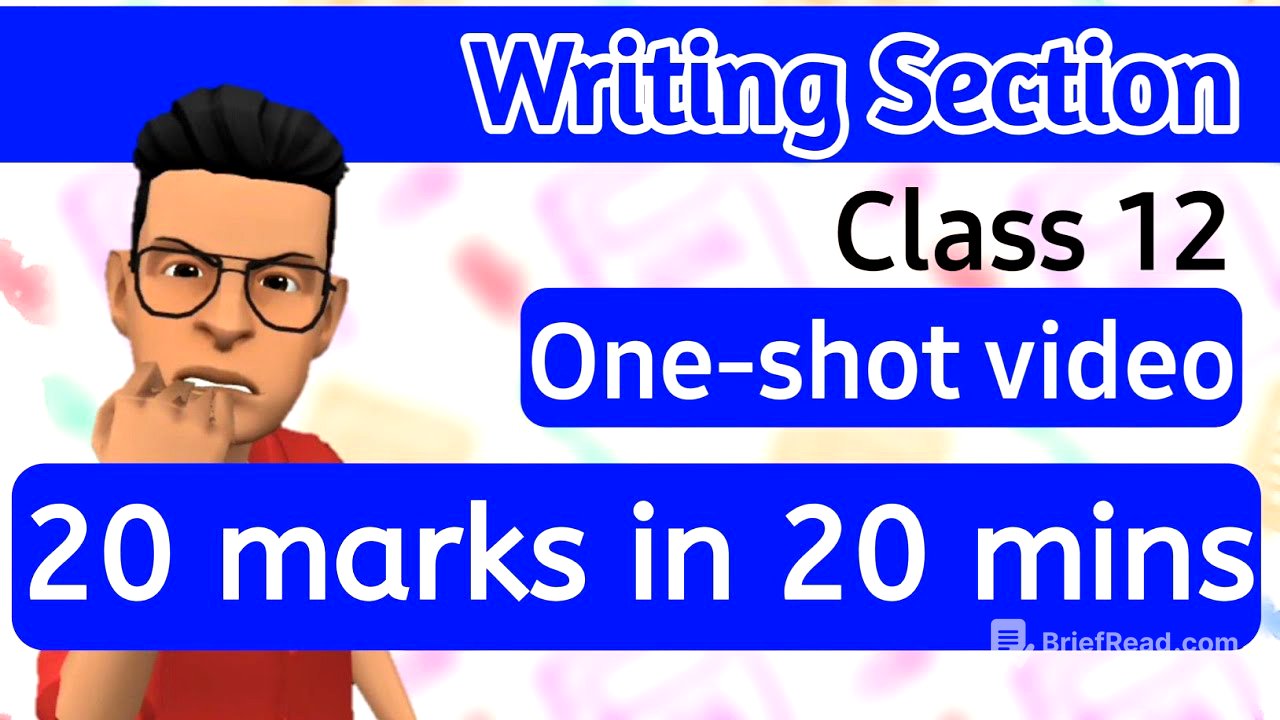
This video provides a comprehensive guide to the writing section of a syllabus, covering four key writing forms: letters (job applications and letters to the editor), notices, invitations and replies (formal and informal), and articles and reports. It details the formats, content guidelines, and specific nuances for each type, offering practical tips and examples to help viewers master these writing skills. The video emphasizes clarity, conciseness, and adherence to established conventions for effective communication.
- Covers four writing forms: letters, notices, invitations/replies, articles/reports.
- Provides formats, content guidelines, and examples for each form.
- Emphasizes clarity, conciseness, and adherence to conventions.
Letter (Job application and editor) [0:23]
The video explains the format for two types of letters: job applications and letters to the editor. For both, begin with the sender's address (two to three lines), followed by the date (month in words). For a job application, the receiver's address is the manager of the institution, while for a letter to the editor, it's "The Editor," followed by the newspaper's name. The subject line for a job application specifies the position, while for a letter to the editor, it directly states the problem. The salutation uses "Dear Sir/Madam."
The body of a job application should state how you learned about the vacancy, express your interest in the position, and highlight your qualifications and experience, attaching a biodata or resume with personal details, academic qualifications, and expected salary. A letter to the editor should briefly introduce the problem, detail its causes and consequences over a few paragraphs, and request the editor to publish the letter to raise awareness. The closing differs: job applications use "Yours sincerely" and include "Thanking you," while letters to the editor use "Yours truly."
Notice [5:30]
A notice is used to make announcements, especially in schools or institutions. The format begins with the word "NOTICE" in capital letters and centered, followed by the name of the institution, also in capital letters and centered. The date is written on the left side. The content should inform readers about the event, including the date, time, and place, along with any additional relevant information, keeping it concise. Include a contact for further inquiries. End with the name, designation (in brackets), and signature. There is no complimentary closing word used.
Invitation [6:52]
Invitations can be formal or informal. Formal invitations, used for inviting many people or a VIP, follow a card format or a formal letter format, respectively. Card-type invitations are short, written in the third person and simple present tense, and answer who, when, where, what time, and for what occasion. They may also mention the chief guest and include "RSVP" with contact details, enclosed in a box.
To invite a special person, use a formal letter with sender's address, date, receiver's address, subject, salutation, body, thanking you, yours sincerely, name, and designation. Informal invitations to friends or relatives are written as informal letters, omitting the receiver's address, subject, and "thanking you," using a personal tone in the body.
Reply [11:05]
Replying to an invitation requires a formal letter for formal invitations and an informal letter for informal ones. Replies should express thanks, state whether you are accepting or declining, and provide a reason. If declining, offer warm wishes. Formal replies should be brief and in the third person if written on behalf of someone. Informal replies can be more personal, including personal comments and best wishes, regardless of acceptance.
Article [13:28]
An article expresses your views on a topic. The format includes a title in the center and a byline with the writer's name. The content consists of an introductory paragraph, development of the topic, and a concluding paragraph. The introduction presents basic information, the development explores various aspects like causes and effects, and the conclusion offers opinions and solutions. The article should stay focused on the topic, use simple language, and benefit from reading other articles to understand idea organization and attractive phrasing.
Report [15:24]
A report describes events that have occurred, with newspaper reports covering tragic incidents and magazine reports covering functions or events. The format is similar to an article, with a title, byline (name, reporter, newspaper), and the place and date of reporting. The first paragraph summarizes the event, including what, when, and where it happened. The second paragraph provides more detail, such as the chief guest's remarks or specific attractions for events, or details of injuries and how the incident occurred. The last paragraph covers events after the main occurrence or witness accounts. Reports should be in the past tense, formal, and factual, without personal views.
What to he boxed? [17:49]
Only notices and card-type invitations should be enclosed in a box. Other writing forms do not require boxes.