TLDR;
This lecture focuses on the women's movement, particularly the second wave of feminism that emerged in the 1960s and 70s. It explores the historical context leading to this movement, including women's roles during and after World War II, the changing family dynamics of the post-war era, legal and employment struggles, and the intersection of race, class, and gender issues within feminism.
- The second wave of feminism aimed for more than just suffrage, advocating for equality across all areas of life.
- Key organizations and figures emerged, addressing discrimination in various sectors, advocating for reproductive rights, and highlighting the experiences of women of color and working-class women.
Historical Context and Early Women's Rights [0:00]
This chapter discusses the women's roles during World War II, including the employment of women as Rosie the Riveter in factories and shipyards. After the war, these women were often pushed back into traditional roles and lower-paying jobs, as returning veterans were prioritized for employment. The post-war ideal of the nuclear family was established, emphasizing the husband as the breadwinner and the wife as a homemaker, reinforced by consumer culture and advertising that promoted domestic appliances as essential for a successful marriage.
Economic Independence and Legal Rights [2:30]
Here, the focus shifts to women's economic independence and the financial and legal limitations they faced. Despite being able to own property and maintain bank accounts, women often faced discrimination in securing credit and mortgages, which were often tied to their marital status. Employment restrictions also forced women into specific roles, and the gender wage gap remained prevalent. The Equal Pay Act of 1963 and Title VII of the Civil Rights Act of 1964 began to address these disparities, but enforcement and real change were significant challenges.
Reproductive Rights and Personal Freedoms [4:38]
This section examines women's reproductive rights and the legal context of marriage. Laws strongly favored men, making it difficult for women to secure divorces or gain custody of children without proving moral grounds, thus reinforcing financial dependence. Additionally, domestic violence was often treated as a private issue, leading to the establishment of women's shelters to advocate for stronger protections.
Second-Wave Feminism: Broadening the Agenda [6:31]
The second wave of feminism, emerging from earlier civil rights movements, sought not just the right to vote but also an active role in all aspects of society. The movement addressed discrimination in education, employment, and cultural representation. However, there was no unified agenda, as various factions within the movement disagreed on priorities related to race, class, sexuality, and definitions of liberation.
Key Organizations and Diverging Feminist Approaches [10:25]
Betty Friedan founded the National Organization for Women (NOW) in 1966, advocating for equal participation in public life and addressing issues like employment discrimination and reproductive rights. This chapter distinguishes between liberal feminism, which sought reforms to existing structures, and radical feminism, which aimed to address deeper issues of patriarchy and systemic power imbalances.
Personal is Political: Women's Experiences [12:34]
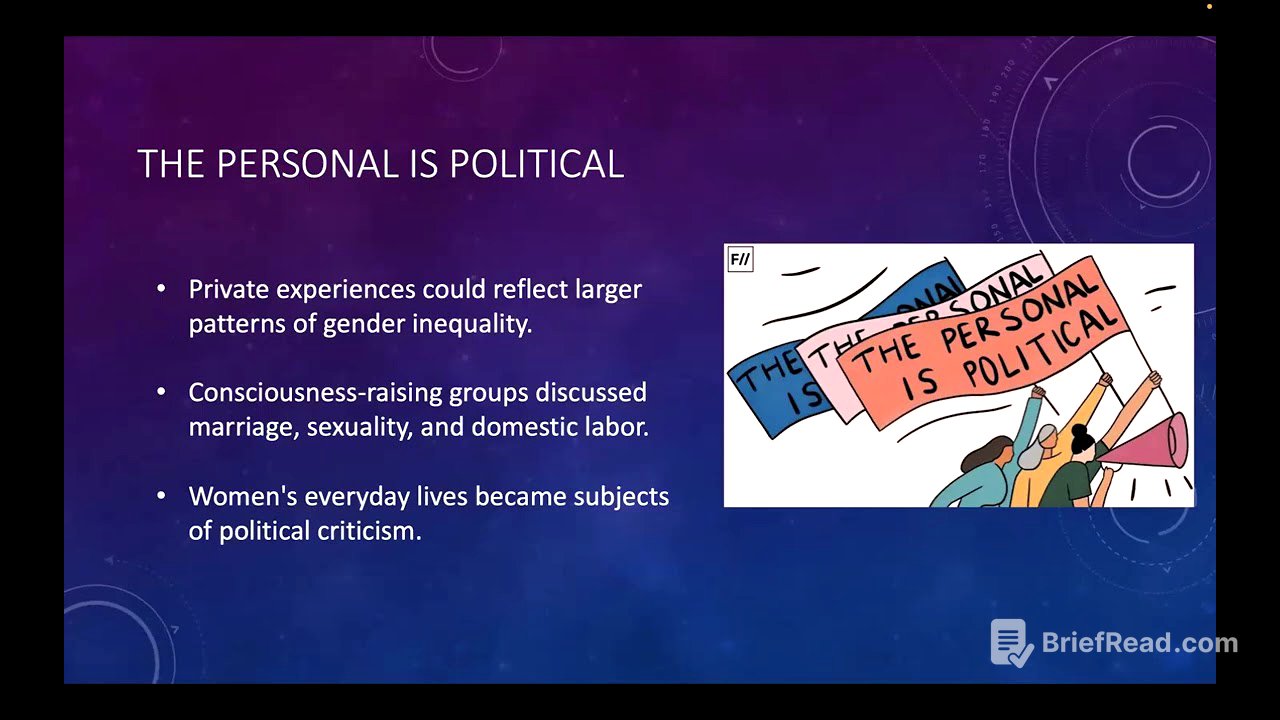
The slogan "The personal is political" encapsulated the idea that personal problems were often rooted in societal structures. Feminists utilized consciousness-raising groups to address domestic roles and societal expectations, recognizing that issues traditionally seen as private were actually influenced by broader political contexts. Events like the Miss America protest in 1968 exemplified public backlash against traditional beauty standards.
Legal and Educational Advances [14:45]
This chapter discusses significant legislative changes, including Title IX, which prohibited sex discrimination in education. These changes were not only vital for educational access but also contributed to women's independence by expanding career opportunities. The ability to control reproductive choices became increasingly critical, highlighted by key Supreme Court cases like Griswold v. Connecticut and Eisenstadt v. Baird.
Struggles Over the Equal Rights Amendment [18:44]
The Equal Rights Amendment (ERA), proposed in 1923 and passed by Congress in 1972, aimed to guarantee equal legal rights irrespective of sex. Despite initial support, it faced opposition and failed to achieve ratification by enough states. Notably, figures like Phyllis Schlafly campaigned against it, arguing it threatened women's traditional roles.
Criticism and Tensions Within Feminism [21:32]
Criticism arose within the movement, particularly concerning representation and the focus on privileged women's experiences. Women of color and working-class women had different concerns, including economic stability and discrimination. Concepts of intersectionality emerged, highlighting the interconnectedness of race, class, and gender.
Contemporary Female Experiences and Choices [26:33]
The chapter explores the cultural phenomenon of "tradwives," reflecting on the allure of traditional domestic roles amidst modern challenges. While some women embrace these roles, the discussion centers on whether such choices are genuinely free or influenced by societal expectations. Contemporary feminist issues continue to examine themes of autonomy and personal choice.
Art and Literature of the Women's Movement [29:25]
Key artwork such as Judy Chicago's "The Dinner Party" and works by Miriam Shapiro and Faith Ringgold celebrate women's contributions and challenge the perception of women's roles. This chapter also addresses literature from figures like Betty Friedan and Maya Angelou, focusing on the themes of discontent and resilience among women in different contexts and acknowledging the complexity of experiences.
Songs of the Women's Movement [46:18]
This section highlights influential songs from the women’s movement, beginning with Lesley Gore’s "You Don’t Own Me," which asserts a woman's autonomy. Other songs, like Loretta Lynn’s "The Pill," explore reproductive rights, while Nina Simone's "Four Women" presents diverse experiences of black womanhood, illustrating the intersections of race, gender, and social expectations.
Reflections and Ongoing Issues [49:05]
Finally, the lecture reflects on the achievements of second-wave feminism while noting the ongoing issues that need further attention. It emphasizes the importance of recognizing whose voices are included in the feminist discourse and advocating for a more inclusive approach to gender equality that considers varied experiences of all women.