TLDR;
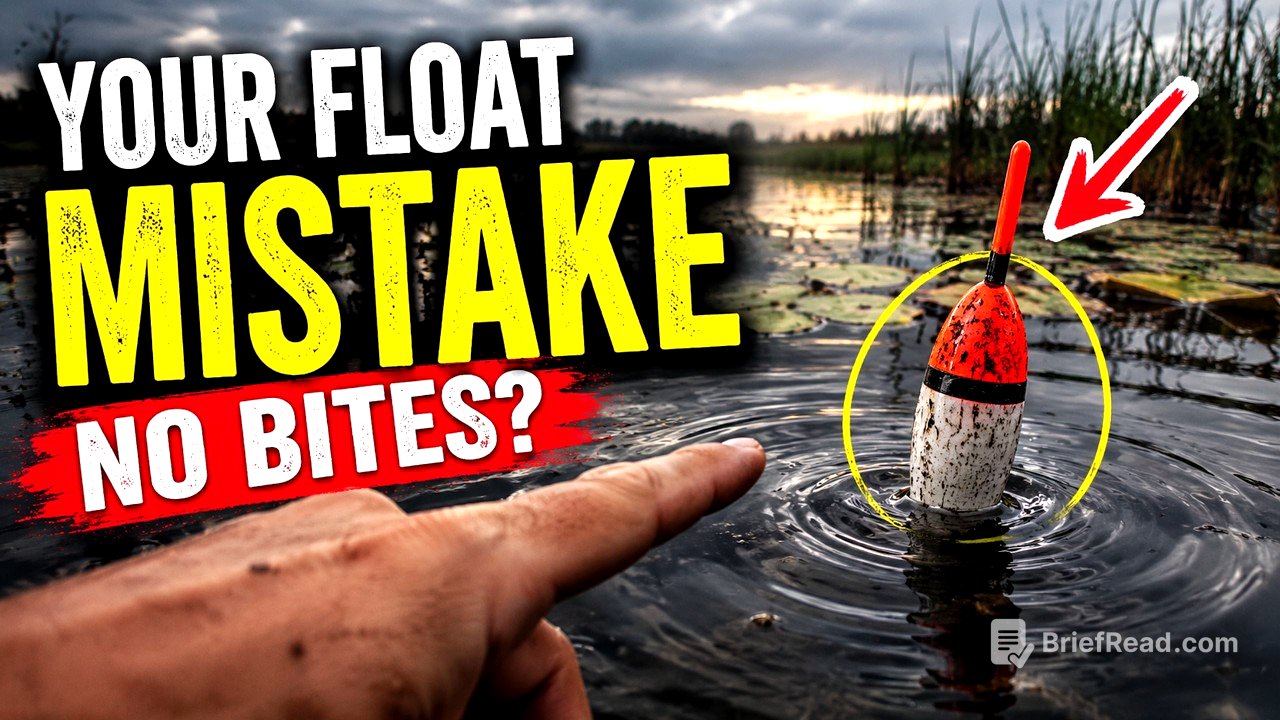
This video explores ten common fishing mistakes that prevent anglers from catching more fish. The narrator emphasizes the importance of understanding the tools used for fishing, particularly focusing on floats as essential instruments rather than just bobbers. Each chapter provides insights related to common errors and technological solutions associated with fishing techniques, using historical examples, scientific explanations, and practical tips.
- Understanding the difference between a float and a bobber is crucial.
- Proper use of weights and maintaining the right depth can significantly improve fish detection.
The Needle On The Gauge [0:00]
The chapter introduces the concept of floats as instruments for reading fish activity, referencing two fishermen at the same pond who experience different outcomes due to their equipment choices. The first man fails to catch fish, attributing it to luck, while the second is successful because he uses a tool that reads signals from the fish below the surface.
Two Men Fish The Same Bank [0:04]
In this segment, the narrator contrasts the experiences of two men fishing from the same bank. One comes home with a dry net, while the other catches several fish. The key difference lies in their equipment and their ability to read the signals from the water.
Same Pond Same Gray Morning [0:07]
The scene is set on a gray morning at a familiar pond where both fishermen encounter similar conditions yet yield different results. The success of the second fisherman is attributed to his understanding of the equipment and the behavior of fish.
Same Bream Rolling Out Past The Lily Pads [0:09]
This chapter describes the bream swimming past lily pads, with one fisherman struggling to connect while the other continues to reel in fish, highlighting the need for an effective fishing strategy and the importance of equipment that can pick up subtle signals.
One Of Them Goes Home With A Dry Net [0:13]
One fisherman leaves empty-handed, illustrating the failure to adapt and use the right tools for the fishing environment. His experience captures a typical frustration for many anglers who rely solely on luck.
And A Story About How The Fish Just Weren'T Having It [0:15]
The unsuccessful fisherman shares a story about how fish were simply "not biting," reflecting a common misconception among anglers that their lack of catch is out of their control.
The Other One Is Unhooking His Fifth Fish [0:19]
Contrasting the first man’s experience, the other fisherman continues to catch fish due to his proficiency with the fishing tools.
Before The First Man Gets A Single [0:21]
The narrator details how the successful fisherman catches multiple fish while the other man struggles, underscoring that it isn't luck but rather skill and equipment that leads to success.
Clean Bite [0:23]
The chapter emphasizes the significance of detecting clean bites and how improper equipment can hinder this process. The narrator explains how understanding the signals fish send can adjust the angler's strategy.
People Love To Call That Luck [0:25]
The common belief in luck within fishing is discussed, challenging this notion by attributing success to knowledge and skill in recognizing fish behavior.
It Isn'T The Second Man Is Reading Something The First Man Cannot See [0:27]
One skilled fisherman can read the faint signals from fish due to his choice of a suitable float that works effectively, unlike his counterpart who misreads the situation.
There'S A Signal Coming Up That Line [0:33]
The focus shifts to the concept of signals traveling through the line from the fish to the angler, which is paramount in successful fishing. The discussion highlights the need for proper equipment to detect these subtle signals.
Faint As A Fingerprint Pressed On Glass [0:35]
The chapter compares the signals from fish to faint fingerprints, underscoring their delicate nature and how careful fishing techniques allow anglers to detect these signals.
And One Of These Men Is Holding A Tool That Reads It [0:38]
The responsible fisherman is equipped with the right gear to interpret the signals from fish. The difference in tools directly affects the outcome of their fishing experiences.
And The Other Is Holding A Painted Cork That Doesn'T [0:41]
In contrast, the other man uses a basic bobber, which does not provide critical feedback from the fish, leading to missed opportunities.
I Make Floats Have Done Most Of My Life [0:46]
The narrator shares his background in making fishing floats and emphasizes the artistry and precision required to craft tools that can effectively read the fishing signals.
I Shape Them Out Of Balsa And Goose Quill And Reed [0:49]
He describes the materials used in crafting these tools, highlighting the importance of choosing the right components for effective float performance.
I Sink Them In A Glass Tube Of Water On My Bench [0:53]
The method of testing the floats in water is discussed, illustrating how proper calibration is essential for functionality in the field.
Until Only A Thread Of The Tip Shows [0:56]
The chapter explains how a well-constructed float should barely show above the water, which can enhance sensitivity to fish movements.
And Along The Way I Learned One Thing [0:58]
The narrator shares key insights gained from his experience, primarily focusing on the misconceptions surrounding fishing equipment.
The Tackle Wall At Your Local Store Will Never Print On A Package [1:00]
He points out that commercial tackle manufacturers often fail to educate anglers about the true nature of floats and their significance in fishing.
A Float Is Not A Bobber [1:05]
In this chapter, the narrator clarifies the distinction between floats and bobbers, suggesting that floats are instruments vital for success in fishing.
A Float Is An Instrument It Is The Needle On A Gauge [1:09]
This section solidifies the analogy of floats as instruments, which measure fish activity. Understanding this can enhance an angler's toolkit.
And The Gauge Is Reading The Mouth Of A Fish 40 Feet Away In The Dark [1:14]
The conversation shifts to how a float is essentially reading signals from fish that are far beneath the surface, linking distance to fishing success.
Somewhere Back Down The Years [1:19]
The historical perspective discusses how the tackle industry has shifted focus away from effective tools to more simplistic options, diminishing the quality of fishing experiences.
The Tackle Trade Quietly Took That Instrument Out Of American Hands [1:21]
The discussion centers on how the fishing industry has simplified gear and inadvertently removed essential fishing knowledge from everyday anglers.
And Slid A Red And White Plastic Ball Across The Counter Instead [1:25]
The replacement of advanced fishing tools with simplistic bobbers is critiqued, noting the significant loss in efficacy for anglers.
They Called It Simple [1:30]
The term "simple" reflects the oversimplification of fishing equipment that has led to decreased catch rates among anglers.
What It Really Is Is Death [1:35]
The narrator starkly calls out the simplification of fishing tools as detrimental to angling success, highlighting the loss of effective communication with the fish.
And Over The Next 20 Minutes [1:37]
He promises to guide viewers through ten mistakes that lead to ineffective fishing practices, providing a comprehensive overview of each.
I'M Going To Walk You Through The 10 Ways That Deafness [1:40]
The narrator emphasizes that many fishing failures stem from anglers being unable to properly interpret the signs from fish due to poor technique or equipment.
Bleeds Fish Off Your Hook [1:43]
This section indicates that each failure contributes to a greater inability to catch fish, underscoring the complexity of effective fishing practices.
Because Almost None Of This Is About The Fish [1:45]
The focus here is shifted onto the methods and tools used by the angler, asserting that understanding equipment is significantly more important than mere fishing skill.
It'S About Whether The Thing On Your Line Can Still Hear Them [1:49]
Effective fishing is deeply connected to how well the equipment can transmit signs from the fish, emphasizing the need for device sensitivity.
Let'S Start Where The Signal Dies First [1:53]
The narrator begins outlining the specific mistakes anglers make when fishing, starting from the basic setup with floats.
Pick Up A Float Any Float [1:56]
He encourages viewers to examine any float they use, setting the stage for a breakdown of effective versus ineffective floats while emphasizing their critical role in readings.
Look At How Much Of It Stands Above The Water When It'S Working [1:59]
The visibility of a float above water is crucial for understanding how effectively it transmits signals from fish, recommending minimal tip exposure.
If You'Ve Got 2 Or 3 Inches Of Fat Plastic Riding The Surface [2:02]
This chapter discusses how a float that rides too high results in a poor fishing experience, equating it to a fish trying to drag a heavy object underwater.
Here'S What That Feels Like On The Other End [2:07]
The feelings and experiences of fish when dealing with a poorly balanced float setup are analyzed, stressing the need for proper balance.
It Feels Like A Fish Being Asked To Drag A Basketball Under The Water [2:14]
This vivid comparison illustrates how heavy floats deter fish from biting since they struggle against unmanageable weight.
Using Nothing But Its Lips [2:17]
This section highlights the mechanics of how fish interact with bait and the challenges they face when encountering an improperly set float.
Picture A Swimmer Treading Water [2:19]
The narrator asks viewers to visualize the ideal balance a float should maintain while in the water, reinforcing the need for sensitivity in fishing tools.
Perfectly Balanced Neither Sinking Nor Floating Up [2:23]
A properly balanced float serves as an effective indicator of fish activity and should hover just beneath the surface, allowing anglers to detect even the smallest bites.
That Is What Your Float Should Be [2:26]
The focus is on establishing an optimal float setup for better fish communication, emphasizing the balance necessary for effective fish tracking.
Pinch On Tiny [2:27]
This section provides practical advice on adding small weights to ensure the float remains positioned correctly under the water.
Split Shot Until The Whole Body Settles Under The Surface [2:31]
The technique of adjusting weights is more elaborated upon to help the float integrate into the water, allowing for better sensitivity and communication with fish.
And Only A Sliver Of Tip Is Left [2:34]
The ideal setup has only a small part of the float above the water, ensuring the angler can detect subtle movements and bites easily.
Showing [2:35]
The last bit of the float that remains above the water offers the perfect balance for receiving signals from fish, enhancing fishing success.
Now When A Fish So Much As Breathes On Your Bait [2:39]
With the right float position, even the smallest nibble will register, highlighting the importance of sensitivity in float setup.
There Is Almost Nothing Holding That Tip Up [2:43]
Fishing success heavily relies on minimal resistance caused by a properly calibrated float setup.
So The Smallest Pull Shows The Tip Dives Or It Lifts [2:46]
When the setup is right, even the faintest tug from a fish is easily detectable, increasing the chances of hooking the fish.
Or It Slides Off Sideways [2:51]
The angler's ability to detect movement on the line is largely dependent on the float's sensitivity to shifts caused by fish pulling or nibbling.
It Talks To You [2:54]
An effective float acts as a communicator between the angler and the fish, enhancing the fishing experience by allowing for a better understanding of fish behavior.
Leave The Body Riding High And The Float Fights The Fish For You [2:56]
Setting the float body too high complicates fishing, leading to missed catches since resistance makes fish easily escape.
The Fish Lifts The Bait Feels A Dead Weight Shoving Back Up At It [3:00]
When a float is set too high, fish become deterred by the resistance they experience, often rejecting the bait with little chance for a catch.
And Drops It Before Your Tip Ever Twitches [3:05]
The frustration of missed opportunities is discussed, stressing how crucial the float setup is to register all potential catches.
You Sit There Sure [3:09]
The anticipation of catching a fish that turns into disappointment reveals the operational failures of floats when they're not adjusted correctly.
That Nothing'S Happening [3:10]
Here, the narrator reflects on how disheartening it can feel to assume fish are absent when the reality may simply be ineffective tools being used.
A Good Fish Just Tasted Your Hook And Spat It Back [3:12]
The chapter emphasizes that often fish do bite, but due to a poor float strategy, the angler never connects.
And The Painted Cork Never Said A Word [3:15]
The limitations of a basic bobber instead of an effective float lead to miscommunication between fish behavior and the angler’s perception.
That Is Mistake No. 1 And Everything Else Is Built On Top Of It [3:19]
The first mistake, using a float that rides too high, creates a foundation for further inefficacies in fishing techniques.
The Body Never Rides High [3:24]
This portion re-emphasizes the critical need for floats to sit submerged to effectively communicate with the fish beneath.
Sink It To The Tip [3:26]
The importance of proper weight adjustment is reiterated, encouraging viewers to keep floats positioned suitably low.
Mistake No. 2 Is One Step Down The Line In Your Weights [3:29]
This chapter identifies a common mistake with weight management and how improper placement can lead to fewer successful catches.
Most Folks Squeeze All Their Shot Into One Fat Lump [3:33]
Anglers often lump weights too close to the hook, creating rigidity that prevents fish from effectively biting the bait.
Right Above The Hook [3:37]
Placing weights directly above the hook creates a physical deterrent for cautious fish, resulting in missed connections.
To A Careful Fish That'S Biting A Worm And Finding It [3:39]
This chapter