TLDR;
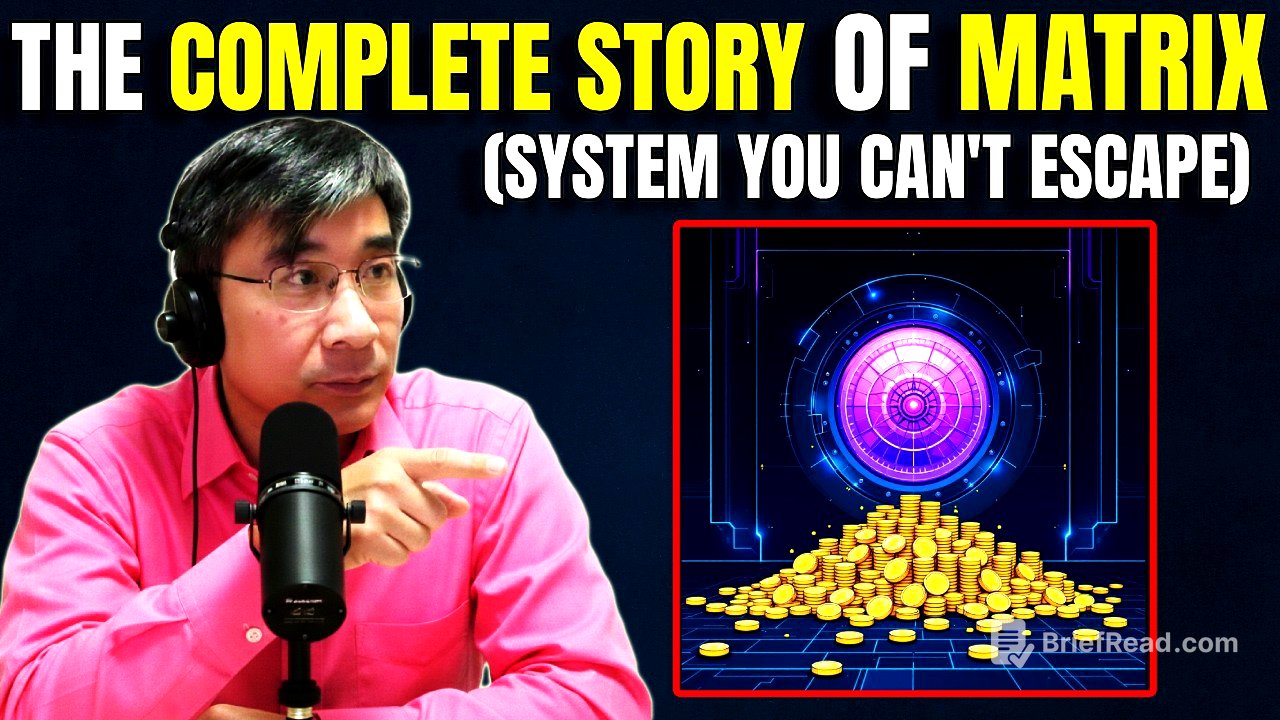
This video introduces a framework for understanding reality that challenges conventional beliefs. It emphasizes critical thinking, questioning established ideas, and understanding how power structures shape our perceptions. The course will explore geopolitics, predict future events, and analyze the "secret history" of the world, focusing on how power operates through money, the concept of the individual, and the nation-state.
- The course aims to liberate imagination from constraints imposed by powerful forces.
- It uses Emanuel Kant's philosophy to highlight that our minds actively construct our experience of reality.
- It challenges the notion of objective reality, suggesting reality is what we imagine it to be.
Introduction: Challenging Perceptions of Reality [0:01]
The video starts by stating that the course will explore a framework for understanding reality that challenges conventional beliefs. It's about how ideas connect and shape the world, and how understanding them can liberate individuals. The course encourages questioning and critical thinking, contrasting it with traditional education that often promotes passive acceptance of information. The goal is to train imagination to see the world more clearly by questioning everything, including the ideas presented in the course.
Emanuel Kant and the Nature of Reality [1:48]
The video introduces Emanuel Kant, an 18th-century philosopher, and his revolutionary idea that we can never know objective reality. Kant posited the existence of an ultimate reality called the "numina," which is inaccessible to us. Instead, we perceive the world through our senses, which warp and change it into a structure we can process, called the "phenomena." Kant used the example of time and space, arguing that they don't exist outside of us but are categories our minds impose on experience to make sense of it. This means reality is what we imagine it to be, and life is a constant act of imagination, creating the world through perception.
Colonized Imagination and the Project of Liberation [4:40]
The video addresses the practical implications of Kant's philosophy, questioning who controls our imagination and how we perceive the world. It asserts that our imaginations have been colonized, with powerful forces implanting ideas that shape our perceptions, often without our awareness. The project of the course is about liberation, freeing imagination from these constraints to see the world more clearly. While complete objectivity is impossible, the effort to achieve it will train minds to think more critically.
Course Structure: Past, Present, and Future [6:18]
The video outlines the course structure, which involves analyzing the past, present, and future to construct a more accurate picture of reality. In the present, the course will study geopolitics, examining conflicts like those in Ukraine and the Middle East to understand the hidden structures of power. This analysis will lead to an analytical model of geopolitics, which will then be used to make predictions about the future. The accuracy of these predictions will test the validity of the model. If the model proves accurate, it will be used to analyze the past and reveal the "secret history" of the world, challenging the conventional historical narratives.
The Secret History and the Mechanisms of Power [8:25]
The video challenges the accuracy of conventional history, asserting that the history we learn is a narrative implanted by powerful people to serve their interests. Understanding the past shapes our understanding of the present and future possibilities. The central question of the course is how power works, and understanding its mechanisms leads to liberation and freedom. By understanding how we are manipulated, we become empowered to live authentically and see the world in a way that is true to ourselves.
Money as a Tool of Power: Thought Experiment [10:09]
The video introduces three concrete examples of how power works in the modern world: money, the individual, and the nation-state. These concepts are so fundamental that most people never question them, but they are actually constructions created to serve specific purposes. The video starts with money, presenting a thought experiment involving a bank to illustrate how money is created. The experiment shows that banks can create money out of thin air by making loans, which is legally permitted.
Money Creation and the Role of Banks [12:46]
The video explains that in reality, banks create money by simply typing numbers into a computer when they make a loan. This contrasts with the traditional understanding of the fractional reserve system. Chinese banks are cited as an example of how banks create money to finance infrastructure projects. The key point is that money is not scarce; banks can create as much of it as they want, yet we are taught from childhood that it is scarce and we must work hard to get it.
Historical Origins of Banking [14:57]
The video traces the historical origins of banking to merchants who needed money to facilitate trade. Early banks traded primarily in gold, giving receipts for gold deposits. These receipts began to circulate as a form of money themselves. Bankers realized they could lend receipts for more gold than they actually had, effectively doubling the money in circulation and creating money out of nothing. This is how modern banking works: banks create new money when they make loans.
Bank Runs, Royal Clients, and Central Banking [19:00]
The video discusses the problems with the banking system, including bank runs, which occur when everyone wants their gold back at the same time, leading to economic devastation. Bankers often lent money to kings and nobles for war, which was risky because kings could die or refuse to pay back loans. To solve these problems, bankers formed cartels through partnerships and intermarriage, creating networks of financial power. This system of network financial power is what we call central banking today, which controls the creation of money and the allocation of credit.
Money as Social Technology and the Illusion of Scarcity [23:27]
The video summarizes that money is not a natural thing but a social technology based on power. The power to create money is the power to turn nothing into everything through the manipulation of belief. This pattern extends beyond money, with power working by creating shared beliefs and making people accept as real things that are actually just ideas. The video then poses the question: if money is infinite, why do we have poverty?
Poverty as a Functional Tool for Social Control [25:12]
The video addresses the paradox of poverty in a world where money is infinite. It argues that poverty is not due to scarcity but is functional, serving as a tool for social control. Powerful people who control the creation of money don't want everyone to have money because if everyone had money, no one would work. Poverty motivates people to work, study, and compete. The video asserts that poverty is created artificially by those who control the monetary system to drive people to work.
Economic Crisis, War, and the Illusion of Scarcity [29:38]
The video extends the logic to explain economic crises and wars. Economic crises exist to destroy money, preventing people from becoming complacent. Wars also destroy wealth, creating the need for people to work hard to rebuild. Banks often finance both sides of major conflicts, profiting from the loans governments take out to finance military operations. The video draws a parallel between the artificial scarcity in video games and the real world, where the monetary system is designed to extract labor.
Abundance vs. Distribution and the Persistence of Scarcity Mindset [33:46]
The video addresses the argument that physical resources are genuinely limited, arguing that we live in a world of abundance organized to create the appearance of scarcity. There is enough food, energy, and medicine, but a distribution system designed to create artificial scarcity. Even genuine scarcity doesn't explain the massive inequality we see. The video concludes by asking the audience to consider that much of what they believe about economics and resources might be wrong.
The Individual vs. Collective Happiness [35:46]
The video shifts to the concept of the individual, questioning what makes us happy. It notes that almost everything on the list of things that make us happy is about individual happiness, which is a relatively new way of thinking. Historically, people focused more on collective happiness, understanding that individual well-being depended on the well-being of the community. The idea of the individual as a separate self with its own private happiness is a recent invention that serves certain purposes.
Ancient Generosity vs. Modern Accumulation [37:32]
The video contrasts ancient and modern attitudes toward wealth. In ancient societies, people who came into sudden wealth would throw a huge feast for their community, sharing their good fortune. Status depended on how much you gave away, not how much you accumulated. Modern economic systems have tried to suppress this instinct and replace it with the drive for individual gain.
Exile as the Ultimate Punishment and the Invention of the Individual [39:32]
The video explores the concept of the individual, noting that it is not a natural fact but an invention. In ancient societies, the worst punishment was exile, being cast out from the community. This shows that people did not think of themselves as separate individuals but as parts of a larger whole. The modern concept of the individual, with its emphasis on independence and personal responsibility, makes people alone and easier to control.
Two Worldviews: Fate vs. Control [41:31]
The video presents two different worldviews. The first, a polytheistic worldview, recognizes that there are powerful forces beyond our control, such as gods and fate. In this view, we are not masters of our fate and should focus on living well in the present. The second worldview, the one taught in schools, says that we are biological machines who can control our emotions and master our fate through therapy and self-optimization.
The Polytheistic Worldview vs. the Modern Worldview [44:14]
The video argues that the polytheistic worldview actually gives you more accurate information about how reality works, while the modern worldview is misleading and serves the interests of power. The polytheistic worldview encourages living well in the present, while the modern worldview focuses on self-optimization and blames individuals for their failures. The modern worldview makes people work harder and makes them powerless by individualizing their problems.
The Therapeutic System and Dependence on Authority [47:31]
The video uses the example of feeling sad to illustrate how the modern worldview makes people dependent on authority. Instead of seeking support from friends and family, people are taught to see a psychiatrist who diagnoses them with a condition and gives them medication. This medicalizes their sadness and makes them dependent on drugs and professionals, preventing them from experiencing the full range of human emotions and working through them naturally.
The Nature of the Gods and the Wisdom of the Ancients [49:50]
The video addresses the objection that the gods in the polytheistic system are also authority figures. It argues that the gods are not benevolent authority figures but are capricious and dangerous, showing what power looks like when it's unconstrained by morality. The ancients knew that power corrupts and that those at the top of hierarchies serve their own interests, not yours. The gods were a way of encoding this wisdom in story form.
Schools and the Reproduction of the Nation State [52:17]
The video shifts to the third major example: the nation-state and schools. Schools are the primary mechanism through which the nation-state reproduces itself. The video notes that only three societies in history introduced mandatory free public education before the modern era: Sparta, the Aztec Empire, and Prussia. These societies were all fundamentally war societies organized around military conquest.
The Prussian Model of Schooling and the Purpose of Education [54:43]
The video focuses on Prussia, which created the model of schooling that the rest of the world eventually adopted. The Prussian school system was explicitly designed to produce obedient, disciplined, and loyal citizens who would follow orders without question. The king of Prussia said that the purpose of education was to create subjects who would obey.
The Violence of Mandatory Schooling and the Severing of Family Bonds [55:49]
The video argues that taking children from their parents is a form of violence and one of the worst things you can do to a family. Mandatory schooling takes children away from their families for most of their waking hours, during the most formative years of their life. This severs the bond between parent and child so that the child can be more effectively shaped by the state.
Implanting the Concept of the Nation State [58:05]
The video asserts that the primary function of modern schooling is to implant the concept of the nation-state. Before modern nationalism, people did not identify themselves by nationality. Schools teach a common language, history, and set of symbols to make children identify as members of the same nation. National history creates a story that connects ancient events to the present nation, making people feel obligated to the future of their nation.
The Nation State as an Illusion and the Power of Implanted Memory [1:02:26]
The video concludes that the nation-state is an illusion, an idea implanted in our minds through deliberate conditioning. The nation is a story, but this story has enormous power, leading people to kill, die, and sacrifice for their nations. Schools are designed to create this implanted memory.
Money, the Individual, and the Nation State as Constructions [1:04:19]
The video summarizes that money, the individual, and the nation-state are constructions created to serve particular purposes and implanted in our minds through deliberate conditioning. Money is a technology for extracting labor, the individual is a concept for preventing collective action, and the nation-state is a framework for commanding loyalty and obedience.
Monotheism as the Source of Modern Concepts [1:05:08]
The video reveals that all three of these concepts trace back to monotheism, the belief in one true God. Monotheism introduced new ways of thinking about value, the self, and political organization. It replaced the polytheistic world with a world organized around singular authority. Monotheism introduces the idea of a single transcendent source of value and meaning, creating the conceptual foundation for money as a universal equivalent.
Alchemy: Turning Nothing into Everything [1:08:45]
The video returns to the concept of alchemy, arguing that we have achieved alchemy in the social sense by turning nothing into everything. Money, the nation, and the individual are all nothing in themselves, but through the power of collective belief, we have made them the most valuable things in the world. Power is the capacity to turn nothing into everything, and monotheism was the original breakthrough in social alchemy.
Liberation Through Understanding [1:10:46]
The video acknowledges that it is a lot to process and that it is natural to feel resistant or confused. It emphasizes that understanding how these systems work is liberating. If you understand that money is a social technology for extracting labor, you can think more clearly about your relationship to money. If you understand that the individual is a concept designed to prevent collective action, you can think more clearly about your relationships with others. If you understand that the nation-state is an implanted memory designed to command your obedience, you can think more clearly about your relationship to political authority.
The Promise of Critical Thinking and Freedom [1:12:15]
The video concludes by stating that knowledge is power, not power over others, but power over yourself. The power to question the beliefs that have been implanted in you, to imagine alternatives, and to live according to your own values. The power structures want you passive, but you have the capacity to think, question, imagine, and act. Once you truly understand this, you become free in your mind, free to see clearly, free to choose consciously, and free to be fully alive.