TLDR;
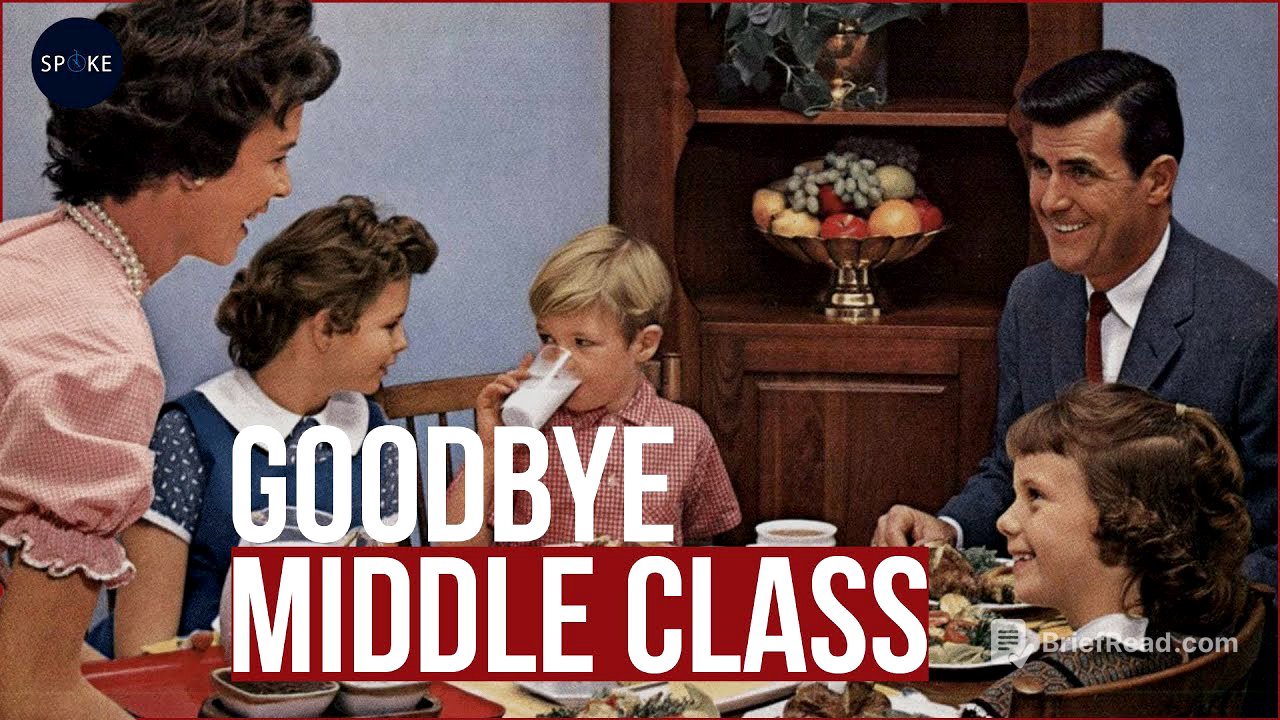
The video discusses the decline of the middle class in America, arguing that its golden age (1950s-1970s) was a unique historical period fueled by specific conditions that are unlikely to return. It identifies three main reasons for this decline: unrealistic expectations based on the past, changes in the nature of work (specifically the decline of manufacturing), and the rising cost and necessity of higher education. The video also touches on wealth inequality, the dismantling of the social safety net, and the unsustainability of relying on politicians' promises to restore the middle class.
- The middle class is shrinking and not coming back due to unrealistic expectations, changes in work, and the rising cost of education.
- The golden age of the middle class was a unique period of government support, low interest rates, and American dominance.
- Manufacturing jobs have declined due to offshoring and automation, leading to lower wages and fewer benefits for many workers.
- Higher education is now often required for middle-class entry, but it comes with significant debt.
- Wealth inequality has increased dramatically, with a large portion of wealth concentrated at the top.
Intro [0:00]
The video starts by highlighting the common political promise of restoring the middle class, a central theme in the American dream. It challenges the notion that the middle class can be revived to its former state. The speaker asserts that the middle class has been declining for decades and will continue to do so due to fundamental shifts in expectations, work, and education.
The Golden Age of the Middle Class (1950s-1970s) [1:04]
The period from the 1950s to the 1970s is identified as the golden age of the middle class, a time of significant economic prosperity following World War II. The American government invested heavily in veterans through education subsidies, low-interest housing loans, and business loans. The Cold War spurred technological innovation, further boosting the economy. The Bretton Woods Conference established the U.S. dollar as the basis for global monetary exchange, giving the U.S. significant financial influence. Homeownership and median incomes increased substantially, and strong unions supported stable manufacturing jobs with high wages. High tax rates on top earners funded a robust social safety net.
Unrealistic Expectations [3:59]
The video argues that current expectations of the middle class are based on the unique conditions of the past, which are unlikely to be replicated. The speaker notes that the high levels of government support, low interest rates, and high tax rates that characterized the golden age are unrealistic in today's world. The decline in union power further contributes to the difficulty of recreating that era.
The Changing Nature of Work [4:53]
The video discusses the decline of manufacturing jobs in the U.S. due to offshoring and automation. In 1960, manufacturing accounted for 28% of total employment, but by 2017, it was only 8%. The shift towards deregulation in the 1980s led companies to split up their operations and move manufacturing to countries with lower wages. While some countries like Germany and Japan integrated R&D and manufacturing, the U.S. became complacent and failed to innovate. The Apple model, which outsources manufacturing to China, created a stigma around manufacturing jobs. The loss of these jobs has disproportionately affected workers without a college degree, who have had to take lower-paying service jobs.
The Rising Cost of Education [8:20]
The video highlights the increasing importance and cost of higher education as a barrier to middle-class entry. Those who lost manufacturing jobs had to either take lower-paying service jobs or get a degree. The average student loan debt in America is $65,111, with monthly payments of $200 to $299. While a higher percentage of college graduates are in the upper-income tier, the percentage of those with a bachelor's degree in the middle class has decreased. The cost of living has increased faster than wages, leading to a decrease in the middle class across almost every demographic.
Wealth Inequality and the Dismantling of the Social Safety Net [10:58]
The video addresses the dramatic increase in wealth inequality since the 1970s. In the U.S., 50% of households hold less than 4% of the nation's wealth, while the top 10% hold over two-thirds. The Bretton Woods system collapsed in the 1970s, leading to the neoliberal politics of the 1980s, which dismantled the social safety net and reduced government spending. The speaker concludes that the economic and social systems that supported the middle class in the past are gone and are not coming back, and politicians' promises to restore the middle class are unlikely to be fulfilled.