TLDR;
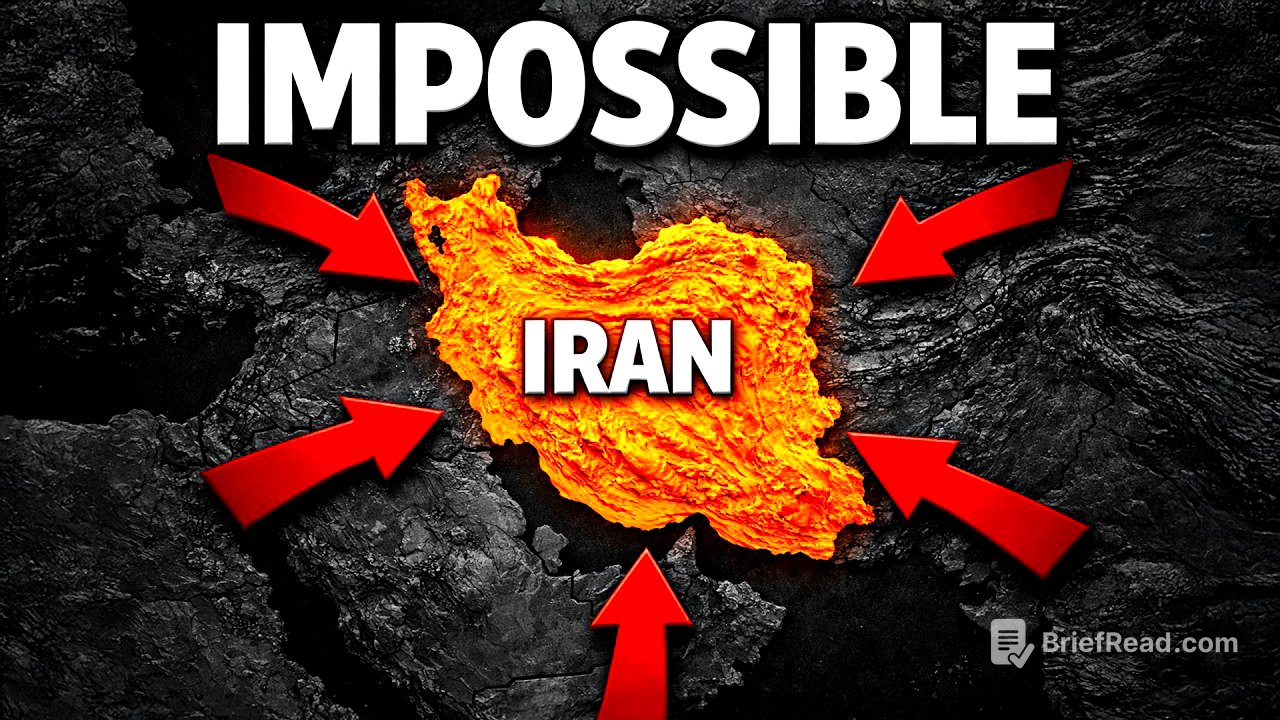
This video explores the reasons behind Iran's resilience against foreign invasions throughout history. It highlights Iran's unique geographical advantages, including its mountainous borders, strategic location regarding the Strait of Hormuz, and diverse ethnic population, all of which contribute to its formidable defense capabilities. The video also touches on Iran's strategic depth and its ability to leverage time and internal unity as weapons against potential adversaries.
- Iran's natural geography acts as a fortress, with mountains and deserts providing defense.
- The Strait of Hormuz gives Iran significant strategic leverage over global oil supplies.
- Iran's multi-ethnic society, while challenging to govern, complicates any invasion.
- A strong sense of national unity, especially in times of war, bolsters Iran's defense.
- Iran's strategic depth allows it to exhaust enemies as they penetrate further inland.
Natural Fortress: Iran's Geography [1:05]
Iran's geography is a significant asset, acting as a natural fortress. The country is surrounded by mountains, including the Zagros range in the south, which serves as a barrier against enemies approaching from that direction. In the northwest, these mountains become rugged and tall, creating a nearly impassable border with Turkey. Where mountains are absent, marshlands, particularly around the Tigris and Euphrates rivers, form natural barriers. To the north, the Alborz Mountain range provides protection near the Caspian Sea and Azerbaijan. In the east, smaller mountain ranges create a protective ribbon along the borders with Afghanistan and Pakistan.
Strategic Control: The Strait of Hormuz [4:33]
The Strait of Hormuz is a crucial strategic asset for Iran. The entire northern part of the Persian Gulf, from beginning to end, is under Iran's control, while the southern part is shared among seven countries. Iran's coastline along the Strait of Hormuz forms a V-shape, allowing it to control the area effectively from three sides. Iran has the ability to close the Strait, which puts pressure on not only the Gulf countries but also the entire world, as 20% of the world's oil and 90% of Qatar's LNG pass through it, accounting for 5% of the world economy.
Coastal Defense: Iran's Extensive Coastline [6:25]
Iran possesses an extensive coastline, totaling 2,815 kilometers along the Caspian Sea and the Persian Gulf, which accounts for 32% of its border. This coastline is not merely sandy beaches but is characterized by mountainous terrain where Iran has installed missile batteries in secret locations. These locations include caves and blind spots that are difficult to detect via satellite or drone surveillance. Any enemy landing on the coast would immediately face mountainous terrain, making them vulnerable to sudden attacks.
Multi-Ethnic Society: A Double-Edged Sword [7:25]
Iran is a multi-ethnic country comprising Persians, Azeris, Kurds, Arabs, Baloch, Turkmen, and other groups. This diversity presents challenges in governance, as each group seeks to protect its rights, language, and culture. These groups, often residing in mountainous regions, have centuries-old disagreements. While Iran has attempted to unite them under the umbrella of Shia Islam, protests are common. However, this multi-ethnicity also poses a significant challenge for any potential invader, who would need to contend with both the geography and the diverse population, making occupation nearly impossible.
National Unity: Strength in Solidarity [9:43]
Despite internal disagreements, the majority of Iran's population (95%) are Shia Muslims, which fosters religious unity. Historically, external attacks have united these diverse groups. During the Iran-Iraq War in the 1980s, despite Saddam Hussein's expectations that Arabs and Kurds within Iran would rebel, they instead united under the Shia Muslim banner, strengthening Iranian nationalism. This unity transformed what Saddam Hussein thought would be a swift victory into an eight-year war of attrition.
Strategic Depth: A War of Attrition [11:18]
Iran's size is a significant strategic advantage. Covering 1.6 million square kilometers, it presents a complex strategic maze. Any invading force would face the challenge of navigating ancient mountain paths, desert plateaus, and deeply situated cities. This concept of strategic depth means that as an enemy advances, their supply lines become longer, increasing pressure on fuel and logistics, while allowing Iran more time to prepare. Major cities like Tehran, Isfahan, and Mashhad are located inland, far from the borders, ensuring they remain secure even if the borders are breached.