TLDR;
Dr. Daniel Black argues that Black spiritual life in the United States carries African traditions that often survive within practices labeled Christian. He calls for teaching about African history and spiritual systems, restoring self-love and ancestral connection, and moving beyond debates centered on white approval. The conversation also addresses deconstruction, Black creativity, Christian nationalism, and the need to build communities rooted in freedom, knowledge, and love.
- Black church traditions can express African spirituality through ritual, music, devotion, and remembrance of ancestors.
- Black people need not seek outside agreement to affirm their divinity, dignity, or cultural value.
- Deconstruction can be a starting point, but the conversation should move toward imagining joyful life beyond Western materialism and colonial frameworks.
- Teaching about African spiritual traditions and Black history is essential alongside, and sometimes more than, preaching.
African Spirituality Disguised as Christianity [0:00]
Dr. Black opens with the claim that Black people in American churches often practice African spirituality while calling it Christianity. He points to Black choirs processing into church as a ritual preparation for encountering God, rather than merely a musical entrance. The march, he says, reflects a tradition of gathering, devotion, and spiritual preparation. The opening also introduces a central theme: reclaiming ancestral rituals and teaching African spiritual systems.
Introducing Dr. Daniel Black [1:12]
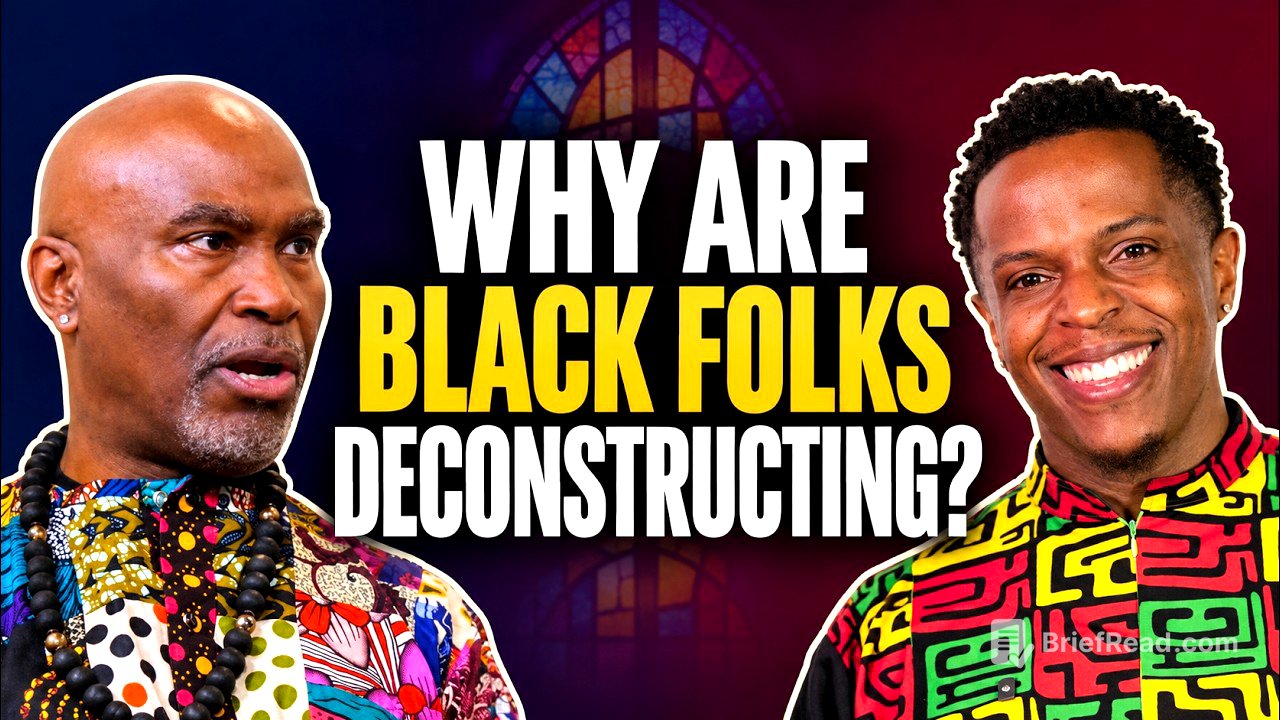
Host Christian A. Smith welcomes viewers to TFC Live, a program focused on challenging harmful theology and building community. He introduces Dr. Daniel Black, a longtime professor of African-American Studies at Clark Atlanta University who has inspired generations of Black scholars. The episode will consider why Black people are deconstructing their faith. The hosts also establish their community guideline: honor God and people’s lived experiences, welcome critical discussion, and treat one another with kindness.
Dr. Black's Purpose and Spiritual Journey [5:23]
Dr. Black describes his purpose as helping Black people restore their love for themselves, which he sees as diminished by oppression and by valuing oppressors more than the self. He argues that Black people are not dependent on other people—or even on a book—to know God. In his view, enslaved Africans did not first encounter God through enslavers; rather, they brought their own understanding of God and humanity with them. He says that recognizing the divine in oneself and in others is necessary to truly recognize God.
We Didn't Meet God Through Our Enslavers [6:45]
Dr. Black insists that Africans brought spirituality with them to the Americas instead of receiving their knowledge of God from enslavers. He describes every person as an expression of the divine, with God present in human beings in varied forms. Recognizing that divinity in other people, he says, prepares people to recognize God beyond this life. The discussion frames spiritual knowledge as something Black people already carried, rather than something they owed to colonial Christianity.
White Violence Is Not Black Identity [8:30]
Dr. Black says he is learning to give white America’s trauma back to white America instead of treating white violence as Black history or identity. He uses lynching as an example: studying it reveals the behavior and culture of those who carried it out, not the nature of Black people. He argues that Black culture does not celebrate such violence, even though individual Black people can act violently. This distinction matters because, in his view, African spirituality is larger than the religion Black people encountered under enslavement.
Ritual vs. Religion vs. Ceremony [10:52]
Dr. Black distinguishes ritual from ceremony. Ritual happens when people gather, place spirit at the center, and surrender their usual control over time; it transforms those who participate. Ceremony, by contrast, is governed by a set schedule. He argues that Black church practices often retain ritual elements and therefore transcend the categories of conventional Christianity. He warns that adopting a religion tied to another people’s domination can reproduce bondage, and says a spiritual path that requires someone else’s oppression cannot represent divine liberty.
Your Divinity Doesn't Require Agreement [14:46]
Dr. Black argues that people’s existence and divinity do not depend on others agreeing with them. He compares disagreement with natural realities to objecting to the sun rising or a flower blooming: nature continues regardless of anyone’s approval. He calls demands for agreement with another person’s identity a form of Western arrogance that places personal opinion above sacred reality. Black people, he says, do not need outside validation to know their excellence, beauty, strength, or spirituality. Rather than arguing to prove their worth, they can affirm themselves and allow others to “catch up.”
Why Are Black Folks Deconstructing? [18:56]
Asked what deconstruction means for Black people, Dr. Black suggests that many are examining who they are and how they might thrive in America. He celebrates political progress but says Black joy and majesty were established long before recent electoral shifts, citing Harriet Tubman, Nat Turner, and Sojourner Truth. He urges people to move beyond deconstruction toward imagining a life of joy, peace, and wonder outside Western materialism. Material possessions, he argues, can become a kind of bondage because they create more desire and obligations while taking attention away from human connection. Relationships and shared spiritual presence, not cars, homes, or clothing, are what can help people heal.
Moving Beyond Deconstruction and Decolonization [21:50]
The hosts connect Dr. Black’s ideas to decolonization, but he cautions that even decolonization can keep people focused on their oppressors. He wants Black people to build an understanding of African life that does not constantly begin with what others did to them. He compares African resilience to ants rebuilding a disturbed mound: they focus on restoring what was disrupted rather than arguing with the person who damaged it. Enslavement did not destroy African creativity, he says; it carried African people and their creative power around the world. Traditions changed form—for example, from kente weaving to quilting, and from djembe rhythms to hambone—but Black creative genius endured and continually remade itself.
Christian Nationalism in the Black Church [25:45]
The conversation turns to Christian nationalism and its influence in Black churches, including churches that are reluctant to identify as Black churches. Dr. Black agrees that some Black Christians adopt white evangelical beliefs and priorities. He says transformative work does not require mass agreement; a committed few can be enough, as illustrated by the small group of disciples in the Gospel accounts. He also warns that some people attach themselves to leaders for personal advantage rather than genuine transformation. The task, he suggests, is to recognize who is ready to do the work rather than trying to bring everyone along.
We Need More Teaching Than Preaching [28:35]
Dr. Black calls for more teaching in Black churches, especially teaching about Black people’s identity, history, and origins. He names ancient Kemetic spirituality and its Tree of Life, Ifá, Vodun, and other African spiritual systems as subjects that deserve attention. He argues that Black church life often practices African spirituality under a Christian label. Practices such as the choir’s procession, devotion, and the emotional character of a service can reflect ancestral ritual. He also describes Black homegoing services as affirmations that people move from life to more life, and says ancestors continue to work on behalf of the living in the spirit realm. He contrasts the choir, which he sees as expressing Black communal tradition, with the raised pulpit, which he interprets as a symbol of imposed white patriarchy.
Reclaiming Our Ancestral Spirituality [33:22]
Rich Auntie reflects on how people can be drawn to the formality of white Christian ceremony without understanding the importance of returning to ancestral rituals—a process she connects to the Akan concept of Sankofa, looking back to reclaim what is valuable. She describes growing up in Christian schools and later attending an HBCU, where new perspectives prompted an awakening. Returning to strict religious rule-keeping, she says, created fragmentation, insecurity, and doubt. She now identifies with Hoodoo and explains that she cannot identify as Christian in good conscience because she sees anti-Blackness at Christianity’s roots, while ancestral spirituality is grounded in love. She also says that some people remain within their hometowns and churches and may never encounter perspectives beyond what they inherited.
Continue the Conversation on Patreon [37:03]
The episode closes as the host invites viewers to continue the discussion on Patreon, where the full conversation and other episodes are available.