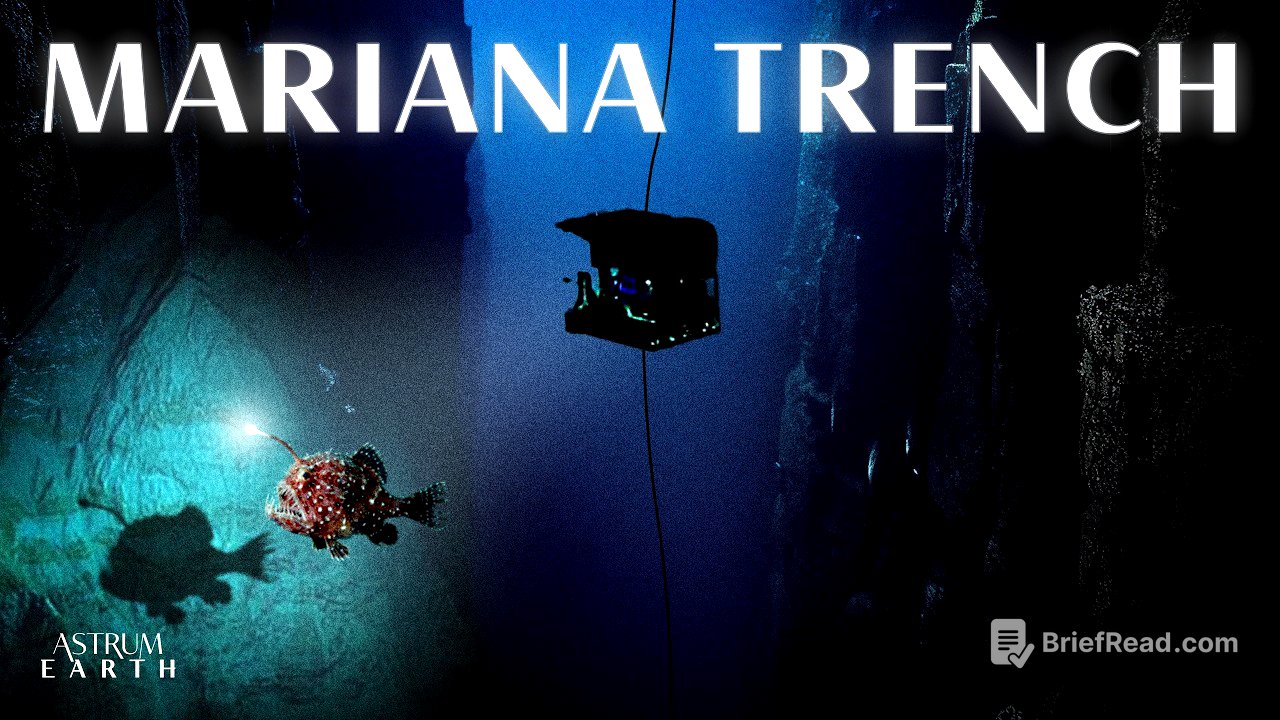
TLDR;
This video explores the mysteries of the Mariana Trench, the deepest part of the world's oceans. It covers its discovery, formation, the extreme conditions within, and the unique life forms that have adapted to survive there. The video also discusses the challenges of exploring such depths and highlights the limited knowledge we have about this vast, unexplored frontier.
- Discovery and Formation: The Mariana Trench was discovered during the HMS Challenger expedition and is formed by the subduction of the Pacific Plate under the Philippine Plate.
- Extreme Conditions: The trench has immense pressure and near-freezing temperatures.
- Unique Life Forms: Creatures have adapted to the extreme conditions, including giant amphipods, translucent sea pigs, and specialized microorganisms.
- Exploration Challenges: The video emphasizes the difficulties in exploring the trench and the limited scientific exploration compared to space exploration.
The Mystery of the Mariana Trench [0:00]
The Mariana Trench is a dark, cold, and highly pressurized environment located deep in the Pacific Ocean. It was once believed to be devoid of life due to its extreme conditions, which can destroy living cells and dissolve bones. However, life has been found at these depths, with unique adaptations to this environment. Much of our knowledge about the trench comes from remote probes and occasional deep-sea fishing catches. The creatures retrieved are often distorted or destroyed when removed from their natural habitat, making it difficult to understand their true form and behavior. The deep ocean floors remain the last unexplored frontier on our planet.
Finding the Mariana Trench [2:10]
The Mariana Trench was discovered about 150 years ago by the British ship HMS Challenger during the first mapping of the ocean floors. While taking soundings 2,000 km east of the Philippines, the crew found that the ocean depth exceeded 8 km. This discovery marked what is now known as the Mariana Trench. A little further west lies the Challenger Deep, the deepest point on Earth, reaching a depth of 11 km. The Mariana Trench is a vast, curved valley on the ocean floor, approximately 2,000 km long and 70 km wide, beginning south of Japan and extending towards the Philippines. The Challenger Deep alone could swallow up five Grand Canyons.
How Did the Mariana Trench Form? [6:59]
The Mariana Trench is part of a series of unstable chasms in the Earth's crust encircling the Pacific Ocean, accompanied by a ring of volcanoes. These formations are responsible for 90% of all earthquakes. The Earth's surface consists of continents and oceans, with continents being thick, ancient layers of rock and ocean crust being thinner and younger, made from solidified magma. The continents and ocean floors move due to thermal currents in the magma below. The Atlantic Ocean is expanding as the Americas move away from Africa and Europe, creating new ocean floor. Conversely, the Pacific Ocean is shrinking as the Americas move closer to Asia and Australia. The ocean floor is forced downwards, sinking under the continents in a process called subduction, which recycles the Earth's crust. This process creates earthquakes, volcanoes, and deep ocean trenches. The Pacific plate, the oldest ocean crust, subducts under the Philippines plate, creating the Mariana Trench.
Extreme Pressure [14:03]
Exploring the depths of the Mariana Trench presents significant challenges, with the most formidable being the extreme pressure. At such depths, the pressure is more than a thousand times that at the surface, equivalent to a ton weight on a thumbnail, which can destroy most living cells. The destructive power of this pressure is so immense that even equipment designed for these depths can fail catastrophically. For example, in 2014, an unmanned deep-sea exploration vehicle, Nerius, imploded during a dive into the Kermadec Trench. Military submarines can only safely dive to around 1,500 meters, highlighting the need for specialized equipment to reach the bottom of the Mariana Trench.
Who Has Explored the Mariana Trench? [15:18]
In 1960, Don Walsh and Jacques Picard made the first successful descent into the Mariana Trench in the Trieste, a specialized bathyscaphe. During their descent, they heard a loud bang, later discovering that one of the plexiglass window blocks had cracked. Despite this, they continued to the bottom, where they observed what they believed to be a flatfish, now thought to be a sea cucumber. They stayed for only 20 minutes before ascending, and no one repeated their dive for another half-century. In 2012, James Cameron made the first solo dive into the Challenger Deep in the Deep Sea Challenger. Since then, there have been about 20 more dives into the Challenger Deep. In 2021, Hamish Harding made the longest and deepest dive into the Challenger Deep. The tragic implosion of the Titan submarine in 2023, which resulted in the death of Harding and four others, serves as a reminder of the dangers of deep-sea exploration.
The Journey Begins [18:10]
The journey into the Mariana Trench begins with a descent into the epipelagic zone, where sunlight floods the water, supporting photosynthesis and the base of the ocean food chain. Phytoplankton produce half the oxygen we breathe and are consumed by zooplankton, which in turn are eaten by larger animals. This zone is where many food fish, such as tuna, herring, and cod, are found.
The Twilight Zone [19:54]
As one descends deeper, light diminishes, and the water becomes darker and more blue, marking the transition into the twilight zone (mesopelagic or dysphotic zone) at around 200 meters. Here, there is insufficient light for photosynthesis, and the water is much colder. Bioluminescence, light produced by marine life, becomes visible. The biomass of fish in this zone is believed to be as much as the rest of the ocean combined. The most abundant vertebrate on the planet, the bristle mouth fish, lives in these waters, feeding mainly on zooplankton.
The Midnight Zone [21:25]
Deeper still, the last faint blue light disappears, and the water becomes completely dark, entering the bathypelagic zone, or midnight zone, at 1 kilometer down. Bioluminescence is prominent, used by species to find mates and hunt. The temperature is a steady 4°C, and the pressure is dangerous. Creatures in this zone have adapted to the cold, dark waters and great pressure.
Creatures of the Deep [23:00]
In the midnight zone, strange-looking creatures with enormous eyes, like the owl fish and barrel eyes, have adapted to see in near-total darkness. Others, like the small eye snipe eel, have reduced their reliance on sight, using pressure sensors to detect movement. The angler fish uses bioluminescence to lure prey. The giant squid, with the largest eyes of any animal, inhabits these depths. Deep-sea gigantism is common, where species grow larger due to the scarcity of food and reduced predation. Examples include the chimera (ghost shark) and the pelican eel, which can swallow prey larger than itself. The lancet fish is a predatory hunter in this zone.
The Hadal Zone [26:31]
Beyond the midnight zone lies the hadal zone, named after Hades, the Greek god of the underworld. It is characterized by darkness, immense pressure, and near-freezing temperatures. Cold water currents from Antarctica flow through these deep trenches, crucial for global weather and climate. Life forms here rely on this constant supply of cold, pressurized water to access more oxygen. The seafloor is covered in fine silt, and microbial ooze on rock formations uses chemosynthesis, deriving energy from chemical reactions rather than sunlight. Giant amphipods and translucent sea pigs scavenge for scarce organic matter. Mariana snailfish and cusk eels are the deepest known fish on Earth. Xenophyophores, single-celled organisms that grow to a large size, are also found here. Studying these extreme life forms provides insights into how cells adapt and function, potentially leading to new medical treatments.
The Bottom of the Ocean [31:29]
Descending further into the deepest waters of the Mariana Trench, life becomes even scarcer. It is believed that the water is too deep for any fish, but this remains uncertain due to limited exploration. Only 27 people have visited the Challenger Deep, and most dives have been for tourism rather than scientific research. Tying a dead fish to a pole to attract creatures provides limited information. Only 400 species have been identified in the hadal zone, compared to thousands in a typical freshwater lake. The deep oceans are remote, vast, and require equipment that can withstand exceptional conditions. Despite advancements in space exploration, much remains unknown about the deepest parts of our own planet.