TLDR;
This video explores the history, practices, and evolution of alchemy, distinguishing it from modern chemistry while acknowledging their shared origins. It covers alchemy's development from Hellenic Egypt through the Islamic world and into Europe, highlighting key figures, theories like the sulfur and mercury theory, and the shift in understanding from physical transmutation to spiritual metaphor. The video also addresses common misconceptions and the modern reinterpretation of alchemy, particularly influenced by Carl Jung.
- Alchemy's origins lie in Hellenic Egypt, blending practical arts with Greek philosophy.
- Islamic scholars, notably Jabir ibn Hayyan, significantly advanced alchemical theories and practices.
- Alchemy in medieval Europe was closely tied to religious institutions and figures, with a focus on both transmutation and medicine.
- The decline of alchemy in the 18th century led to its separation from chemistry and modern reinterpretations emphasizing spiritual transformation.
Intro [0:01]
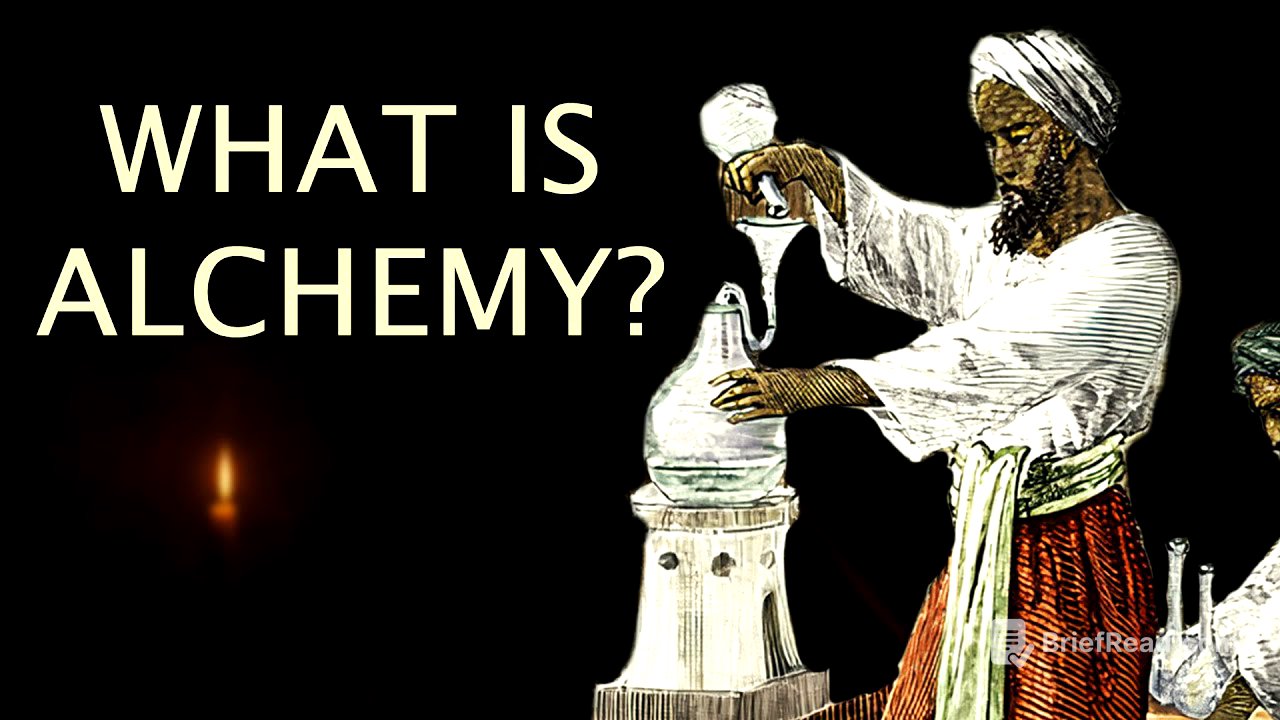
Alchemy is often portrayed in popular culture through various media, but its true nature, history, and practices are complex. The video aims to explore alchemy's origins, its relationship with modern chemistry, and whether it is primarily a magical practice or has scientific underpinnings. The discussion will cover alchemy's historical phases, from its beginnings in Hellenic Egypt to its golden age in Europe, with a focus on Islamic alchemy.
The Origins of Alchemy [4:42]
The earliest examples of alchemy can be traced back to the first centuries of the first millennium AD in Hellenic Egypt, a region influenced by Greek culture and language. This environment fostered the development of hermeticism, neoplatonism, gnosticism, and alchemy. Alexandria was a particularly significant center where the earliest forms of alchemy emerged, initially focused on imitating precious materials like gold, as seen in the writings of pseudo-Democritus. Over time, the goal shifted towards actually creating gold, a practice known as chrysopia.
Zosimus & Philosophical foundations [7:08]
Zosimus of Panopolis is considered the earliest major figure in the alchemical tradition, with surviving writings that provide detailed descriptions of transmutation techniques. Zosimus viewed metals as composed of two principles: body (soma) and spirit (puma), where the spirit gives metals their characteristics. This theoretical foundation suggests that metals can be transformed by separating and manipulating these principles. This view was influenced by Greek philosophical theories, including Aristotle's ideas, and the concept of monism, represented by the Ouroboros symbol, indicating that all substances are made of the same fundamental essence.
Islamicate alchemy [12:37]
Alchemy reached maturity in the Islamic context, with Arabic-speaking scholars developing the art further. The very name "alchemy" originates from the Arabic term "al-kimiya." The origins of alchemy in the Islamic world are somewhat obscure, but many sources suggest that the Shi'a movement was a breeding ground for its development, as Shiism was associated with esoteric and occult knowledge. As Arabs and Muslims spread across the Middle East and Mediterranean, they translated and studied Greek and other texts, incorporating them into their knowledge base.
Jabir ibn Hayyan [15:50]
Jabir ibn Hayyan, known in Latin as Geber, is a central figure in the history of Islamic alchemy, though his historical reality is debated. Writings attributed to Jabir introduced the sulfur and mercury theory of metals, which became a standard theoretical foundation for alchemy. Jabir argued that all metals are made up of sulfur and mercury in different configurations, influencing alchemical theory for centuries. Jabir also connected these theories with Aristotelian elements, theorizing that materials and metals could be reduced to their simplest elements and principles, which could then be used to create transmuting substances.
Hermes & Hermetism [23:12]
During the Islamic period, alchemy became increasingly connected with Hermes and hermeticism. Hermes Trismegistus, the legendary sage of the Hermetica, became associated with the Quranic prophet Idris, giving him a position within Islamic sacred history. Hermes was identified as the originator and master of alchemy, and many hermetic texts composed in Arabic had direct connections with alchemy. The Emerald Tablet, a foundational text of alchemy, was associated with Hermes and contained the famous phrase "as above, so below," reflecting the concept of microcosm and macrocosm.
Chymistry? [27:12]
The categories of alchemy and chemistry were not separated until the modern period; before this, they were seen as one and the same, a phase denoted as "chymistry." This included both the alchemical goal of transmuting metals and other experiments with natural substances. This broader perspective is evident in the work of Islamic alchemists like Abu Bakr al-Razi.
Abu Bakr al-Razi [28:19]
Abu Bakr al-Razi, a 10th-century philosopher and scientist, is known for giving alchemy a more scientific outlook based on empirical investigation. His books describe techniques such as distillation and sublimation, and he classified substances into influential categories. Al-Razi's use of alchemy was broader than just transmutation, encompassing anything that could be called chemical.
Ibn Umail [31:17]
Muhammad ibn Umail al-Tamimi represents a more mystical approach to alchemy compared to al-Razi's empiricism. Ibn Umail, likely an Ismaili, aimed to explain the symbolic language used by alchemical sages on a mystical and spiritual level. While acknowledging the physical aspect of alchemy, his focus was on providing a key for the mystical understanding and reading of alchemical texts.
Alchemy in Sufism [34:21]
Alchemical language and symbolism have been used in the context of spiritual practice and transformation, particularly in Sufism, or Islamic mysticism. Alchemical language of purification of metals is used as a metaphor for the purification of the heart or soul. Sufi masters like Ibn Arabi used alchemical concepts to describe the transformation of the soul and its journey towards perfection, viewing the philosopher's stone as a spiritual inspiration that can transform anyone to spiritual perfection.
Sceptics of Alchemy [39:33]
Not everyone was a proponent of alchemy. Ibn Sina, a prominent Islamic philosopher and physician, was critical of chrysopia and the possibility of metallic transmutation. Despite his involvement with chemistry and alchemy, he denied the reality of transmuting metals, influencing many others.
Alchemy in medieval Europe [40:38]
The knowledge and experimentation of alchemy from the Islamic world spread to Europe in the later Middle Ages, leading to another golden era during the Renaissance and early modern periods. Alchemy was enthusiastically adopted, driven by the allure of creating gold and its potential political and economic benefits. Figures like Roger Bacon defended alchemy as a divine science, strengthening Christendom and faith. Religious institutions, especially Franciscans, were widely involved in alchemical activities.
Golden age of Alchemy in Europe [51:11]
Alchemy grew into a major field of interest and practice in Europe by the early modern period. The inherited writings and ideas from Arab Islamic writers were expanded upon and adjusted to the new cultural context. The basics remained a huge interest in Chrysapea and the transmutation of base metals into gold particularly by being able to create the sought-after philosopher stone. Paracelsus revolutionized medicine by rejecting traditional practices and emphasizing chemistry, adding salt as a third central ingredient alongside mercury and sulfur.
The Decline of Alchemy [55:47]
Alchemy experienced a rapid decline in popularity in the 18th century, losing credibility within a few decades. New scientific findings demonstrated the impossibility of chrysopia, undermining the theoretical foundations of alchemy. This led to the separation of alchemy and chemistry, with alchemy being associated with irrational practices and chemistry with useful ventures like medicine.
Modern reinterpretations [57:43]
The discovery of the impossibility of transmutation led to reinterpretations of alchemy's nature. Figures like Mary Anne Atwood argued that alchemical descriptions were veiled language for self-transmutation. This view was picked up by the Theosophical Society and became popular in Western esotericism. Carl Jung further popularized the idea that alchemy was primarily an art of transforming the psyche, influencing the modern understanding of alchemy.
Conclusions [1:00:00]
Today, alchemy is often viewed either as a dark, esoteric practice or as a metaphor for spiritual transformation, neither of which fully captures its historical reality. Alchemy has always had an air of secrecy, but it was also a branch of natural science, widely known and sometimes sponsored by institutions. The distinction between alchemy and chemistry is a modern one, and understanding the history of alchemy helps to understand the complexities of history and human society.