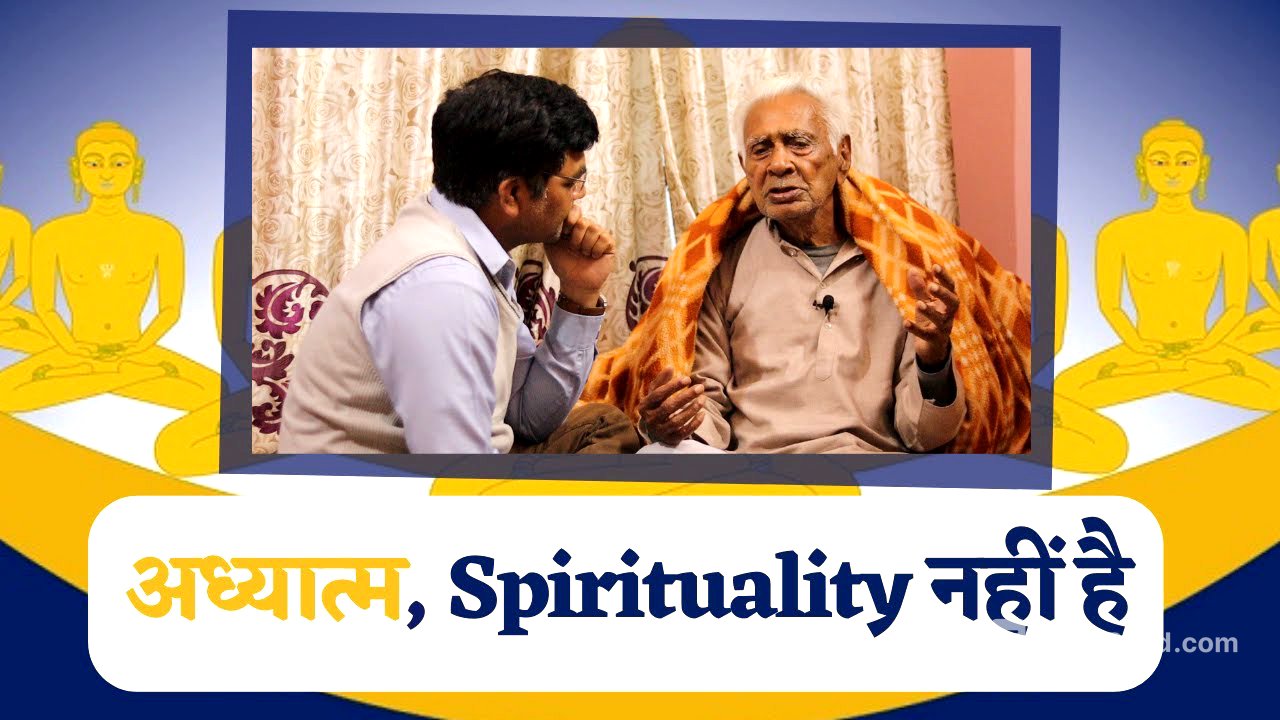
TLDR;
This video explores the true meaning of "Adhyatma" (spirituality) and its significance in life. It challenges conventional interpretations, emphasizing that genuine spirituality is rooted in morality and the pursuit of truth and justice. The discussion references Yoga, Mahatma Gandhi, Karl Marx, and B.R. Ambedkar to illustrate how true spiritual awakening involves standing against exploitation and fighting for what is right.
- True spirituality is rooted in morality.
- Spiritual awakening involves standing against exploitation and fighting for justice.
- The concept of "Adhyatma" is often misunderstood and misrepresented.
Introduction [0:00]
The video begins with a discussion about the importance of morality in spirituality. It asserts that one cannot be truly spiritual without being moral. The speaker criticizes those who claim to be spiritual but lack moral principles, labeling their practices as hypocritical.
Understanding the Meaning of Adhyatma [0:41]
The discussion defines "Adhyatma" as having faith in the soul, understanding its nature, and recognizing it as the foundation of life. It emphasizes the soul's eternal and supreme nature, contrasting it with the impermanence of physical things. The speaker clarifies that the English term "spirituality" doesn't fully capture the essence of "Adhyatma," as "spirit" doesn't equate to "atma" (soul).
The Misinterpretation of Adhyatma in Education [3:00]
The video recounts an incident where the University Grants Commission (UGC) sought to incorporate spiritual education into schools. The speaker describes a conference where educators and religious figures debated the meaning of "Adhyatma." Many attendees equated spirituality with outward displays like wearing religious attire and performing rituals. The speaker argued that true spirituality, as taught in Yoga, requires adherence to "Yamas" (moral restraints) and "Niyamas" (observances).
The Role of Morality in Spiritual Practice [6:08]
The speaker asserts that morality is essential for spiritual growth, referencing Patanjali's Yoga Sutras, which state that one cannot achieve Samadhi (a state of meditative consciousness) without practicing "Yamas" and "Niyamas." He explains that moral principles like truthfulness (Satya) and non-stealing (Asteya) are integral to spiritual development. True truthfulness involves aligning one's thoughts, speech, and actions. Non-stealing extends to not desiring what one doesn't have a right to.
Critique of Superficial Spirituality [9:22]
The speaker criticizes superficial displays of spirituality, such as wearing religious symbols while engaging in unethical behavior. He references Mahatma Gandhi's views on spirituality, stating that Gandhi didn't consider those who merely wore religious attire as spiritual. Instead, Gandhi believed that a truly spiritual person is one who can stand for truth and justice through Satyagraha (nonviolent resistance).
Gandhi's Interpretation of Spiritual Awakening [10:56]
Gandhi believed that the first instance of Satyagraha was demonstrated by the vulture Jatayu in the Ramayana. When Sita was abducted, Jatayu, unlike the sages who claimed to be detached from worldly affairs, fearlessly confronted Ravana. Gandhi emphasized that spiritual awakening is marked by the courage to stand against injustice, even at the cost of one's life.
Spirituality in Marxism and Ambedkarism [14:46]
The speaker challenges the notion that Karl Marx was purely materialistic, stating that Marx used the concept of "spiritualism" to empower the oppressed. Marx believed that spiritual power awakens when people stand against injustice. He argued that no one can be exploited unless they are willing to be exploited, advocating for a moral force that resists exploitation. Similarly, B.R. Ambedkar sought to awaken the spiritual strength of the Dalit community, asserting that no one can exploit them if they refuse to be exploited.
Redefining Adhyatma [17:03]
The speaker concludes by emphasizing that "Adhyatma" is often misunderstood and misrepresented. He contrasts the true essence of spirituality, as exemplified by Gandhi, Marx, and Ambedkar, with superficial practices like forced meditation in schools. True spirituality involves empowering people to resist exploitation and stand for justice.
Concluding Thoughts on Spirituality [17:51]
The speaker summarizes that the spiritual is not another world, like Plato's world of ideas, but a force. He suggests that both religious and non-religious individuals seek this force, which can lead to revolutionary change. The discussion concludes with a call for a comprehensive understanding of "Adhyatma" that incorporates diverse perspectives, including those of philosophers, Marxists, Gandhians, and Yoga practitioners.
![If I Wanted To Become a Millionaire in 2025, This Is What I'd Do [FULL BLUEPRINT]](https://wm-img.halpindev.com/p-briefread_c-10_b-10/urlb/aHR0cDovL2ltZy55b3V0dWJlLmNvbS92aS9BTjJLcFJCc21SWS9ocWRlZmF1bHQuanBn.jpg)