TLDR;
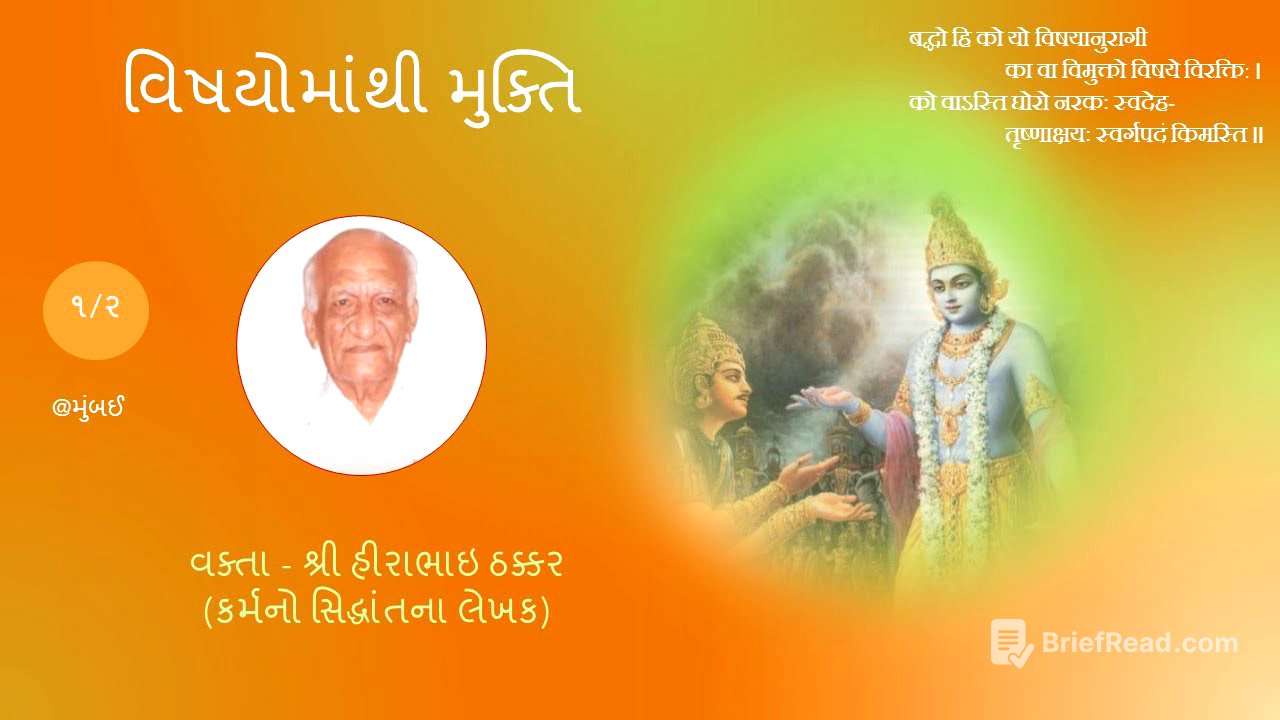
This video explores the concept of Moksha (liberation) in human life, contrasting it with the pursuit of sensory pleasures. It emphasizes that true liberation comes from freeing oneself from the attachments to the senses and worldly desires, rather than seeking external achievements or physical comforts. The discourse uses analogies and examples to illustrate how humans become bound by their senses and how detachment leads to genuine freedom.
- Moksha is the ultimate goal of human life, distinct from the experiences of animals.
- True freedom comes from detaching from sensory pleasures and worldly desires.
- Understanding and breaking free from the bonds of the senses is essential for achieving liberation.
Introduction [0:00]
The video starts with a devotional chant.
The Essence of Moksha [2:30]
The speaker discusses the concept of Moksha, the ultimate goal of human life, which is to attain liberation. Unlike animals that live to fulfill desires, humans have the unique ability to achieve Moksha. The speaker questions the common understanding of Moksha, challenging whether it is merely a geographical location or a state of being. He stresses that accumulating wealth or indulging in sensory pleasures is not the ultimate aim of human existence.
Sensory Pleasures vs. True Happiness [6:19]
The speaker contrasts sensory pleasures with true happiness, noting that while humans often seek इंद्रिय जन्य सुख (sensory pleasures), these are fleeting and can lead to दुखी (sorrow). He argues that if the purpose of human life is solely to indulge in sensory pleasures, then it is no different from the lives of animals. True fulfillment lies in recognizing and pursuing the विशेष चरम लक्ष्य (ultimate goal) of Moksha.
Understanding Bondage to Achieve Freedom [8:12]
The speaker explains that to achieve मुक्ति (freedom), one must first understand बंधन (bondage). He questions what truly binds us and emphasizes that liberation is not about physical freedom but about freeing oneself from internal attachments. The speaker suggests that many people talk about Moksha without truly understanding what they need to be liberated from.
The Nature of True Liberation [10:54]
The speaker elaborates on the nature of true liberation, stating that it is not about achieving something new but about realizing one's inherent state of freedom. He emphasizes that the effort should be directed toward breaking the bonds that keep us from recognizing our true, मुक्त (free) स्वरूप (nature). The speaker uses the analogy of a person in jail, pointing out that true freedom is not just about leaving the physical prison but about freeing oneself from internal constraints.
The Illusion of Worldly Attachments [12:48]
The speaker critiques the pursuit of worldly comforts and pleasures, suggesting that even if one attains great सुख (happiness) in life, it is temporary and ultimately leads to दुख (sorrow). He uses the example of people who become engrossed in acquiring wealth and possessions, only to leave them behind at the time of death. The speaker questions whether such a life is truly fulfilling.
Moksha and the Saints [14:59]
The speaker discusses how saints talk about Moksha and emphasizes that to be truly मुक्त (free), one must understand what binds them. He reiterates that liberation is not about achieving something new but about breaking free from the bonds that prevent us from realizing our true nature. The speaker stresses that the effort should be directed toward understanding and breaking these bonds.
An Illustrative Story [15:55]
The speaker shares a story about a Mahatma (great soul) and his disciple encountering a police officer. The story illustrates how people often fail to recognize their own बंधन (bondage) and instead focus on external matters. The speaker uses this story to highlight the importance of self-awareness in the pursuit of Moksha.
The Nature of Bondage [17:54]
The speaker emphasizes that liberation is not about achieving something new but about breaking free from the bonds that prevent us from realizing our true nature. He reiterates that the effort should be directed toward understanding and breaking these bonds. The speaker stresses that मुक्ति (freedom) is always available, but we must make the प्रयास (effort) to break free from our बंधन (bondage).
The Source of Bondage: The Senses [18:29]
The speaker identifies the इंद्रियों (senses) and their विषयो (objects) as the primary source of बंधन (bondage). He explains that Moksha is essentially about freeing oneself from the attachments to these senses and their objects. The speaker emphasizes that this liberation is not about going to a specific place or performing certain rituals but about detaching from sensory desires.
Understanding and Studying the Self [19:11]
The speaker encourages a study-based approach to understanding the self and the nature of बंधन (bondage). He suggests that instead of relying on कथाकार (storytellers) or बाहरी महात्मा (external great souls), individuals should engage in self-study to understand their own limitations and attachments. The speaker emphasizes that true liberation comes from within.
The Illusion of External Freedom [20:09]
The speaker clarifies that true मुक्ति (freedom) is not about physical freedom but about freeing oneself from internal attachments. He uses the analogy of a jailer and a prisoner to illustrate that even if one is physically free, they may still be bound by internal constraints. The speaker emphasizes that liberation is about freeing oneself from the desires and attachments that bind us.
Shankara's Teachings on Liberation [20:59]
The speaker references शंकराचार्य (Shankara) and his teachings on liberation, particularly his work "Mani Ratna Mala." He explains that this text presents a series of questions and answers that explore the nature of बंधन (bondage) and मुक्ति (freedom). The speaker emphasizes that the key to liberation lies in understanding what binds us and freeing ourselves from those attachments.
The Human Potential for Liberation [21:48]
The speaker emphasizes that the possibility of मुक्त थवानी (becoming free) is unique to मनुष्य (humans). He contrasts this with पशु (animals), suggesting that while animals are bound by their instincts, humans have the capacity to transcend these limitations and achieve liberation. The speaker reiterates that the चरम लक्ष (ultimate goal) of human life is to attain मुक्ति (freedom).
Defining Bondage and Liberation [22:12]
The speaker defines बंधन (bondage) as being attached to इंद्रियों ना विषयो (objects of the senses) and विमुक्ति (liberation) as विषय विरक्ति (detachment from sensory objects). He explains that as long as one is भटक (wandering) in the pursuit of sensory pleasures, they are bound. True मुक्ति (freedom) comes from वैराग्य (detachment) and तीव्र वैराग्य (intense detachment) from these pleasures.
The Importance of Breaking Free from Bondage [23:09]
The speaker reiterates the importance of breaking free from बंधन (bondage), emphasizing that as long as one is bound by इंद्रियो विषय बंधन (sensory attachments), they cannot achieve true मुक्ति (freedom). He uses the analogy of a bird with पाज (shackles) to illustrate that even if one has access to भौतिक सुखो (material comforts), they are still bound. The speaker stresses that the key to liberation is to कटत (cut) these बंधन (bonds).
Recognizing and Addressing Bondage [24:10]
The speaker emphasizes the importance of recognizing बंधन (bondage) before attempting to मुक्त (free) oneself. He uses the analogy of a person with a माथू चड़ (headache), suggesting that one must first understand the cause of the pain before seeking a remedy. The speaker stresses that self-awareness is essential for breaking free from बंधन (bondage).
The Illusion of Strengthening Bondage [25:42]
The speaker warns against strengthening बंधन (bondage) by becoming more attached to sensory pleasures. He uses the analogy of a person wearing बेड़ी (chains) and then धारे मजबूत करवा (making them stronger). The speaker emphasizes that true मुक्ति (freedom) comes from breaking these chains, not reinforcing them.
A Story of a President Visiting a Jail [26:07]
The speaker shares a story about a president visiting a jail to illustrate the concept of बंधन (bondage) and मुक्ति (freedom). The story highlights how prisoners often focus on minor comforts and conveniences rather than seeking true liberation. The speaker uses this story to emphasize that true मुक्ति (freedom) comes from within, not from external circumstances.
The Desire for Liberation [29:36]
The speaker emphasizes that unless there is a genuine इच्छा (desire) for मुक्त थवानी (becoming free), बंधन (bondage) will not be cut. He uses the example of a पोपट (parrot) in a पांजरा (cage) that does not desire to be free. The speaker stresses that the first step toward मुक्ति (freedom) is to develop a genuine longing for liberation.
The Misconceptions of Moksha [30:13]
The speaker addresses common misconceptions about Moksha, such as equating it with material possessions or worldly achievements. He emphasizes that true मुक्ति (freedom) is not about acquiring more but about detaching from desires. The speaker uses the example of a person who is खावा (eating) to illustrate that true fulfillment comes from within, not from external pleasures.
The Story of Narasingh Mehta, Tukaram, and Mira [31:02]
The speaker shares a story about नरसिंह मेहता (Narasingh Mehta), तुकाराम (Tukaram), and मीरा (Mira) to illustrate the concept of बंधन (bondage) and मुक्ति (freedom). The story highlights how these saints were able to transcend worldly attachments and achieve true liberation. The speaker uses this story to emphasize that true मुक्ति (freedom) comes from within, not from external circumstances.
The Nature of True Freedom [35:38]
The speaker reiterates that true मुक्ति (freedom) is about realizing one's सचिदानंद स्वरूप (true nature). He uses the analogy of a person traveling on a train without a ticket to illustrate the importance of understanding the purpose of one's journey. The speaker emphasizes that true मुक्ति (freedom) comes from within, not from external circumstances.
The Cycle of Birth and Death [37:01]
The speaker discusses the cycle of जन्म (birth) and मृत्यु (death), emphasizing that unless one breaks free from बंधन (bondage), they will continue to चक्र में फरिया (wander in the cycle). He uses the example of patients in a hospital to illustrate that true मुक्ति (freedom) comes from within, not from external circumstances.
The Story of Jawaharlal Nehru [37:28]
The speaker shares a story about जवाहरलाल नेहरू (Jawaharlal Nehru) visiting a hospital to illustrate the concept of बंधन (bondage) and मुक्ति (freedom). The story highlights how patients often focus on minor comforts and conveniences rather than seeking true liberation. The speaker uses this story to emphasize that true मुक्ति (freedom) comes from within, not from external circumstances.
The Nature of Attachment [39:51]
The speaker emphasizes that बंधन (bondage) is a result of attachment to worldly relationships and possessions. He explains that we have had अनेक जन्म (many births) and अनेक पत्नी (many wives) and अनेक दरा (many children) in the past. The speaker stresses that true मुक्ति (freedom) comes from detaching from these attachments.
The Creation of One's Own World [40:39]
The speaker explains that we create our own संसार (world) through our कर्म (actions). He emphasizes that the जगत (universe) is created by परमात्मा (God), but the संसार (world) is created by us. The speaker stresses that true मुक्ति (freedom) comes from detaching from this self-created संसार (world).
The Nature of the World [42:23]
The speaker clarifies that the संसार (world) is not the same as the जगत (universe). He explains that the जगत (universe) is created by परमात्मा (God), but the संसार (world) is created by us. The speaker stresses that true मुक्ति (freedom) comes from detaching from this self-created संसार (world).
The Cycle of Karma [43:38]
The speaker discusses the cycle of कर्म (karma), explaining that our actions in past lives determine our present circumstances. He emphasizes that true मुक्ति (freedom) comes from breaking free from this cycle of कर्म (karma). The speaker uses the example of a child who is खराब (bad) to illustrate that the child's behavior is a result of past कर्म (karma).
The Nature of Maya [47:56]
The speaker describes the nature of माया (illusion), explaining that it is like a सर्प (snake) that दष्ट (bites) us. He emphasizes that true मुक्ति (freedom) comes from recognizing and detaching from this माया (illusion). The speaker uses the analogy of a tree with roots and branches to illustrate the nature of माया (illusion).
The Path to Liberation [52:36]
The speaker reiterates that true मुक्ति (freedom) comes from detaching from ्र विषय (sensory objects). He emphasizes that असक्ति (attachment) is the root cause of बंधन (bondage). The speaker stresses that true मुक्ति (freedom) comes from अस (detachment) and विरक्ति (renunciation).
The Nature of Bondage and Liberation [53:08]
The speaker summarizes the nature of बंधन (bondage) and मुक्ति (freedom), explaining that बंधन (bondage) is a result of attachment to संसार (world) and मुक्ति (freedom) is a result of detaching from संसार (world). He emphasizes that true मुक्ति (freedom) comes from recognizing and detaching from our own कर्म (actions).
The Importance of Understanding Bondage [54:26]
The speaker emphasizes the importance of understanding बंधन (bondage) before attempting to मुक्त (free) oneself. He references the गरु पुराण (Garuda Purana) to illustrate the nature of बंधन (bondage). The speaker stresses that self-awareness is essential for breaking free from बंधन (bondage).
The Five Senses and Their Objects [55:35]
The speaker discusses the five senses (शब्द, स्पर्श, रूप, रस, गंध) and their corresponding objects. He explains that attachment to these senses and their objects leads to बंधन (bondage). The speaker uses the example of कुरंग (deer), मातंग (elephant), पतंग (moth), मीना (fish), and भ्रमर (bee) to illustrate how each of these creatures is trapped by a single sense.
The Deer and Sound [56:13]
The speaker explains how the कुरंग (deer) is trapped by शब्द (sound). He describes how hunters use संगीत (music) to lure the deer and capture it. The speaker emphasizes that attachment to शब्द (sound) can lead to बंधन (bondage).
The Elephant and Touch [57:58]
The speaker explains how the मातंग (elephant) is trapped by स्पर्श (touch). He describes how hunters use a बकेली (decoy) to lure the elephant and capture it. The speaker emphasizes that attachment to स्पर्श (touch) can lead to बंधन (bondage).
The Moth and Sight [59:45]
The speaker explains how the पतंग (moth) is trapped by रूप (sight). He describes how the moth is attracted to the flame and flies into it, burning itself. The speaker emphasizes that attachment to रूप (sight) can lead to बंधन (bondage).
The Fish and Taste [1:04:58]
The speaker explains how the मीना (fish) is trapped by रस (taste). He describes how the fish is lured by bait and caught on a hook. The speaker emphasizes that attachment to रस (taste) can lead to बंधन (bondage).
The Bee and Smell [1:07:06]
The speaker explains how the भ्रमर (bee) is trapped by गंध (smell). He describes how the bee is attracted to the fragrance of a flower and becomes trapped inside. The speaker emphasizes that attachment to गंध (smell) can lead to बंधन (bondage).
The Illusion of Freedom [1:09:18]
The speaker reiterates that true मुक्ति (freedom) comes from recognizing and detaching from our असल स्वरूप (true nature). He uses the analogy of a कीर (parrot) and मरकट (monkey) to illustrate the illusion of freedom. The speaker emphasizes that true मुक्ति (freedom) comes from within, not from external circumstances.
The Parrot and the Wooden Log [1:10:22]
The speaker shares a story about a parrot and a wooden log to illustrate the concept of बंधन (bondage) and मुक्ति (freedom). The story highlights how the parrot becomes attached to the wooden log and is unable to fly away. The speaker uses this story to emphasize that true मुक्ति (freedom) comes from detaching from worldly attachments.
The Nature of Avidya [1:11:06]
The speaker discusses the nature of अविद्या (ignorance), explaining that it is the root cause of बंधन (bondage). He references डॉक्टर राधा कृष्ण (Dr. Radha Krishnan) and his book on ब्रह्म सूत्र (Brahma Sutra) to illustrate the nature of अविद्या (ignorance). The speaker emphasizes that true मुक्ति (freedom) comes from overcoming अविद्या (ignorance).
The Importance of Understanding the Self [1:12:33]
The speaker emphasizes the importance of understanding the self and the nature of बंधन (bondage). He uses the analogy of a tree with roots and branches to illustrate the nature of संसार (world). The speaker stresses that true मुक्ति (freedom) comes from detaching from this self-created संसार (world).
The Nature of Maya and the Ocean of Births [1:13:58]
The speaker describes माया (illusion) as an ocean filled with births, emphasizing the vastness and complexity of the cycle of reincarnation. He explains that this ocean is not just a physical entity but a mental construct, a product of our own वि (thoughts) and कल्पना (imagination). The speaker stresses that true मुक्ति (freedom) comes from transcending this ocean of माया (illusion).
The Human Form and the Opportunity for Liberation [1:15:30]
The speaker highlights the significance of the human form (मानव तरी) as a unique opportunity for liberation. He contrasts this with other forms of life, such as animals, which are more controlled by प्रकृति (nature). The speaker emphasizes that humans have the potential to control nature and achieve स्वतंत्रता (freedom).
The Balance of Freedom and Responsibility [1:17:59]
The speaker discusses the balance between स्वतंत्रता (freedom) and जवाबदारी (responsibility). He explains that the more स्वतंत्रता (freedom) one has, the more जवाबदारी (responsibility) they must bear. The speaker emphasizes that true मुक्ति (freedom) comes from accepting and fulfilling one's जवाबदारी (responsibility).
The Importance of Detachment [1:18:32]
The speaker reiterates the importance of detachment from इंद्रिय विष (sensory objects) for achieving मुक्ति (freedom). He explains that attachment to these objects leads to बंधन (bondage). The speaker stresses that true मुक्ति (freedom) comes from detaching from these attachments.
The Essence of Liberation [1:20:57]
The speaker summarizes the essence of liberation, explaining that it is about detaching from कोयो विष (sensory objects) and cultivating विरक्ति (renunciation). He emphasizes that true मुक्ति (freedom) comes from transcending the limitations of the शरीर (body) and realizing one's true nature.
Conclusion [1:21:25]
The speaker concludes by inviting questions and emphasizing the importance of understanding the depth of the subject. He encourages listeners to reflect on the teachings and strive for true मुक्ति (freedom). The video ends with a prayer for peace and well-being.