TLDR;
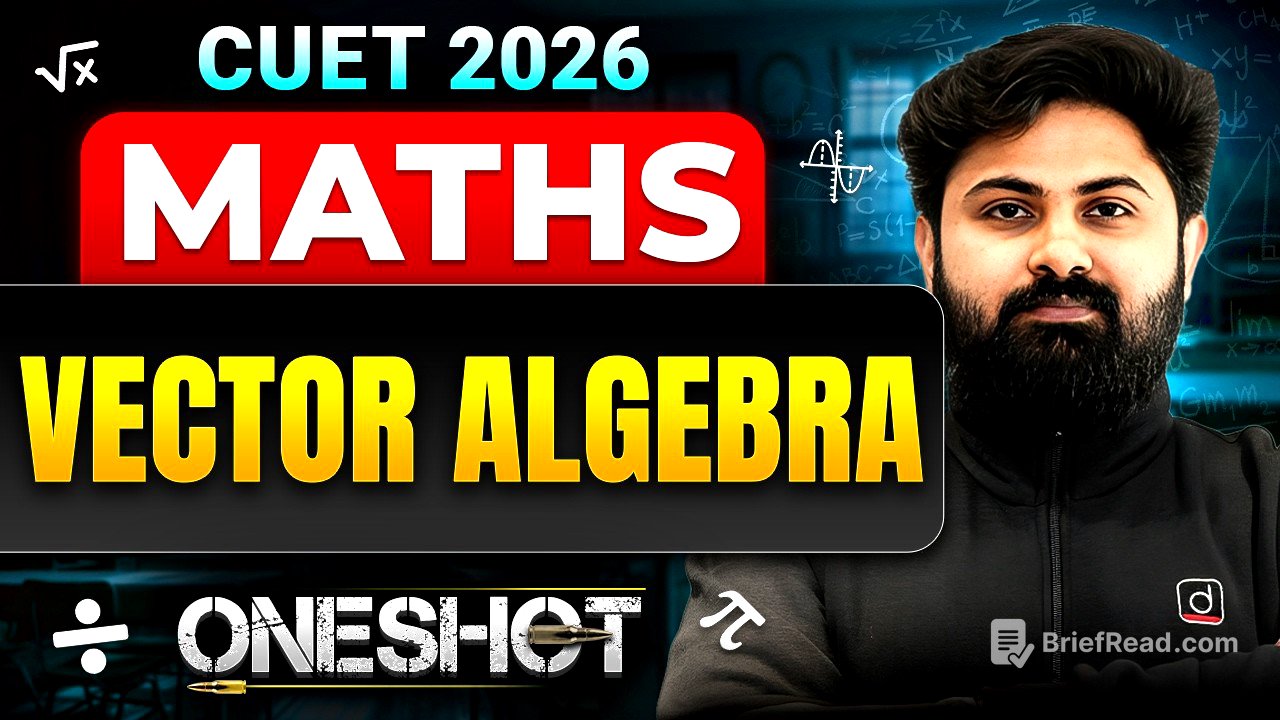
This YouTube video by Drishti CUET provides a comprehensive one-shot lecture on Vector Algebra, tailored for the CUET exam. The lecture covers fundamental concepts, various types of vectors, vector algebra, and geometrical representations, including dot and cross products. The instructor emphasizes a structured approach to understanding the material and focuses on problem-solving with numerous examples and MCQs.
- Covers basics of Vector Algebra for CUET exam.
- Includes various types of vectors and their properties.
- Focuses on dot and cross product with geometrical representation.
- Provides MCQs for practice.
Introduction and Syllabus Discussion [0:00]
The instructor welcomes students to the session, confirming that the audio and video are clear. He introduces the plan for a comprehensive one-shot on Vector Algebra, highlighting its importance and relative ease compared to other topics like matrices. The session aims to cover all possible question types, ensuring students can confidently tackle any problem from the CUET exam. Notes will be available on the Drishti CUET Telegram channel. The lecture aims to provide a complete understanding of Vector Algebra, similar to previous sessions on Differential Equations and AOD, ensuring no questions come from outside the covered material. The instructor emphasizes the need for dedicated focus during the 3-hour session to master the topic and eliminate any fear related to Vector Algebra.
Basics (quantities, Vector and Cartesian notation) [5:31]
The lecture begins by defining physical quantities, differentiating between scalar and vector quantities. Scalar quantities, such as time and distance, possess only magnitude, while vector quantities, like force, torque, velocity, and acceleration, have both magnitude and direction. The discussion transitions to representing Cartesian coordinates in vector form, explaining how to convert coordinates into vectors using i, j, and k notation. For example, the coordinate (2, 3) is written as 2i + 3j.
Position Vector [8:08]
The concept of a position vector is introduced, defining it as the location of a point in space expressed in vector terms, always with respect to a reference point. The lecture explains the importance of the reference point when defining a position vector. Key terminology related to vectors is clarified, including the tail, head, final point, initial point, terminal point, and reference point. The representation of a position vector in terms of coordinates is discussed, such as a vector a = xi + yj + zk, where the position vector is the coordinate (x, y, z). The formula for finding the position vector of a point A with respect to B, denoted as AB = B - A, is presented, along with the relationship AB = -BA.
Magnitude of a vector and it's MCQs [12:29]
The method to calculate the magnitude of a vector a = a1i + b1j + c1k is explained as √(a1² + b1² + c1²). Two important triplets are highlighted for quick calculation: the (2, 2, 1) triplet, which always results in a magnitude of 3, and the (6, -2, 3) triplet, which yields a magnitude of 7. A basic MCQ is presented to practice finding the magnitude of a vector, emphasizing the importance of remembering these triplets for faster calculations.
Types of the vectors [16:04]
The lecture moves on to discuss different types of vectors, starting with free vectors, which can be displaced without changing their magnitude and direction. The discussion covers zero or null vectors, defined as vectors with a magnitude of zero, where the initial and final points are the same. Equal vectors are then explained as vectors with the same magnitude and direction.
Unit Vector & Imp. note [20:15]
The concept of a unit vector is introduced, which is a vector with a magnitude of one, obtained by dividing a vector by its magnitude (â = a / |a|). The importance of a key note is emphasized: to write a vector of magnitude k in the direction of a vector a, use k * (a / |a|).
MCQs on Magnitude [22:59]
Several MCQs are presented to reinforce the concepts of unit vectors and magnitude. These include finding the unit vector in the direction of a sum of vectors, determining the value of x if a given vector is a unit vector, and finding a vector with a specific magnitude in a given direction.
Parallel/Collinear Vector & Imp. Note [28:34]
Two vectors are parallel or collinear if one is a scalar multiple of the other (a = λb). The lecture clarifies why parallel and collinear are used interchangeably in vector algebra, relating it to the properties of free vectors. An important note is presented: if a = a1i + b1j + c1k and b = a2i + b2j + c2k are collinear, then a1/a2 = b1/b2 = c1/c2.
MCQs on Collinearity [34:57]
MCQs are presented to test understanding of collinearity. These include finding the value of λ if three points are collinear. The instructor also demonstrates how to approach collinearity problems using both vector algebra and 2D geometry concepts like slope.
Co Planar Vector [44:19]
Coplanar vectors are defined as vectors lying on the same plane.
Co-Initial Vector [44:39]
Co-initial vectors are defined as vectors sharing the same initial point. Examples are provided to differentiate co-initial vectors from others. A question from CUET 2023 is discussed, involving matching vectors based on properties like co-initiality and equality.
Negative of a vector [48:33]
The negative of a vector is defined as having the same magnitude but opposite direction. It's noted that a vector and its negative are collinear and can be termed anti-parallel.
Algebra of the vector (Vector Addition) [49:35]
Vector addition is explained through two laws: the triangular law and the parallelogram law. The triangular law involves placing vectors head to tail, with the resultant vector connecting the tail of the first to the head of the second. The parallelogram law involves vectors sharing a common tail, forming a parallelogram, with the resultant vector being the diagonal.
Imp. Note 1 [53:37]
In a closed triangle, AB + BC + CA = 0.
Imp. Note 2 and MCQs [54:20]
In a parallelogram, the longer diagonal is a + b, and the shorter diagonal is a - b. If diagonals d1 and d2 are given, the sides can be found as (d1 + d2)/2 and (d1 - d2)/2. A CBT question from 2023 is solved, involving vector addition and properties to identify correct statements.
Component Form of the Vector [59:21]
The component form of vectors is discussed, with i, j, and k representing unit vectors along the x, y, and z axes, respectively. It's noted that |i| = |j| = |k| = 1.
Properties of the Vector Addition [1:01:11]
Properties of vector addition, including commutative and associative laws, are stated. The additive identity is the null vector (a + 0 = a), and the additive inverse is the negative vector (a + (-a) = 0).
Properties of the Scalar Multiplication [1:01:46]
Properties of scalar multiplication are outlined, such as k(a + b) = ka + kb and (k + m)a = ka + ma. The multiplicative identity is 1 (1 * a = a).
Distance formula [1:05:32]
The distance between two points A and B with position vectors A and B is given by |B - A|.
MCQ of Distance Formula [1:07:01]
MCQs are solved using the distance formula, including finding the length of a line segment joining two points and identifying correct vector relationships.
Section Formula [1:08:53]
The section formula is presented: for a point C dividing AB in the ratio m:n, C = (mB + nA) / (m + n) for internal division and C = (mB - nA) / (m - n) for external division. The midpoint formula is a special case with m = n = 1, resulting in C = (A + B) / 2.
MCQs on Section Formula [1:14:04]
MCQs are solved using the section formula, including finding the position vector of a point dividing a line segment in a given ratio. The method to find an unknown ratio is explained: assume the ratio is λ:1, apply the internal division formula, and use given conditions to find λ. If λ is positive, the division is internal; if negative, it's external.
Centroid of A triangle [1:20:22]
The centroid of a triangle is defined as the intersection point of its medians. The position vector of the centroid G is given by (A + B + C) / 3. The centroid divides each median in a 2:1 ratio.
Dot (Scalar) Product [1:26:26]
The dot product of two vectors a and b is defined as |a| |b| cos θ, where θ is the angle between the vectors. It's emphasized that θ is between 0 and π.
Properties of Dot Product [1:27:38]
Properties of the dot product are discussed, including its scalar nature and the formula for finding the angle between two vectors: cos θ = (a · b) / (|a| |b|). If two vectors are perpendicular, their dot product is zero. The dot products of unit vectors i · j = j · k = k · i = 0 and i · i = j · j = k · k = 1 are stated. The component form of the dot product is given as a · b = a1a2 + b1b2 + c1c2.
Dot Prod. Imp. Note 1 [1:32:35]
Important notes on the dot product are presented, including that it is commutative and associative. The cancellation law does not hold true; if a · b = a · c, it does not imply b = c. Instead, it implies that a is perpendicular to (b - c).
Dot Prod. Imp. Note 2 [1:34:37]
Formulas for |a + b|² = |a|² + |b|² + 2(a · b) and |a - b|² = |a|² + |b|² - 2(a · b) are given. The parallelogram law of identity, |a + b|² + |a - b|² = 2(|a|² + |b|²), is also presented.
MCQs on Note 1 & 2 [1:36:14]
MCQs are solved using the properties of the dot product, including finding the angle between vectors and applying the parallelogram law of identity.
Dot Prod. Imp. Note 3 and MCQ [1:47:25]
If θ is acute, then a · b > 0; if θ is obtuse, then a · b < 0. An MCQ is solved using this property.
Geometrical Representation of Dot Product (Orthogonal Vec) [1:51:13]
If two vectors are orthogonal (perpendicular), their dot product is zero.
MCQs on Orthogonal Vectors [1:52:24]
MCQs are solved involving orthogonal vectors, including finding the value of a variable if two vectors are perpendicular.
Projection of A vector w.r.t another [1:56:52]
The projection of vector A in the direction of vector B is given by (A · B) / |B|.
MCQs on Projection [1:58:11]
MCQs are solved to practice finding the projection of one vector onto another.
Projection Vector, of a vector wrt another [1:59:43]
The projection vector of A onto B is given by ((A · B) / |B|²) * B.
MCQ on projection Vector [2:01:51]
An MCQ is solved to find the projection vector of one vector onto another.
Cross(Vector) Product [2:07:43]
The cross product of two vectors a and b is defined as |a| |b| sin θ n̂, where θ is the angle between the vectors and n̂ is a unit vector perpendicular to both a and b. The direction of a × b is determined using the right-hand thumb rule.
Properties of the Cross Product [2:13:26]
Properties of the cross product are discussed, including that |a × b| = |a| |b| sin θ. If two vectors are parallel, their cross product is zero. The cross product is not commutative; a × b = - (b × a). The component form of the cross product is given using a determinant.
MCQs on Cross Product [2:20:29]
MCQs are solved using the properties of the cross product, including finding a vector of a given magnitude perpendicular to two given vectors.
Geometrical Representation of Cross Product [2:28:51]
Geometrical representations of the cross product are discussed. If C is a vector perpendicular to both A and B, then C = λ(A × B). The area of a triangle with adjacent sides A and B is (1/2) |A × B|. The area of a parallelogram with adjacent sides A and B is |A × B|. If d1 and d2 are diagonals of a parallelogram, its area is (1/2) |d1 × d2|.
MCQs Practice [2:38:04]
Various MCQs are solved, reinforcing concepts related to dot and cross products, including identifying correct statements, finding areas of parallelograms, and applying properties of vector algebra.
Reln. Between Dot and Cross Product [2:52:01]
The relationship between the dot and cross product is discussed, including the identity |a × b|² + (a · b)² = |a|² |b|² and the formula tan θ = |a × b| / (a · b).
Question Practice [2:54:02]
Additional questions are solved, covering a range of concepts from the chapter, including finding angles, applying properties of dot and cross products, and using the section formula.
Outro and Ending Discussion [3:21:40]
The instructor concludes the session, summarizing the topics covered and providing guidance for further practice. He emphasizes the importance of reviewing the notes and attempting remaining questions. He encourages students to leave comments and sets a reminder for the upcoming live mock test.