TLDR;
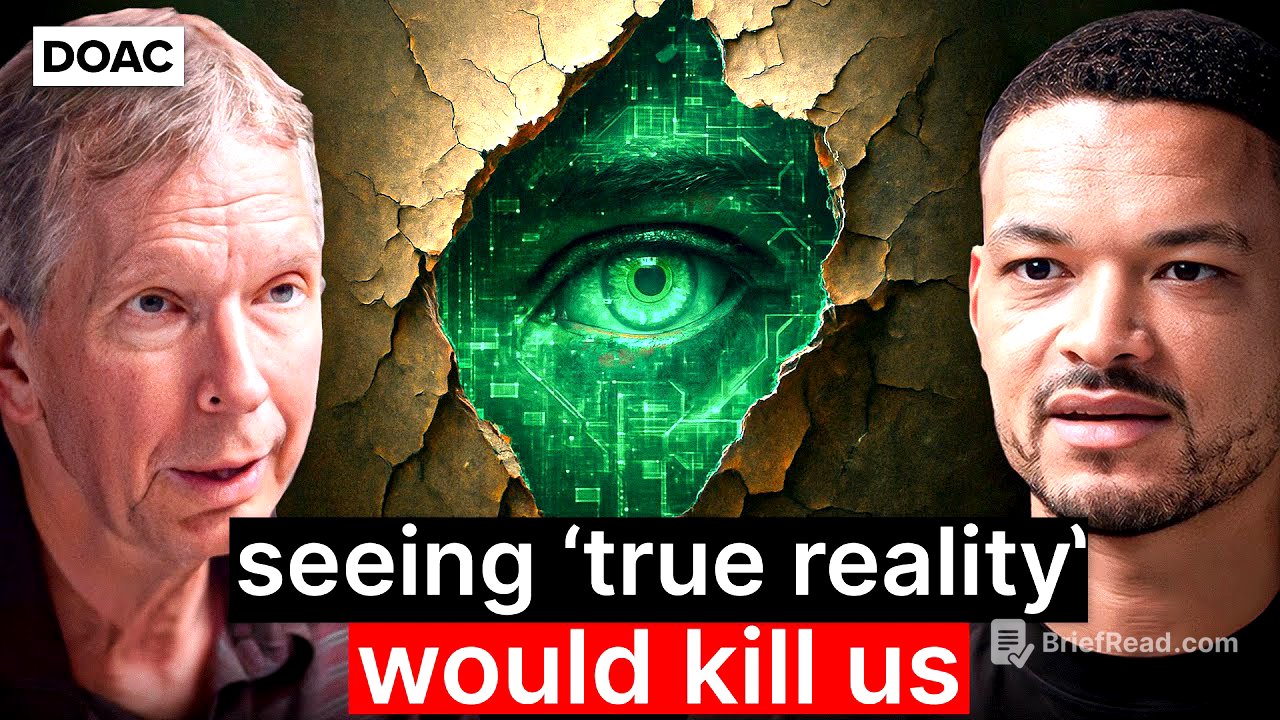
In this thought-provoking video from "The Diary of A CEO," Donald Hoffman discusses the nature of reality, consciousness, and the implications of simulation theory on human existence. He argues that our sensory perceptions do not reveal objective truth but rather serve evolutionary survival. Hoffman explores concepts like the virtual reality of our experiences, the limitations of space-time, and the potential for advancing technologies that can manipulate these realities. He emphasizes the significance of recognizing one's true self beyond the avatar and the role of love and compassion in life.
- Reality may not be what it seems; our perceptions are limited.
- Understanding consciousness can lead to extraordinary advancements in technology and personal growth.
Intro [0:00]
The video introduces the concept that the world we perceive is not the true reality but rather a virtual one, shaped by our sensory systems for survival. Donald Hoffman discusses his current work on editing the "code" of reality and the exciting possibilities that new technologies could unlock, such as time travel.
Do We Understand What We're Seeing? [2:17]
Hoffman highlights the key issue that few understand the nature of reality. He describes how even advanced scientists have limited imaginations about reality and urges viewers to think beyond current frameworks. He suggests that our sensory systems have evolved not to show us the truth but to ensure survival, leading to a skewed understanding of reality.
Space-Time [2:50]
The discussion turns to space-time, elaborating that it cannot be the fundamental nature of reality. Hoffman explains how at certain microscopic levels, the concept of space-time ceases to hold any meaning, suggesting that it should be viewed as a 'virtual reality headset' through which we perceive our existence.
Are We in a Virtual Reality World? [5:25]
Hoffman posits that our experiences are akin to wearing a VR headset, which restricts our view of a broader reality. He illustrates this through analogies like video games, arguing that most are unaware of the vast complexities beyond their immediate perceptions and experiences.
Darwin’s Theory Suggests Our World Isn’t Real [7:37]
Hoffman discusses Darwin's theory, asserting that our sensory systems were not designed to reveal the truth but to enhance reproductive success. He claims there's a zero probability that our senses have evolved to perceive objective reality, emphasizing that perception is deeply tied to survival instincts.
What Would Reality Be Without Our Senses? [12:53]
The conversation explores what reality might look like if all senses were removed. Hoffman suggests that without sensory input, we have no conception of reality, indicating that our experiences are constructs of our perceptions created for survival rather than reflections of an ultimate reality.
Simulations That Prove This Isn’t Real [17:54]
Hoffman references simulations he conducted to demonstrate that organisms that perceive reality must do so through simplified interfaces. In his findings, organisms that only perceive a fraction of reality tend to thrive over those that see everything, underlining that complex perceptions require more energy and resources.
What This Means for Living a Better Life [23:15]
Hoffman suggests that understanding our limited perception of reality can lead to a more fulfilling life. He encourages viewers to embrace their creativity, recognize their power to shape their reality, and abandon competition, as life is not a comparative game.
Understand Who You Are [33:30]
Hoffman emphasizes the importance of self-awareness and knowing one's true identity beyond societal labels. He argues that recognizing oneself as the creator of one's reality can liberate individuals from feelings of inadequacy and competition.
Simulation Theories [38:11]
Simulation theory is explored in detail, where Hoffman notes that our entire perception might just be a simulation created for understanding. He shares insights into how different realities can exist simultaneously and questions whether reality as we perceive it is merely a consequence of conscious interpretation.
What’s the Meaning of Life in This Reality? [43:04]
Hoffman posits that the meaning of life may exist in exploring love and understanding ourselves as part of a larger consciousness. He reaffirms that recognizing the interconnectedness of all beings can enhance life’s significance.
Did Someone or Something Create Consciousness? [44:43]
The video raises the question of whether consciousness is a product of a creator or an inherent aspect of existence. Hoffman suggests that our nature might be to explore these realms of existence and consciousness as part of life's inherent journey.
Where Does God Fit in This Reality? [46:46]
Exploring concepts of divinity, Hoffman argues that every person's understanding of God is subjective and personal. He suggests that we can all be seen as manifestations of a singular consciousness, which reflects a unifying divine essence.
Was Jesus Divine Beyond Any of Us? [48:11]
Hoffman addresses Jesus' perceived divinity, suggesting that everyone is equally divine in their essence. He emphasizes love and compassion as central tenets of spirituality that can transcend individual experiences and divisions.
Near-Death Experience and What Happens When We Die [52:43]
The discussion explores near-death experiences, with Hoffman suggesting that these may provide glimpses of existence beyond our current reality. He contends that insights gained from such experiences can lead to greater understanding of consciousness and beyond.
Grief and Love [1:01:51]
Hoffman discusses the nature of grief and its connection to love, stressing that love remains a powerful force even through loss. He suggests that understanding our connections and the transient nature of life can mitigate the pain associated with grief.
Light and Tunnel in Near-Death Experiences [1:05:00]
Hoffman elaborates on common elements in near-death experiences, such as tunnels and light, attributing them to possibly conditioned consciousness responses. He suggests these occurrences might offer insights into the nature of reality and consciousness beyond standard perceptions.
Why Do We Suffer? [1:07:12]
The video examines suffering in the context of existence, with Hoffman suggesting it is part of a broader exploration of life's meaning. He reflects on pain as a signal, emphasizing the need to view suffering through a lens that fosters growth and understanding.
What Is Your Theory of Consciousness Proving? [1:18:35]
Hoffman articulates his theory of consciousness, asserting it as fundamental and suggesting that understanding it could unlock new realms of technological and personal advancements. He stresses the need for scientific inquiry into consciousness to understand our perception of reality better.
Biggest Discovery: We Can Engineer Time [1:24:41]
Hoffman's groundbreaking claim is that time can potentially be engineered through advances in our understanding of consciousness. He discusses the implications of this discovery for humanity's future and the possibility of transcending current limitations.
The Consequences of Your Findings [1:28:46]
The impact of Hoffman's findings on future scientific and technological advances is scrutinized, with emphasis on the profound changes that could arise from this newfound understanding of consciousness. He discusses potential benefits and ethical questions raised by this knowledge.
Mental Health and Illusions [1:38:13]
The link between mental health and perceptions of reality is highlighted. Hoffman suggests that misunderstandings of one's perception can adversely affect mental health, and he emphasizes the importance of understanding the nature of consciousness.
How This Reality Helps You Deal with Life [1:45:23]
Hoffman suggests that a deeper understanding of reality, consciousness, and love can equip individuals to handle life's challenges more effectively. He advocates for self-awareness and compassion as paths to better mental well-being.
The Nature of Reality and AI [1:52:10]
The relationship between reality, artificial intelligence, and consciousness is examined. Hoffman touches on the limitations of AI as it currently stands, suggesting that true understanding must include fundamental aspects of consciousness.
What Would You Do If You Knew You Could Not Fail? [1:57:41]
Hoffman concludes by sharing that if he knew he could not fail, he would continue his work on bridging the gap between consciousness and modern physics. He reflects on the transformative potential of theoretical breakthroughs in consciousness for humanity's future.