TLDR;
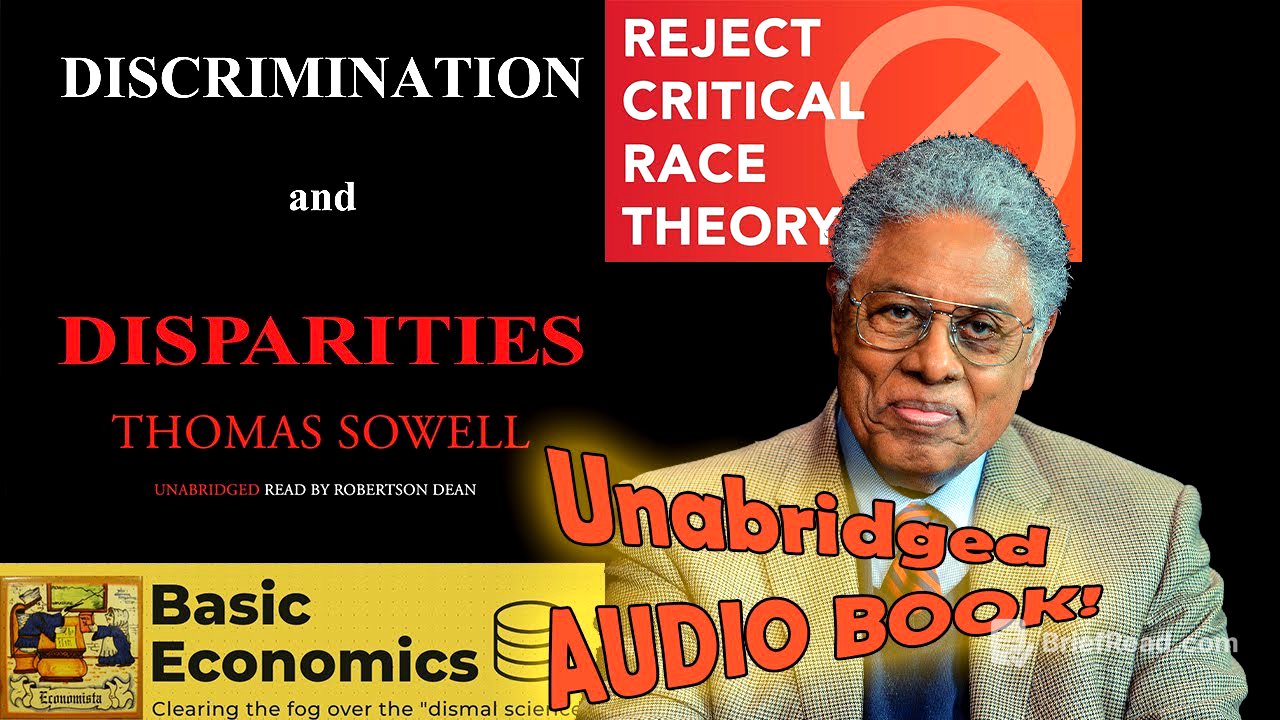
This text, "Discrimination and Disparities" by Thomas Sowell, read by Robertson Dean, explores the multifaceted nature of disparities in economic and social outcomes. It challenges common assumptions about the causes of these disparities, arguing that factors beyond genetics and discrimination play a significant role. The book emphasizes the importance of prerequisites for success, the impact of skewed distributions, and the limitations of social visions in addressing complex societal issues.
- The book challenges the assumption that disparities are solely due to genetics or discrimination.
- It highlights the significance of prerequisites and skewed distributions in determining outcomes.
- The text examines the costs and consequences of different types of discrimination.
- It underscores the importance of understanding the limitations of social visions and government solutions.
Disparities and Prerequisites [0:26]
Economic and social outcomes differ significantly among individuals, groups, institutions, and nations. Explanations range from genetic capability to victimization by others. Disparities often deviate from random chance expectations. Success depends on specific prerequisites, where small differences can lead to large outcome variations.
Prerequisites and Probabilities [1:52]
Success in endeavors with multiple prerequisites depends on having all prerequisites simultaneously. Even common prerequisites can result in low overall success rates. Success is not evenly distributed due to multiple prerequisites in most meaningful endeavors. Missing even a simple prerequisite can negate the effect of others. Illiteracy, for example, hinders career prospects. Not all prerequisites are within an individual's control. High IQ does not guarantee success; family background and guidance also matter. Success distributions are often skewed, not normally distributed.
Empirical Evidence [12:40]
Disparities exist among individuals and groups, challenging the assumption that they arise solely from genetics or biased treatment. National Merit Scholarship finalists show firstborn children are more likely to succeed, challenging hereditary and environmental explanations. IQ data indicates firstborn children have higher average IQs. Firstborns are overrepresented in higher education and prestigious professions. Undivided parental attention during early childhood may be a key factor. Children from professional families hear more words per hour than those from working-class or welfare families. Upward mobility is not a universal goal. Individuals, groups, or nations may lack prerequisites for success but can achieve it when missing factors are added. Scotland and Japan rose rapidly after overcoming limitations. Jewish achievements surged after barriers to institutions were removed. China's technological lead declined due to isolationist policies. Nazi Germany's nuclear program failed due to antisemitism. Institutions rise and fall, as seen with Eastman Kodak's bankruptcy due to digital cameras. Competition from new technologies can be decisive.
Institutions [32:47]
Nations like ancient Greece and Rome once held superior positions but later declined. Businesses such as Macy's and Hewlett-Packard rose from humble beginnings, while Eastman Kodak collapsed due to technological shifts. Multiple prerequisites can lead to skewed outcomes in nature, such as tornadoes in the United States and species diversity in the Amazon. Skewed distributions contradict assumptions on both the political left and right. Disparate impact statistics have influenced legal decisions, but genetic determinism led to eugenics laws and the Holocaust. Efforts to explain disparities span the ideological spectrum.
Implications [41:57]
Neither equal nor random outcomes are automatic in nature or among humans. Grossly unequal distributions are common, even without genetic or discriminatory factors. The world has never been a level playing field. Geographic differences, such as coastal or river valley locations, contribute to skewed outcomes. Neither genetics nor discrimination is necessary or sufficient to explain these outcomes. Hard evidence is required to substantiate either possibility. Sweeping preconceptions have led to monumental catastrophes like Nazism and communism. Discrimination, like exploitation, should be treated as a testable hypothesis.
Discrimination Meanings and Costs [46:27]
Discrimination has conflicting meanings: discerning tastes and arbitrary behavior based on group identities. Both can lead to large outcome differences. Disparities may result from accurate assessments of qualities or biased misjudgments. Answers vary for different groups and times. Clear definitions are crucial. Discrimination one involves fact-based distinctions, while discrimination two involves negative treatment based on arbitrary assumptions. Ideally, discrimination one judges individuals regardless of group, but this is rare. Context and cost influence decisions. Redlining exemplifies discrimination. Weighing empirical evidence about groups is still discrimination one but differs from judging each individual.
Meanings of Discrimination [49:13]
Discrimination one (1a) involves judging each person as an individual, while discrimination one (1b) bases decisions on group evidence. An employer might prefer hiring from group Y if group X has a high alcoholism rate, even if most in group X are not alcoholics. The employer prioritizes cost-effectiveness in determining individual alcoholism. Customers and society also bear costs from defective products made by alcoholics. This is not discrimination 1a but also not discrimination 2, as the employer may have friends from group X. The point is to classify decision-making processes for analysis.
Real-Life Examples [57:10]
A study showed employers who automatically did criminal background checks (discrimination 1a) hired more young black males, as it eliminated the need to use group information (discrimination 1b). Policies prohibiting criminal record inquiries may hinder employment opportunities for young black males. Employers may engage in discrimination 1b based on group reactions, such as historical antagonisms or positive interactions. Misdiagnosing discrimination's basis leads to ineffective or harmful policies. Higher costs are borne by employers, customers, and society.
High-Crime Neighborhoods [1:01:48]
In high-crime areas, discrimination 1b may lead to redlining, affecting law-abiding residents. Businesses avoid delivery or locating stores in such areas, raising prices due to higher costs. The "poor pay more" phenomenon is often misattributed to exploitation rather than higher business costs. Businesses must recover costs or face closure. Politicians may falsely blame discrimination 2. Understanding the source of higher prices is crucial for effective solutions. Similar economic consequences occur in low-income white neighborhoods.
Sidebar: Factors Behind Price Differences [1:09:00]
Crime is not the only reason for higher prices in low-income neighborhoods. Stores in these areas struggle despite higher prices due to lower inventory turnover and higher delivery costs. This does not indicate the extent of discrimination one or two. Deliberate costs imposed on a group, like denying voting rights or enforcing segregation, are discrimination 2. Analyzing costs paid by discriminators is crucial for understanding and addressing discrimination.
Costs of Discrimination [1:12:56]
The amount and severity of discrimination 2 vary. Group discrimination was pervasive in the past. Discrimination in hiring raises questions about causation and morality. Statistical disparities do not automatically equate to discrimination 2. Different ethnic groups have different median ages, affecting income disparities. Conditions prior to job applications can have a disparate impact. Individual decisions also affect outcomes.
Causation and Morality [1:14:08]
The cause of an outcome requires untangling complex factors, not just pointing to statistical disparities. The cost of discrimination to the discriminator plays a causal role. Society pays a cost by forfeiting the productive potential of those discriminated against. Understanding incentives and constraints is crucial. Systemic analysis considers what emerges, not just individual preferences.
South Africa Under Apartheid [1:25:22]
In South Africa under apartheid, white employers in competitive industries often violated laws by hiring more blacks and in higher positions. Employers paid a price for discrimination 2 in lost opportunities, while legislators paid no price for imposing discrimination. Both employers and legislators pursued self-interests within different institutional incentives. Non-whites lived in whites-only areas despite laws. Costs to property owners competed with costs of disobeying laws. Racists prefer their own race but prefer themselves most of all.
Institutional Incentives and Constraints [1:30:45]
Municipal transit companies in the South fought against laws requiring racially segregated seating, as it reduced profits. Railroads also opposed segregation laws due to increased costs. The Supreme Court case of Plessy v. Ferguson arose from railroad cooperation to challenge segregation laws. Economic and political forces conflict. Public utility monopolies and non-profit organizations face different incentives, leading to more discrimination 2.
AT&T Example
Before fair employment practices laws, AT&T had few black women as telephone operators. After the laws, they began hiring blacks disproportionately. Regional disparities reflected state government regulations. Additional costs were passed on to customers. Similar patterns occurred in government-regulated oil and gas utilities and non-profit organizations.
Unintended Consequences
Laws and policies with different purposes can change the amount and impact of adverse consequences. Minimum wage laws can reduce the cost of discrimination 2, leading to higher unemployment rates for black teenagers. Building restrictions in coastal California increased home prices, disproportionately affecting black populations.
Minimum Wage Laws
Minimum wage laws increase job applicants but decrease hires, reducing the cost of discrimination. Empirical evidence supports this. During a period with no effective minimum wage, black and white teenage unemployment rates were similar. After minimum wage laws were restored, black teenage unemployment rates became much higher. Labor force participation rates also show a racial reversal.
Building Restrictions
Severe building restrictions in coastal California led to skyrocketing home prices and a decline in the black population. Unlike unsuccessful racist efforts in Harlem, these restrictions achieved their goal. Costs matter.
Sorting and Unsorting People
People sort themselves by where they live and with whom they interact. This sorting is seldom even or random. Residential and social self-sorting are common among immigrants, who cluster together based on origin and religion. Black-white residential separations are often seen as unique, but discriminatory impositions have occurred for many groups worldwide.
Residential and Social Sorting
Sorting occurs within black neighborhoods based on socioeconomic levels and behavioral standards. Black homeowners cluster separately from black renters. Black newspapers criticized newcomers from the South for behavior that gave blacks a bad name. Similar patterns occurred during mass migrations to the Pacific Coast.
The Prevalence of Sorting
People sort themselves in residential patterns and social interactions. IQs of spouses are highly correlated. Sorting by lifestyle occurs in bohemian neighborhoods. Equal or random distribution is rare. Individuals can face costs due to actions of their group.
William Julius Wilson Example
Sociologist William Julius Wilson described being feared as a black man, even as a Harvard professor. Economist Walter E. Williams argued people economize on information costs, using physical attributes as proxies. Wilson's reactions were similar to blaming store owners for high prices rather than those whose behavior raised costs.
Imposed Residential and Social Sorting
Governmental regulations have prescribed where particular groups can live, such as ghettos for Jews and restrictions on black Americans. The question is whether such restrictions can be automatically inferred from non-random clusterings.
Causation
Explaining residential patterns requires considering discrimination one and two. Free persons of color faced restrictions, which tightened in the South but eroded in the North. Plantation slavery in the South saw free persons of color as dangers. In the North, legal and social restrictions eroded as blacks acculturated.
The 20th Century
In the 20th century, a retrogression set in as large numbers of southern blacks migrated to northern cities. Northern school segregation increased. The arrival of newcomers was followed by retrogressions in black-white relations.
The Prevalence of Sorting
The prevalence of sorting is not unique to the United States. The actions of the former failed to keep blacks out of Harlem, while the actions of the latter drove out of San Francisco half the blacks already living in that city. Costs matter.
Unsorting People
Residential and other outcomes produced by sorting became widely condemned. Unsorting people became a high priority, especially in schools and neighborhoods.
Educational Unsorting
The Supreme Court's decision in Brown v. Board of Education declared racially segregated schools unconstitutional. However, Dunbar High School, an all-black school, had a history of academic achievement. The decision led to Dunbar becoming a typical failing ghetto school.
Charter Schools
New and highly successful charter schools brought educational excellence back to ghetto communities. These schools were often located in low-income minority neighborhoods. Self-sorting was crucial.
Residential Unsorting
Government programs aimed to racially and socioeconomically unsort neighborhoods. These programs encountered bitter opposition from pre-existing residents. The assumption was that social isolation was behind social pathologies.
The Chicago Tribune
The harshest criticism of dispersing public housing's tenants comes from blacks. Black residents in working-class or middle-class communities have been particularly uninhibited in their denunciations of people from housing projects.
Hillbilly Elegy
In "Hillbilly Elegy," the author reported that his grandmother saw the government's placing underclass people in their midst as a betrayal.
Moving to Opportunity Program
Extensive empirical studies on the federal government's Moving to Opportunity program found no discernible benefit to economic self-sufficiency, employment outcomes, and risky and criminal behavior for adults and children.
Sean Donovan
Secretary of Housing and Urban Development Sean Donovan vowed to help urban blacks relocate to suburban neighborhoods. He claimed that realtors and landlords still discriminated against blacks.
Disparate Impact
The U.S. Equal Employment Opportunity Commission has sued employers who do criminal background checks on job applicants on grounds that this was racial discrimination.
The Cost of Discrimination
There are costs to both employers and workers when the assortment and proportions of employees differ from the demographic makeup of the local population.
Sears Department Store
A case charging the Sears department store chain with sex discrimination cost the company twenty million dollars in legal fees and took 15 years to resolve through the federal courts.
PepsiCo
In 2012, PepsiCo paid more than three million dollars to settle a charge by the Equal Employment Opportunity Commission that the big soda and snacks companies' use of criminal background checks was discrimination against blacks.
The Implications of Disparate Impact
The implications of the use of a disparate impact basis for costly lawsuits in civil rights cases does not end with employers. Workers can also be adversely affected.
Japanese Firms
Japanese firms seeking to find locations for their first businesses in the United States have specified that they do not want to locate near concentrations of blacks in the local population.
The Demand for Black Workers
Racism has not been sufficient to prevent a demand for black workers in a competitive market.
Chapter 4: The World of Numbers
Statistics are often used to convey the magnitude of disparities and to try to establish their causes. Even when the numbers are correct, the words that describe what the numbers are measuring may be incorrect or misleading.
Group Disparities
During a long and heated campaign in politics and in the media, data from various sources were cited repeatedly showing that black applicants for the most desirable kinds of mortgages were turned down substantially more often than white applicants.
The Atlanta Journal Constitution
The Atlanta Journal Constitution showed that 52 percent of blacks had credit scores so low that they would qualify only for the less desirable subprime mortgages, as did 16 percent of whites.
Household Income Statistics
Household income data are often used to indicate the magnitude of economic disparities in the society.
The Bureau of the Census
As the Bureau of the Census pointed out more than half a century ago, the number of households has been increasing faster than the number of people.
Time and Turnover
Another factor often omitted or distorted in discussions of income disparities is the time dimension.
A University of Michigan Study
A University of Michigan study that followed a given set of working Americans from 1975 to 1991 found that 95 percent of the people initially in the bottom twenty percent were no longer there at the end of that period.
Crime Statistics and Arrest Statistics
Some of the most gross distortions of reality through errors of omission have involved quite simple omissions.
The Most Reliable and Objective Crime Statistics
The most reliable and objective crime statistics are statistics on homicides since a dead body can hardly be ignored regardless of the race of the victim.
A Study by Independent Researchers
A study by independent researchers of nearly 40,000 drivers on the New Jersey Turnpike using high-speed cameras and a radar gun showed a higher proportion of black drivers than of white drivers who were speeding, especially at the higher speeds.
Chapter 5: Social Visions and Human Consequences
Many people may expect discussions of economic and social disparities to end with solutions, usually something that the government can create, institutionalize, staff, and pay for with the taxpayers' money.
The Invincible Fallacy
At the heart of many discussions of disparities among individuals, groups, and nations is the seemingly invincible fallacy that outcomes in human endeavors would be equal or at least comparable or random if there were no biased interventions on the one hand nor genetic deficiencies on the other.
The Supreme Court of the United States
The Supreme Court of the United States has enshrined the prevailing fallacy in the form of its disparate impact standard for presuming discrimination.
Educational Implications
Among the institutions where the prevailing fallacy takes a painfully sweeping toll are those low-income and minority schools in America and low-income white schools in England where young thugs are allowed to destroy the education and the futures of other students there by making those other students and their teachers targets of daily disruptions, harassments, threats, and violence.
The No Child Left Behind Educational Policies
The No Child Left Behind educational policies introduced during the administration of President George W. Bush ignored the painful possibility that there was no such universal desire for education as implicitly assumed and that some uninterested children's behavior prevented other children from learning.
Political Implications
The most spectacularly successful political doctrine that swept into power in countries around the world in the 20th century was Marxism based on the implicit presumption that differences in wealth were due to capitalists growing rich by keeping the workers poor through exploitation.
Social Implications
If these were simply intramural contests among the intelligentsia, there would be little reason for others to be concerned about them, but social visions and even the very catchwords and verbal style in which those visions are discussed diffuse far beyond those who create and elaborate social visions.
The Importance of Social Visions
The importance of social visions goes far beyond the rhetoric they spawn. In a democratic nation, there can be no welfare state without a social vision first prevailing politically, a vision justifying the creation or expansion of a welfare state.
Solutions
Solutions can be a society's biggest problem, and especially governmental solutions, because government is essentially a categorical institution in an incremental world.
Housing Solutions
Once government housing programs have been created to help low-income families, then any family that meets a government agency's arbitrary definition of low income can receive benefits paid for with the taxpayers' money.
Educational Solutions
A categorical institution like government cannot be expected to make the best incremental trade-offs.
Income and Wealth Redistribution Solutions
If those who are more fortunate are the reason others are less fortunate, then such things as redistributing income or wealth may seem much more plausible as a solution than in a world where the accumulation of human capital is more fundamental than the accumulation of physical wealth.
The Past and the Future
Looking back at the past, there is much to inspire and much to appall. As for the future, all that we can be certain of is that it is coming whether we are well prepared or ill prepared for it.