TLDR;
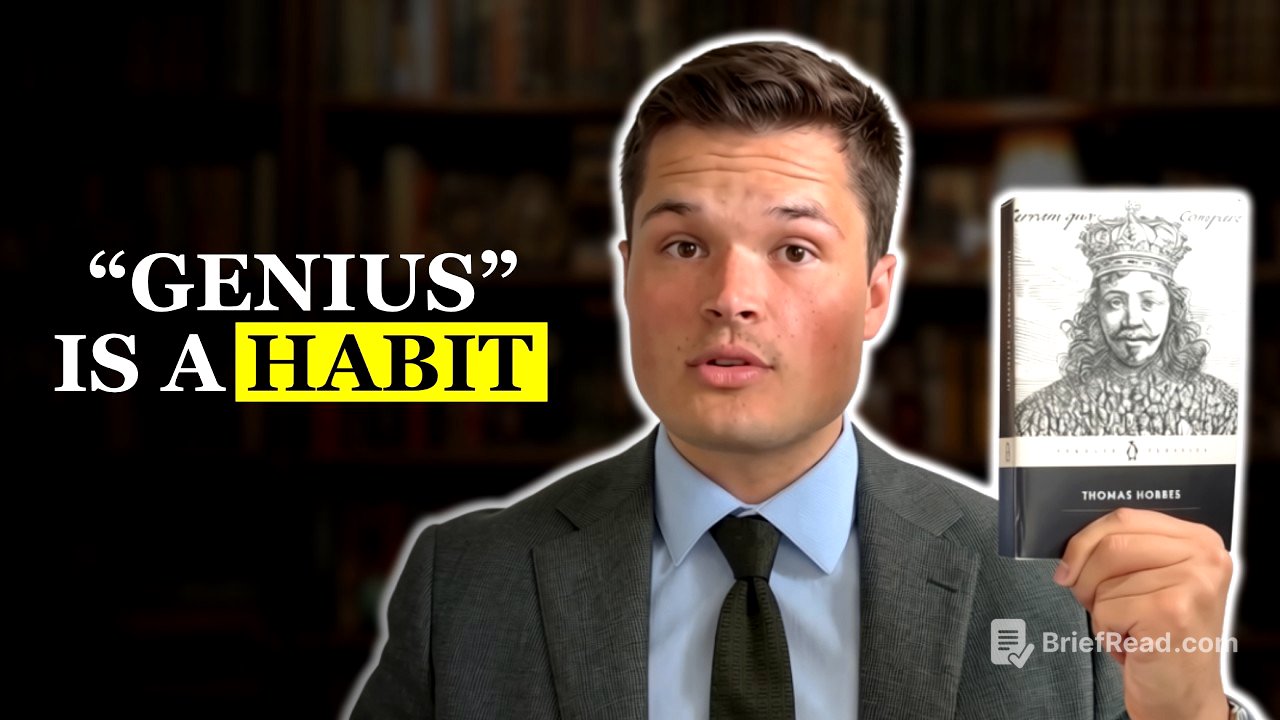
Thomas Hobbes’s Leviathan offers practical lessons for learning and self-education in a world where technology changes faster than formal education can keep up. Effective learning means using confusion to form clear questions, seeking underlying principles instead of memorizing isolated facts, and limiting distractions that leave the mind scattered.
- Treat confusion as a guide to what you need to learn next.
- Focus on how and why things work, not just on remembering what happened.
- Reduce distracting, disorganizing stimuli to improve concentration and reasoning.
Self-Education Is More Important Than Ever [0:00]
The first part of Hobbes’s Leviathan explores the human mind, offering ideas that can inform how people learn today. Although the book’s political arguments may be debatable, its observations about thinking and learning remain useful. As technology advances rapidly, formal education systems struggle to keep pace with the skills people need, so more people turn to the internet and platforms such as YouTube to educate themselves. Independent learning can be valuable, but it works better with a clear structure. The video presents three principles for building that structure: use confusion productively, learn formulas rather than isolated facts, and avoid lifestyle habits that disrupt concentration.
Use Confusion to Guide Your Learning [1:48]
Hobbes describes two kinds of mental movement: unguided thought, which is distracted and directionless, and thought driven by a clear intention. Learning involves moving toward knowledge you do not yet have, so confusion is a natural and useful part of the process. The problem arises when confusion feels overwhelming and people respond by consuming more books, videos, and information without organizing it.
Instead, identify exactly what you do not understand and write down the questions whose answers would help you move forward. These questions give your learning a purpose and act as a compass: you can seek answers one by one and track your progress. Hobbes’s view, as presented here, is that people are not necessarily born with unequal intellectual abilities; they differ in how they handle the initial confusion of learning. Like a detective investigating a crime, a learner should first ask what needs to be known, then use those questions to decide what to examine, read, and investigate. This turns confusion from an obstacle into an engine for learning.
Learn Formulas, Not Just Facts [6:50]
Hobbes distinguishes between an experiential approach, which remembers what happened, and a scientific approach, which seeks to understand what happened, why it happened, and how it happened. Strong learners focus on causes, connections, and principles rather than simply collecting facts. When taking notes, record how ideas relate to one another, how they can be applied, and what obstacles might arise when putting them into practice.
Chess illustrates the difference. A player who memorizes moves and standard responses may know many facts about the game, but a player who understands why those moves work can adapt, break from standard patterns, and create new strategies. The same principle applies to history: someone studying Alexander the Great should examine how particular decisions led to particular outcomes, then compare those patterns with other events. Understanding these relationships can help people interpret the present and anticipate possible consequences. Learning the underlying “formulas” provides more flexibility and creativity than memorization alone.
Avoid Lifestyle Pollution [12:24]
The brain responds to the stimuli it receives, and those stimuli can either help organize thought or make it more scattered. The video cites experiments in which college students who listened to classical music showed a more ordered perception of their surroundings for a short time afterward. By contrast, highly stimulating music, constant social-media scrolling, and chaotic or unfocused entertainment can encourage a reactive, foggy state that makes it harder to concentrate, reason, read for long periods, and organize thoughts.
This does not mean that every distracting activity must be eliminated. Instead, keep disorganizing stimuli to a minimum when preparing to study, research, read, or do important work. The video suggests that the difference between past intellectual achievements and modern life may have less to do with changes in human ability than with the greater volume of stimuli that can disrupt attention. A more ordered mind is essential both for working through the confusion of a new subject and for understanding the principles that connect its ideas.