TLDR;
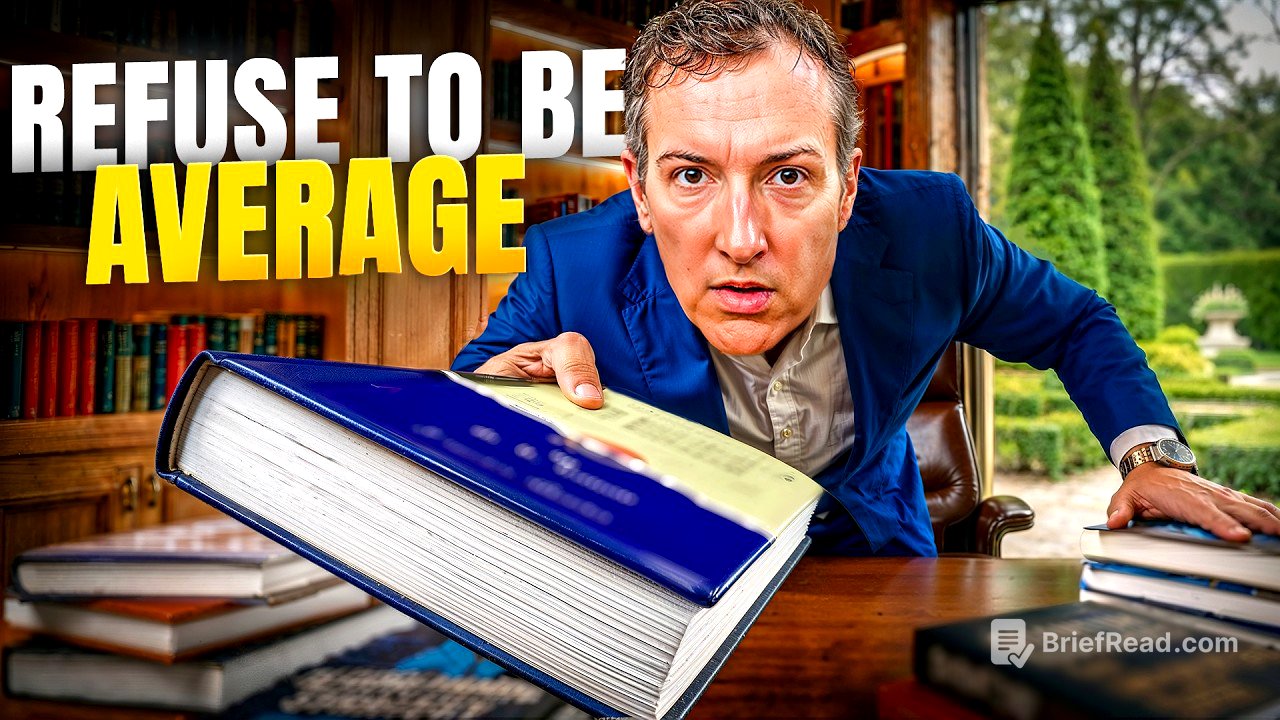
Euclid’s Elements offers a practical model for rigorous thinking, not just a course in geometry. Its methods helped shape Abraham Lincoln’s legal reasoning, Thomas Hobbes’s political philosophy, Albert Einstein’s approach to physics, and Bertrand Russell’s understanding of logic.
- Define key terms, state assumptions openly, and justify each step in an argument.
- Test difficult claims by assuming the opposite and tracing its consequences.
- Break complex problems into smaller steps and build solutions from foundations that can be checked.
- Consider possible cases systematically and rule out alternatives rather than relying on unsupported assertions.
Why You Need to Read This Book [0:42]
Abraham Lincoln had little formal schooling and taught himself law from borrowed books. Early in his legal career, he realized that knowing the facts was not enough: he needed to understand what it meant to demonstrate a claim. He studied the first six books of Euclid’s Elements until he could recite their propositions from memory, then returned to his legal practice.
Euclid begins by defining terms, stating assumptions called postulates, and listing basic logical principles called common notions. Throughout each proof, he identifies the rule that supports every step. Nothing is simply declared “obvious”; each conclusion must be earned. Lincoln’s example shows how this discipline can strengthen reasoning in law and other areas.
A practical exercise is to structure an argument in three layers: define the important terms, state the assumptions being taken for granted, and name the rule that justifies each move from one claim to the next. If a step cannot be justified, the reasoning may not yet be clear.
Skill 1: Reasoning from Axioms [4:17]
Thomas Hobbes encountered Euclid around age 40, when he found Elements open to Book I, Proposition 47—the Pythagorean theorem. At first he thought the conclusion was impossible, but he followed its proof through the propositions it relied on and back to the book’s definitions and postulates. He found no gaps and saw how a conclusion could follow necessarily from stated foundations. His later work Leviathan uses a similar structure: definitions first, then assumptions about human nature, followed by conclusions about political arrangements.
One of Euclid’s key methods is reductio ad absurdum, or proof by contradiction. To prove a claim, assume its opposite and show that this leads to an impossibility. Euclid uses this method to prove that equal angles in a triangle have equal opposite sides. He also uses it to show that there are infinitely many prime numbers: if there were only finitely many, multiply them all together and add one. The resulting number is either prime and absent from the list, or has a prime factor absent from it, contradicting the assumption.
When a claim is hard to prove directly, write down its negation and trace what would follow if it were true. A contradiction can establish the original claim; if no contradiction appears, the exercise may reveal that the original belief is less certain than it seemed. The method also informs legal reasoning, scientific falsification, and strategic thought.
Skill 2: Reductio Ad Absurdum [8:09]
Albert Einstein received Euclid’s Elements when he was 12 and later called it a “holy little geometry book.” What impressed him was the method: begin with a small number of straightforward postulates, then derive results that are not obvious through reasoning alone. The Pythagorean theorem, for example, depends on earlier propositions, which in turn depend on still earlier results. Each claim forms part of a dependency chain—a sequence in which later steps rely on foundations established before them.
Einstein applied a comparable approach in physics. Special relativity begins with two postulates: the laws of physics are the same in all inertial frames, and the speed of light is constant for all observers. From these starting points, further conclusions are derived. The general approach is to make foundations explicit, reason carefully, and allow complexity to emerge step by step.
For a difficult problem, work backward to identify what must be solved or established before the main solution is possible. Keep asking what must be true for each earlier requirement to work until the remaining claims are simple enough to check directly. Then build forward from those verified foundations.
Skill 3: Dependency Chains [10:33]
Bertrand Russell first encountered Euclid at age 11 and later described the experience as one of the great events of his life. Initially, he disliked being told that Euclid’s axioms could be assumed but not proved. He wanted everything established from nothing. Later, through Euclid and his own work in mathematical logic, he came to understand that openly stating assumptions is a strength: it makes the foundations of an argument visible and available for examination.
Hidden assumptions often weaken ordinary arguments. The reasoning may sound logical even when it rests on premises that neither the speaker nor the listener has identified. Euclid’s practice of stating assumptions before proving anything makes it possible to examine and challenge those foundations.
Euclid also demonstrates proof by cases: consider possible alternatives systematically and show that every option except the conclusion leads to a contradiction. Rather than merely claiming that one outcome is true, this method establishes that the alternatives are impossible. The larger lessons from Lincoln, Hobbes, Einstein, and Russell are to define terms, state assumptions, construct arguments instead of asserting conclusions, justify each step, break complex problems into simpler ones, and use the opposite assumption when direct proof is difficult. These are habits of rigorous thinking that apply far beyond mathematics.