TLDR;
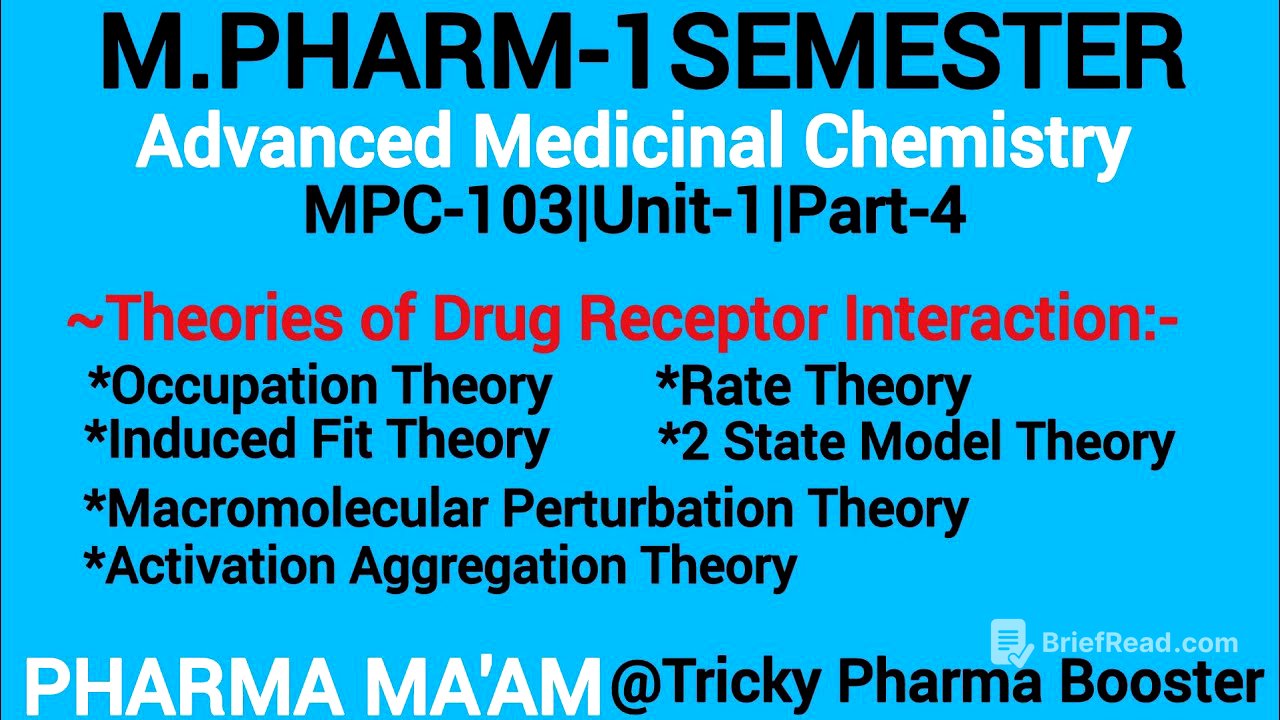
This video explains the theory of drug-receptor interactions, covering basic concepts like receptors, ligands (agonists and antagonists), and the drug-receptor complex. It details six key theories: Occupation Theory, Rate Theory, Induced Fit Theory, Macromolecular Perturbation Theory, Activation Aggregation Theory, and the Two-State Model of Receptor Activation. Each theory offers a unique perspective on how drugs interact with receptors to produce biological responses, focusing on factors like complex formation, reaction rates, and receptor conformations.
- Receptors are macromolecules, usually proteins, with specific binding sites for drugs or ligands.
- Ligands can be agonists (activating receptors) or antagonists (inhibiting receptors).
- Drug-receptor interaction leads to the formation of a complex that triggers a pharmacological effect.
Introduction: Drug-Receptor Interactions [0:00]
The lecture introduces the topic of drug-receptor interactions, emphasizing its importance and relative simplicity. It sets the stage for understanding the basic concepts and terminologies necessary to grasp the theories of how drugs interact with receptors. The presenter encourages viewers to watch the video patiently to fully understand the topic.
Basic Terminology: Receptors and Ligands [0:36]
A receptor is defined as a specific site on a cell or within an organism where a drug binds to produce a biological response. It is typically a macromolecule, such as a protein, with a specific binding site for a drug or ligand. A ligand, or drug, is a natural or synthetic substance that has a physiological effect when administered into the body. Ligands are classified into two types: agonists and antagonists. Agonists activate the receptor to produce a biological response, while antagonists bind to the receptor and prevent activation, thus inhibiting a biological response.
Agonists vs. Antagonists [1:40]
Agonists bind to the active site of a receptor, leading to full activation and a biological response. Antagonists bind to the same site but block activation, preventing a biological response. Agonists produce biological responses, while antagonists inhibit them.
Drug-Receptor Interaction Explained [3:41]
Drug-receptor interaction occurs when a drug binds to the active site of a receptor, forming a drug-receptor complex. This complex then leads to a pharmacological effect. The formation of the drug-receptor complex is essential for eliciting a response.
Theories of Drug-Receptor Interaction [4:30]
Six theories of drug-receptor interaction are introduced: Occupation Theory, Rate Theory, Induced Fit Theory, Macromolecular Perturbation Theory, Activation Aggregation Theory, and the Two-State Model of Receptor Activation. These theories aim to explain how drugs bind to receptors, form complexes, and produce responses, each offering a different perspective.
Occupation Theory [5:34]
Occupation Theory states that the amount of drug-receptor complex formed is directly proportional to the pharmacological response. The maximum response occurs when all receptors are occupied by drug ligands. The maximum response depends on the dose of the drug and the total number of receptors available. Essentially, the more drug-receptor complexes formed, the greater the response.
Rate Theory [7:27]
Rate Theory posits that the response is proportional to the rate of drug-receptor complex formation. The faster the complex forms, the greater the response. The duration of the drug-receptor complex formation determines whether a molecule is an agonist, partial agonist, or antagonist. Agonists have fast association and dissociation rates, partial agonists have medium rates, and antagonists have slow rates.
Induced Fit Theory [9:51]
The Induced Fit Theory explains that the receptor's active site adjusts its shape to better fit the ligand. The receptor's active site modifies itself according to the ligand's structure, allowing for a better fit and subsequent biological response. This theory suggests a dynamic interaction where the receptor adapts to the ligand.
Macromolecular Perturbation Theory [12:11]
Macromolecular Perturbation Theory explains that drug-receptor interaction leads to conformational changes in the receptor. If the conformational change leads to a biological response, the ligand is an agonist. If the conformational change does not lead to a biological response, the ligand is an antagonist. This theory focuses on how ligands alter the receptor's structure and whether these changes result in a response.
Activation Aggregation Theory [13:40]
Activation Aggregation Theory states that receptors exist in a dynamic equilibrium between activated and inactivated forms. The receptor can be in either an active or inactive state. When a ligand binds to the active form, it leads to a biological response, indicating an agonist. If the ligand binds but no response occurs, it indicates an antagonist.
Two-State Receptor Model [15:25]
The Two-State Receptor Model is similar to the Activation Aggregation Theory, stating that receptors exist in two states: active and inactive, in dynamic equilibrium. The equilibrium shifts depending on the ligand that binds. Agonists bind to the active site, shifting the equilibrium towards the active side and producing a biological response. Antagonists do not change the equilibrium, while reverse agonists bind to the inactive site, leading to an opposite response. Agonists bind to the active form (RA), antagonists bind to both active and inactive forms (RA and RI), and reverse agonists bind to the inactive form (RI).