TLDR;
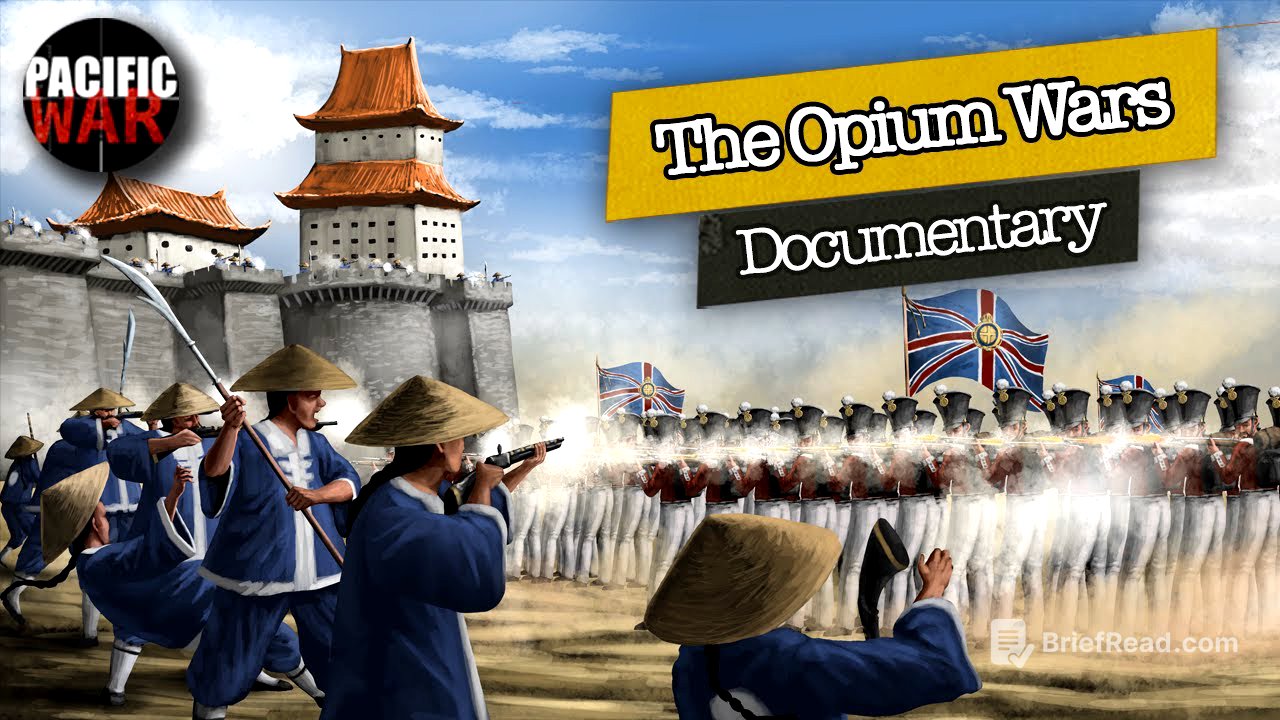
This video provides a detailed account of the First and Second Opium Wars between China and Britain (with France joining in the Second Opium War). It explains the economic and political factors leading to the conflicts, key events, and the resulting treaties that significantly weakened China and opened it to Western influence. The video also touches on the Taiping Rebellion, which occurred during this period, and its impact on China.
- The Opium Wars were primarily caused by Britain's desire to balance its trade deficit with China by selling opium.
- The Chinese government's efforts to suppress the opium trade led to military conflicts with Britain.
- The treaties resulting from these wars, particularly the Treaty of Nanjing, imposed harsh and humiliating conditions on China, opening its ports to foreign trade and ceding territory to Britain.
- The Taiping Rebellion, a major internal conflict, further destabilized China during this period.
Introduction [0:00]
The Pacific War Channel introduces a historical overview of the events leading up to the First Opium War (1839-1842) and its relevance to the broader context of the Asia-Pacific War. The Opium Wars, fought between China and Britain (later joined by France in the Second Opium War), stemmed from the illicit opium trade imposed on China by Britain. These conflicts marked the beginning of significant Western disruption in Asia, weakening China and making it vulnerable to exploitation by Western powers and Japan.
Arrival of Lord Napier, tensions escalate. [12:33]
Following the abolition of the East India Company's monopoly in China in 1833, Britain appointed Lord Napier as the chief superintendent in Canton to manage trade. Napier's mission included protecting British trade, opening more Chinese ports, and establishing an official presence in the emperor's court, but he was instructed to avoid involvement in the opium trade. Napier faced a hostile reception in Canton, with the viceroy, Lun, demanding his departure and halting trade with Britain. This prompted some British merchants to advocate for government intervention. Napier, influenced by Jardine and Matheson, urged Britain to use force against China, underestimating Chinese military capabilities.
Opium confiscation, British evacuation, hostilities begin. [21:51]
In 1836, the Daoguang Emperor banned opium importation and use due to widespread addiction. Commissioner Lin Zexu was appointed to suppress the opium trade, leading to the arrest of 1,600 residents of Canton and the confiscation of over 3,000 chests of opium. Lin surrounded the factories, demanding the surrender of all opium. Captain Charles Elliot ordered British ships to Hong Kong for safety and negotiated with Lin, promising British merchants reimbursement for their losses, a promise he was not authorized to make. Lin destroyed the confiscated opium, leading to increased tensions and the emergence of war.
Sea Battle of Chumai [30:39]
Chinese ships blockaded British ships, leading to naval conflict. The British initiated the first shot of the Opium War, resulting in a Chinese naval defeat at the Sea Battle of Chumai. Despite being outnumbered, British warships outmaneuvered and overpowered the Chinese fleet due to superior technology and tactics.
British cabinet meeting [34:23]
In 1840, the British cabinet convened to address the China issue, deciding to finance the war by making China pay for it. The British government aimed to secure reparations to cover the confiscated opium debt while publicly stating the war was for the defense of British subjects, avoiding any mention of opium compensation. Palmerston instructed Elliot to prepare for war, including blockading rivers and capturing islands, while also demanding various concessions from the Chinese government, such as favorable trade status and the opening of new ports.
Attack on Amoy [51:36]
In 1841, a new British Armada attacked Amoy, which was heavily fortified. The British forces quickly silenced the Chinese guns and landed without opposition, leading to the capture of the city. The British then proceeded to attack and capture other key locations, such as Chusan and Ningbo, despite facing challenges such as illness among the troops.
Treaty of Nanjing [1:02:46]
In 1842, British forces approached Nanjing, leading to negotiations and the Treaty of Nanjing. The treaty required China to pay $21 million in reparations, release British prisoners, cede Hong Kong to Britain, and open ports for permanent British residence and trade. The treaty did not address the opium trade, favoring British interests.
Taiping Rebellion Hong Xiuquan's revolt begins. [1:10:56]
Following the First Opium War, China faced internal turmoil, including the Taiping Rebellion (1850-1864). Led by Hong Xiuquan, the rebellion aimed to overthrow the Qing Dynasty and establish a new society based on a syncretic form of Christianity. The Taiping rebels gained significant support and captured Nanjing, posing a major threat to the Qing government.
Second Opium War: Attack on Canton starts. [1:25:33]
In 1856, tensions escalated again, leading to the Second Opium War. The "Arrow Incident," involving a Chinese-owned ship registered in Britain, provided the pretext for British military action. British forces attacked and bombarded Canton, leading to further conflict and destruction.
Bruce fabricates Russian assistance to Chinese. [1:32:04]
In 1859, Bruce fabricated Russian assistance to Chinese in order to save face. The real reason the Daga fors were so successful this time around was because of Mongol Prince sang who had previously crushed the taing rebels he was in command.
British receive powerful Armstrong field gun. [1:34:22]
In 1860, the British received the Armstrong field gun, a weapon with rifle accuracy and cannon power. British and French forces landed in Beitang and advanced towards Tianjin, encountering Chinese cavalry led by Prince Sang. The Armstrong guns scattered the Chinese cavalry, leading to an Allied victory. The Allies then captured the Dagu forts and Tianjin, forcing China to negotiate.
Elgen burns Summer Palace as retribution. [1:46:55]
In 1860, after capturing Peking, British and French troops looted and burned the Summer Palace as retribution for the torture and deaths of British prisoners. The burning of the Summer Palace was a symbolic act of revenge and a way to restore British honor. The Treaty of Tientsin was ratified, including the legalization of the opium trade and further concessions to the British.