TLDR;
The LGBTQ rights movement challenged the gap between American ideals of freedom and the restrictions imposed on LGBTQ people’s lives. From policing, employment discrimination, and medical stigma to Stonewall, AIDS activism, legal change, literature, and public art, the history shows both the power of collective action and the inequalities within the movement.
- LGBTQ people built communities and resisted discrimination even when visibility could lead to arrest, job loss, or family rejection.
- Stonewall helped turn longstanding resistance into more visible, confrontational organizing, while later debates exposed differences of race, class, gender, and political strategy.
- Baldwin, Butler, and Feinberg examine how gender and identity are shaped by social expectations and enforced through everyday interactions.
- AIDS activism and memorial art challenged neglect, stigma, and the denial of public mourning.
- Legal equality brought important protections, but the lecture asks whether liberation also requires changing the institutions and categories that produce inequality.
Postwar Family Ideals, Policing, and Early Organizing [0:39]
The postwar ideal of the nuclear family treated marriage, conventional gender roles, and child-rearing as signs of maturity, morality, and good citizenship. Although real families were more diverse, schools, churches, medicine, advertising, and employers reinforced this ideal and treated alternatives as failures. LGBTQ people faced both punishment for same-sex relationships and policing of gender expression. Sodomy laws criminalized sexual acts, while police used disorderly-conduct and liquor laws to raid bars, entrap people, and expose them publicly; arrests could lead to prison, job loss, and family rejection.
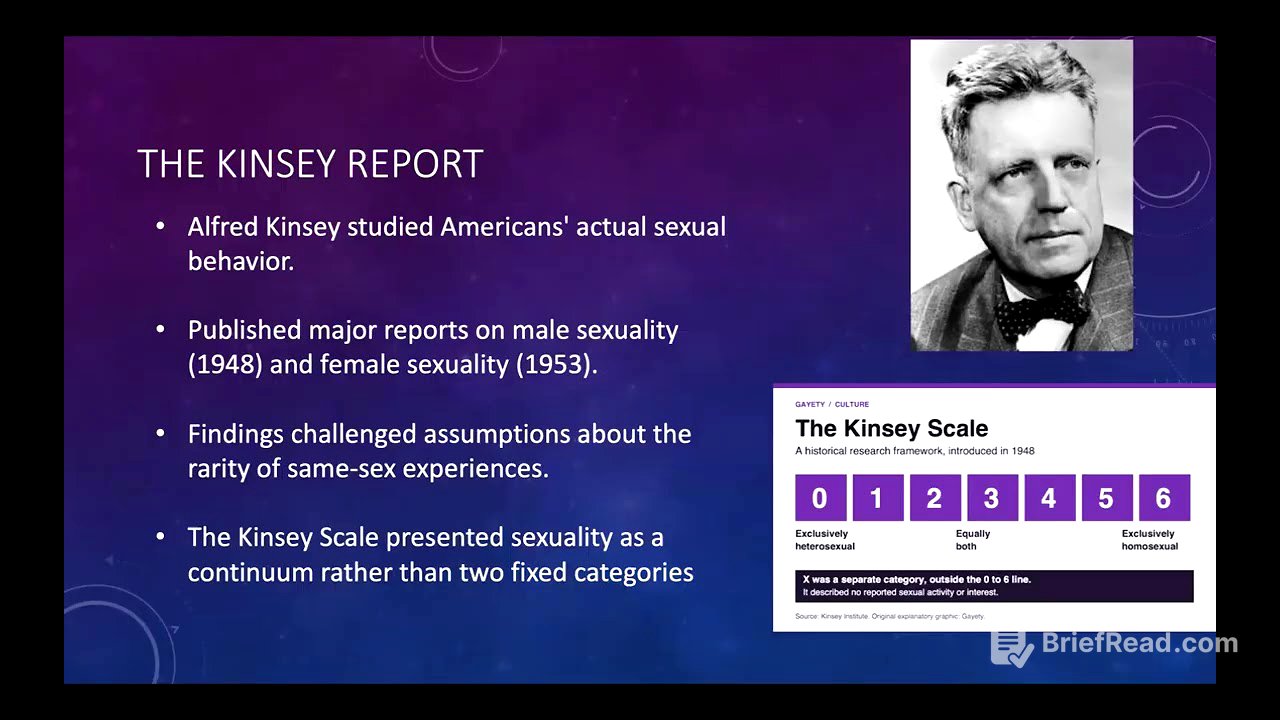
During the Cold War, the Lavender Scare portrayed gay and lesbian federal employees as security risks, on the theory that concealed relationships made them vulnerable to blackmail. Executive Order 10450, issued in 1953, expanded security screening and helped exclude people accused of “sexual misconduct,” often without evidence of disloyalty. Alfred Kinsey’s 1948 and 1953 reports documented a wider range of sexual behavior than conventional morality acknowledged. His Kinsey scale placed sexuality along a continuum rather than in two fixed categories, challenging stigma, though the scale itself remains limited.
Early organizations offered routes to community and political action. The Mattachine Society, founded in Los Angeles in 1950, encouraged gay men to recognize shared political interests; the Daughters of Bilitis, founded in San Francisco in 1955, provided lesbians with social connections and circulated information through its magazine, The Ladder. Both groups had to weigh organizing against the risk of exposing members to arrest, firing, or rejection. Compton’s Cafeteria in San Francisco’s Tenderloin served transgender women, drag queens, and sex workers who were excluded from more “respectable” spaces. In 1966, patrons resisted a police roundup there, years before Stonewall, demonstrating that transgender and gender-nonconforming people were already resisting police control of public space.
Respectability, Sexual Liberation, and Stonewall [10:03]
Some activists used the term “homophile” to emphasize affection rather than sexual behavior and to challenge the idea that gay identity was only about sex. Carefully managed demonstrations often used formal dress codes to present participants as respectable, conventional Americans. This strategy could help build public support, but it also risked implying that people had to conform in appearance or behavior to deserve rights. In some 1950s lesbian bars, butch and femme roles mirrored conventional masculine and feminine pairings.
The sexual revolution, the counterculture, and women’s liberation challenged expectations about marriage, reproduction, and sexual morality. The birth-control pill helped separate sex from reproduction, while feminists opposed sexual double standards. Yet much of the new freedom remained focused on heterosexual relationships. Gay liberation activists argued that sexual freedom should include same-sex relationships and increasingly emphasized visibility and pride rather than respectability. In 1973, following activist pressure and changes in psychiatric perspectives, the American Psychiatric Association removed homosexuality from its diagnostic manual as a mental disorder.
Stonewall took place in the early hours of June 28, 1969, after police raided the Stonewall Inn in Greenwich Village. The Mafia-operated bar served a diverse clientele, including gay men, drag queens, gender-nonconforming people, and homeless LGBTQ youth. Police raids were routine, but this time patrons and people outside resisted, throwing objects as the crowd grew; officers barricaded themselves inside, and the conflict spilled into the streets. Stonewall was not the beginning of LGBTQ activism, but the sustained organizing that followed made it a turning point. The Gay Liberation Front connected LGBTQ demands to the era’s broader liberation movements and questioned institutions that treated heterosexuality and gender conformity as normal. In 1970, Christopher Street Liberation Day marches made public visibility itself a political act and challenged the shame imposed on LGBTQ people.
Backlash, Political Representation, and Intersectionality [18:33]
The gains of gay liberation met organized opposition. In 1971, singer and activist Anita Bryant led a campaign to repeal a Miami-Dade County ordinance prohibiting discrimination based on sexual orientation. Its “Save Our Children” slogan framed equal treatment as a threat to children and promoted unsupported claims that gay people were dangerous. Voters repealed the ordinance, but the defeat helped mobilize LGBTQ activists nationally and foreshadowed later disputes over schools, families, and public visibility.
In 1977, Harvey Milk became one of the first openly gay elected officials in the United States when he won a seat on San Francisco’s Board of Supervisors. Milk argued that coming out could counter stereotypes by making gay people visible as neighbors, relatives, and co-workers. He opposed California’s Proposition 6, the Briggs Initiative, which would have allowed gay and lesbian public-school employees to be dismissed; voters rejected it in 1978. That November, former supervisor Dan White assassinated Milk and Mayor George Moscone. White’s conviction for voluntary manslaughter rather than murder provoked the White Night riots in 1979 and deepened mistrust of the legal system.
The movement’s risks and priorities were not the same for everyone. Race, class, gender, and access to family support could shape a person’s exposure to discrimination and ability to participate. Black feminist lesbians, including the Combahee River Collective, argued that racism, sexism, class oppression, and homophobia could not be treated as separate problems. This framework, called intersectionality, helps illuminate whose concerns received funding and visibility and whether campaigns prioritized employment, housing, health care, or marriage. It also informs readings by James Baldwin, whose experience in gay social spaces was shaped by race, and Leslie Feinberg, whose narrative connects gender policing to working-class life and labor conflict.
The AIDS Crisis and Community Care [22:57]
In 1981, the CDC reported unusual cases of pneumonia among previously healthy gay men in Los Angeles, while physicians also observed Kaposi sarcoma, a rare cancer. Early labels such as GRID (“gay-related immune deficiency”) falsely suggested that AIDS affected only gay men. HIV can infect anyone through blood exposure; people with hemophilia were also affected after receiving contaminated transfusions. The term AIDS was adopted in 1982, but effective combination antiretroviral treatment did not become widely available until the mid-1990s. AIDS attacks the immune system, leaving people vulnerable to infections and cancers, and many patients in the 1980s became gravely ill without effective treatment.
The epidemic affected gay and bisexual men, people who injected drugs, people with hemophilia, heterosexual partners, women, and infants. Race and poverty shaped access to medical care, while fear far exceeded the evidence: HIV is not spread through casual contact, yet people with HIV faced denied services, job loss, and school exclusion. In 1987, Princess Diana shook hands with an AIDS patient without wearing gloves, helping communicate that touch did not transmit the disease. LGBTQ communities organized practical care, including meals, medical appointments, fundraising, safer-sex education, and support for people abandoned by family.
The crisis was worsened by stigma and inadequate public response. President Reagan did not deliver a major address devoted to AIDS until 1987, six years after the first CDC reports. Ryan White, a teenager with hemophilia who acquired HIV through treatment, was barred from public school in 1985; his case challenged the idea that AIDS affected only one stigmatized group. Activists argued that shame surrounding sexual health obstructed accurate information about transmission, condoms, prevention, and testing. They also distinguished slow government action from the efforts of doctors, researchers, nurses, and public health workers, while asking why patients’ needs did not receive a response proportionate to the emergency. Stigma could discourage disclosure and testing, and partners were sometimes excluded from hospital rooms or funerals.
ACT UP and the AIDS Memorial Quilt [30:57]
ACT UP—the AIDS Coalition to Unleash Power—was founded in New York in 1987. Convinced that conventional appeals had failed while people were dying, its members used disruptive protests at government agencies, Wall Street, and religious institutions to force powerful organizations to address the epidemic. At a 1988 protest at the Food and Drug Administration, demonstrators demanded faster access to experimental drugs and changes to clinical trials. Activists studied immunology, drug development, and trial design, becoming informed critics of the medical system and helping patients gain a greater role in research and treatment policy. They also challenged high drug costs and unequal access to care. Their slogan, “Silence = Death,” linked government neglect, public shame, and pressure to hide LGBTQ lives to real consequences.
The AIDS Memorial Quilt began in 1987 through the Names Project, founded by activist Cleve Jones. Each panel commemorates someone who died of AIDS and may include a name, photograph, clothing, or personal objects. Panels measure roughly three by six feet—about the size of a grave—giving individual form to deaths that statistics can obscure. First displayed on the National Mall in Washington, D.C., in 1987, the quilt turned private mourning into a public monument at a time when families often could not or would not acknowledge how loved ones had died. Its panels, whether elaborately embroidered or made from simple materials, invited ordinary people to create a shared record. Unlike traditional war memorials, the quilt honored people whose deaths were often met with silence, shame, or blame, and it made the scale of the national crisis visible.
Legal Victories and Questions About Identity [35:05]
Over time, major LGBTQ organizations increasingly pursued legal reforms concerning employment discrimination, relationships, military service, and laws criminalizing same-sex intimacy. In Lawrence v. Texas (2003), the Supreme Court invalidated remaining laws criminalizing consensual same-sex activity. In Obergefell v. Hodges (2015), it recognized a constitutional right to same-sex marriage. These decisions had practical consequences for inheritance, medical decision-making, benefits, family recognition, and custody arrangements.
At the same time, queer theory questioned whether categories such as gay, straight, man, and woman were as stable as society assumed. It asks not only why particular identities are stigmatized, but also how social rules define and police those categories. Judith Butler argues that repeated enforcement of gender roles helps make them appear natural; this does not mean that people can simply choose any identity at will, since social expectations can be enforced through punishment. Marriage equality can protect couples while preserving the idea that marriage is the most legitimate form of relationship, and public visibility can reduce stigma while exposing some people to new risks. The lecture frames this as a tension between gaining equality within existing rules and seeking freedom from restrictive rules themselves.
James Baldwin on Race, Sexuality, and Masculinity [38:54]
In “Here Be Dragons,” James Baldwin defines androgyny not as a particular anatomy or appearance, but as possessing qualities that culture assigns to both sexes. Love, he argues, requires emotional resources that society divides into masculine and feminine categories. He suggests that people fear those who reveal qualities they refuse to recognize in themselves; a person labeled a “freak” can expose the instability of supposedly secure identities.
Baldwin connects sexuality to an American ideal of masculinity built on toughness, dominance, independence, and rejection of femininity. Culture organizes experience into oppositions—such as cowboys and Indians, good and bad, tough and soft—and pressures people to fit them. He also links gender stereotypes to a society shaped by slavery and racial domination, where ideas about gender helped establish who held power and who was expected to submit. Insults about being feminine or gay function as tools to discipline people who do not perform approved manhood.
Baldwin’s account of Greenwich Village complicates the assumption that bohemian spaces automatically offer freedom. There, he encounters racial objectification shaped by white fantasies about Black masculinity and sexuality. His experience shows that discrimination cannot be reduced to sexuality alone: race shapes the desire, suspicion, and humiliation a person may encounter even among other marginalized people. Baldwin’s argument asks whether the solution is simply to include more men in a narrow ideal of manhood or to question the ideal itself.
Judith Butler on Imitation and Gender [42:30]
In “Imitation and Gender Insubordination,” Judith Butler questions what it means to identify publicly as a lesbian. A label can help people organize, find one another, and claim rights, but it cannot fully describe a person and can impose expectations about who counts as an authentic group member. Coming out is not necessarily a single disclosure that makes identity transparent: someone may be out in one setting and not another, and identity can mean different things depending on who is listening. Butler therefore considers how identity can be used politically without treating it as a permanent, universal definition.
Butler also challenges the idea that heterosexuality is the original and homosexuality merely a copy. Heterosexual gender roles must repeatedly reproduce recognizable gestures of masculinity and femininity to appear natural. People are taught how to sit, dress, speak, flirt, and move through space, and those who do not comply may be corrected or punished. Repeated acts create the appearance of a stable masculine or feminine essence. Butler asks why heterosexual roles should be treated as originals when they also depend on imitation.
Butch and femme identities can reveal how constructed gender roles are, but Butler does not claim that all gender nonconformity is automatically liberating. Performances can reproduce familiar hierarchies as well as disturb them. Her argument goes beyond asking society to accept more identities: it examines how the boundary between normal and abnormal came to seem obvious and what becomes possible when that boundary is recognized as unstable.
Leslie Feinberg’s Stone Butch Blues: Childhood and Gender Policing [46:10]
Leslie Feinberg’s Stone Butch Blues follows Jess Goldberg’s experience of gender policing from childhood. Rather than begin with definitions, the novel shows people reacting to Jess’s body, name, clothing, and behavior. Jess remembers the warmth of a Diné household that helped raise them, contrasted with the emotional coldness of their birth family. This contrast shows that care and belonging do not always come from the people society says should provide them. When one of the Diné women predicts that Jess will have a difficult life, Jess’s parents respond with fear and withdraw from those who had shown Jess affection.
At school, a teacher questions Jess’s name and publicly singles them out as Jewish, showing how classrooms teach which identities are treated as normal. Adults repeatedly ask whether Jess is a boy or a girl, demanding an explanation of Jess’s gender and expression. Jess initially accepts that demand and feels shame, revealing how such questions can exercise power rather than express innocent curiosity. Near a pond, Jess asks a crow the same question people ask; the bird simply caws, offering no judgment and exposing the human-made nature of rigid classification.
That brief freedom ends when neighborhood boys attack Jess, pull at their clothes, inspect their body, and lock them in a coal bin. They believe anatomy should settle identity and feel entitled to enforce that belief through violence. Jess’s father then punishes them instead of focusing on the harm they suffered, showing how family rules can reproduce broader gender expectations. The novel also places this violence in a working-class neighborhood divided by a labor strike, where children inherit conflicts over strikebreaking. Jess’s mother tells them it can be better to let boys think they are stronger, capturing a hierarchy that expects girls to confirm boys’ superiority. At synagogue, Jess is pressured to wear a dress to participate, making belonging conditional on performing an approved gender role.
Leslie Feinberg’s Stone Butch Blues: Community and Its Limits [51:46]
As Jess grows older, they find a lesbian bar and meet butches and femmes for the first time. After being treated throughout childhood as fundamentally wrong, Jess encounters people who look and behave like them and realizes they are not alone. They also learn that this community has its own social codes: butches often adopt masculine clothing and behavior, while femmes embrace conventional femininity. Jess is initially frightened by Butch Al but is drawn to Al’s confidence and strength. Al’s clothing and presentation—including binding her breasts—show Jess a form of masculinity that does not depend on being male.
Al becomes Jess’s mentor, offering affection and guidance in a masculine style. Her tenderness challenges the assumption that masculinity means emotional distance. Still, the bar is not a perfect alternative to heterosexual society. Conflicts between butches escalate, and Al expects Jess to defend themself despite Jess’s fear. Jacqueline and Mona offer protection, showing that solidarity exists alongside expectations of toughness. Jess has escaped punishment for failing to conform to traditional femininity, but now encounters a different set of expectations about assertiveness and fighting. Feinberg shows that marginalized communities can develop their own rules about gender and acceptable behavior.
The later fates of people in the community complicate Jess’s memories of the bar: Yvette is murdered, Mona dies of an overdose, and Jacqueline struggles with heroin addiction. The community provides belonging, but it cannot remove the dangers imposed by a society that marginalizes its members. The novel connects these pressures to the everyday enforcement of gender described by Butler and to Baldwin’s account of how masculinity is maintained through ridicule and threat.
Robert Mapplethorpe and the Politics of Representation [55:22]
Robert Mapplethorpe’s 1989 exhibition The Perfect Moment became a major dispute over censorship and public arts funding. His photographs use controlled lighting, symmetrical compositions, and references to classical sculpture, challenging the assumption that erotic subjects cannot also be formally beautiful. The controversy showed that museums are not neutral: decisions about what can be displayed reflect judgments about bodies, desire, and respectability.
In a 1980 self-portrait, Mapplethorpe presents himself with makeup and softened features, using a more conventionally feminine appearance. In Agitow, a nude figure curls inward, becoming almost sculptural; the pose withholds an easy narrative and invites comparison with the Western tradition of idealized bodies. In Ken Moody and Robert Sherman (1984), two men appear in a carefully balanced composition that contrasts their bodies. The image raises questions about who controls the representation of racialized bodies and whether aesthetic abstraction can hide unequal power. Together, the photographs make viewers consider how bodies become ideals, objects of desire, and classical visual forms, providing a counterpoint to Baldwin’s critique of racialized masculinity.
Keith Haring and Gran Fury: Images Against Silence [58:03]
Keith Haring’s 1989 poster Ignorance = Fear, Silence = Death uses his familiar bold figures and direct graphic style for an urgent message about AIDS. Three figures cover their eyes, ears, and mouths, invoking refusal to see, hear, or speak. The title presents ignorance and silence as sources of danger: refusing to discuss sex or acknowledge the epidemic made education and prevention harder. The poster’s simple, widely recognizable visual language works on streets, flyers, and museum walls, making accessibility part of its politics. It also shows that institutional silence is not neutral because its consequences fall on people already facing stigma.
Gran Fury, an activist collective associated with ACT UP, created the 1989 campaign Kissing Doesn’t Kill: Greed and Indifference Do. The campaign borrowed the polished look of commercial advertising but placed same-sex and interracial couples kissing at its center. By using a familiar format for images of intimacy, it challenged viewers to question which kinds of affection they had been taught to accept. Its slogan redirected attention from kissing to greed and indifference, distinguishing the actual mechanisms of the epidemic from prejudice against those affected. Designed for public spaces such as streets, buses, and advertising surfaces, the campaign made everyday surroundings a site of political argument.
Felix Gonzalez-Torres and Public Mourning [1:00:59]
Felix Gonzalez-Torres’s Untitled (Portrait of Ross in L.A.) (1991) consists of wrapped candies weighing a total of 175 pounds, the healthy weight of his partner Ross Lacock, who died of AIDS. Unlike a conventional portrait, the work does not preserve a recognizable likeness. Viewers are invited to take candy, so the pile physically diminishes and loss takes place in front of them through their participation. The pile can be replenished, complicating the metaphor: Ross’s death cannot be reversed, but care, memory, and renewal continue.
The work connects strangers to a private love that might otherwise remain invisible in public culture. Like the AIDS Memorial Quilt, it turns personal mourning into a public encounter, but it does so through absence, repetition, and audience participation rather than through names and individual panels. Both works insist that people lost to AIDS deserve to be remembered.
Conclusion: Equality, Liberation, and Public Memory [1:02:40]
The LGBTQ rights movement was not only a campaign to change laws; it also challenged everyday assumptions about who can appear in public, who can be loved, and whose life deserves protection and remembrance. Baldwin questions the rigid ideal of American manhood, Butler examines why gender identities are treated as unquestionable originals, and Feinberg shows how those expectations are enforced through ordinary interactions and violence. Mapplethorpe makes bodies and desire visible, Haring and Gran Fury demand a response to public indifference, and Gonzalez-Torres asks viewers to participate in remembering someone lost.
The lecture closes with a central question: does equality mean being admitted into existing institutions, or can genuine liberation require changing the institutions and categories themselves?