TLDR;
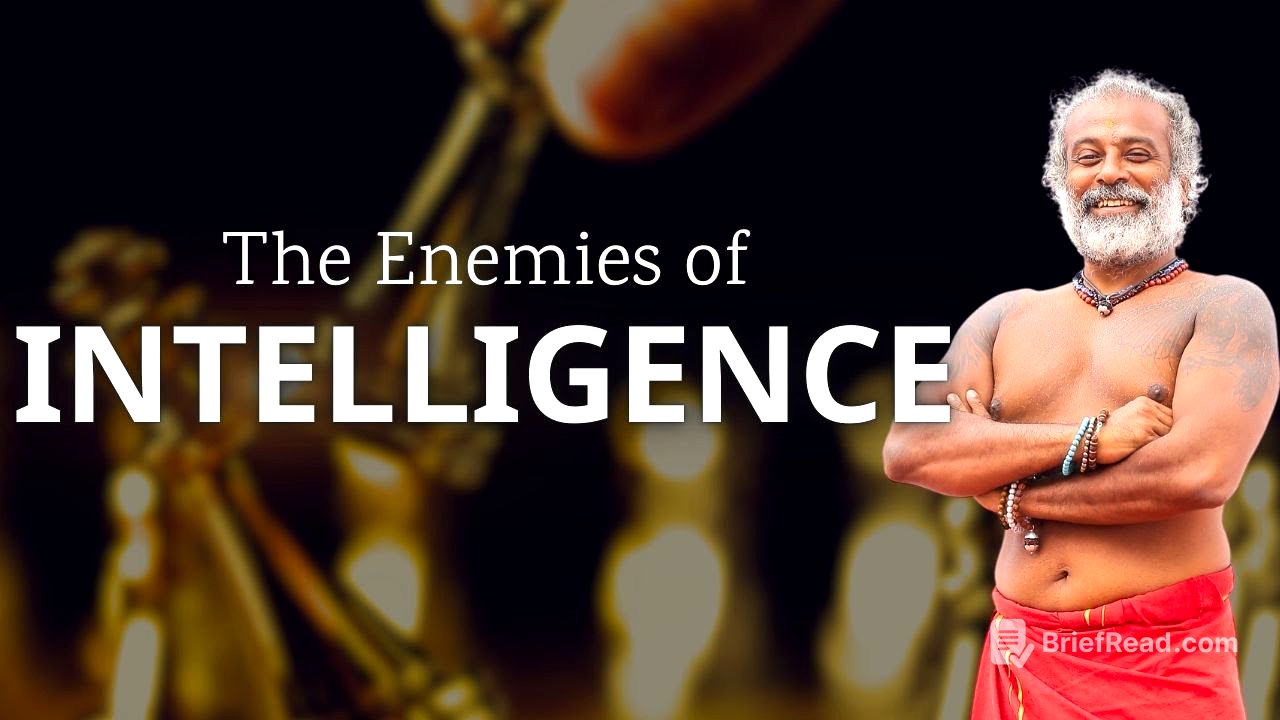
The video discusses the twelve enemies of intelligence that can hinder one's ability to think clearly and make informed decisions. It draws on mythological references, particularly the story of Shiva from the Kalika Puran, to illustrate how grief and other emotions can cloud judgment. Key points include the importance of recognizing these enemies and how to navigate them for better clarity and understanding in life.
- Grief leads to a victim mentality.
- Anger restricts understanding and relationship growth.
- Possessiveness stifles personal development and knowledge sharing.
- Lust, attachment, and pride create a skewed perception of reality.
- Envy and abhorrence prevent analytical thinking and understanding.
Shiva's Grief and the Birth of the River of Death [0:00]
The video opens with the story of Shiva, who mourns the loss of his wife Sati, with whom he spent 10,000 years. His overwhelming grief becomes the W River, symbolizing the divide between the living and the dead. Brahma advises Shiva that grief affects intelligence, prompting a discussion on the other enemies of intelligence.
Enemies of Intelligence: Grief and Anger [0:30]
Brahma identifies grief (shoka) as the first enemy of intelligence, asserting that it leads to a victim mentality. Love should not be measured by grief but by the joy of memories. Anger follows as a second enemy, as it limits one's understanding and prevents constructive communication with others who may cause frustration.
Possessiveness and Lust [2:00]
Possessiveness (loba) represents the need to control and restrict others, which often results in misunderstanding and conflict in relationships. Lust (kama) is highlighted next, detailing how indulgence in sexual fantasies can cloud judgment and prioritize momentary pleasures over meaningful connections.
Attachment to Pleasure and Subservience [3:00]
Another point made is that attachment to pleasure (moha) creates unrealistic expectations from life experiences, often leading to disappointment. Subservience (badhata) describes individuals who blindly follow orders without critical thinking, which stunts personal growth and intellectual development.
Jealousy and Pride [4:00]
Jealousy (ira) is discussed as an emotional hindrance that prevents knowledge sharing and fosters inequality among people. Similarly, pride (mana) can lead individuals to ignore the need for humility and self-improvement, jeopardizing their future growth.
Indecision and Compassion [5:00]
Indecision (vit) is examined as an inability to make choices due to fear of failure, impeding progress. Surprisingly, compassion (kupa) can also be detrimental, as it can lead to overprotectiveness and prevent individuals from allowing others to develop their own strength.
Envy and Abhorrence [6:00]
Envy (asuya) is highlighted as a destructive emotion that fosters resentment and diminishes one's own accomplishments. Abhorrence (jupa) involves labeling actions as entirely wrong without understanding the reasoning behind them, which diminishes the ability to address and solve issues effectively.
Conclusion: Overcoming the Enemies of Intelligence [7:00]
To be supremely intelligent, one must recognize and avoid engaging with these enemies of intelligence. The conclusion encourages viewers to reflect on these points, take notes, and strive for a higher state of awareness to enhance their intellectual capacity.





![Squidward's Revenge Full Animated Short Film🎥 Parts 1-4 [Re-uploaded]](https://wm-img.halpindev.com/p-briefread_c-10_b-10/urlb/aHR0cDovL2ltZy55b3V0dWJlLmNvbS92aS9YdU93dDFXbGhnUS9ocWRlZmF1bHQuanBn.jpg)