TLDR;
This book summary reveals that many human actions are driven by hidden motives, often for show or status, even when those actions don't truly benefit us. It explores how our brains conceal these selfish intentions, leading to self-deception. The key takeaways include understanding that our brains prioritize personal gain while avoiding appearing selfish, recognizing that institutions often serve hidden agendas, and acknowledging that self-deception can be both beneficial and detrimental. The summary also touches on the importance of body language, the social functions of laughter, and the role of language in signaling status.
- Human actions are often driven by hidden motives for show or status.
- Our brains conceal selfish intentions, leading to self-deception.
- Institutions often serve hidden agendas beyond their stated purposes.
- Body language, laughter, and language play significant roles in social signaling.
Introduction: The Elephant in the Brain [0:00]
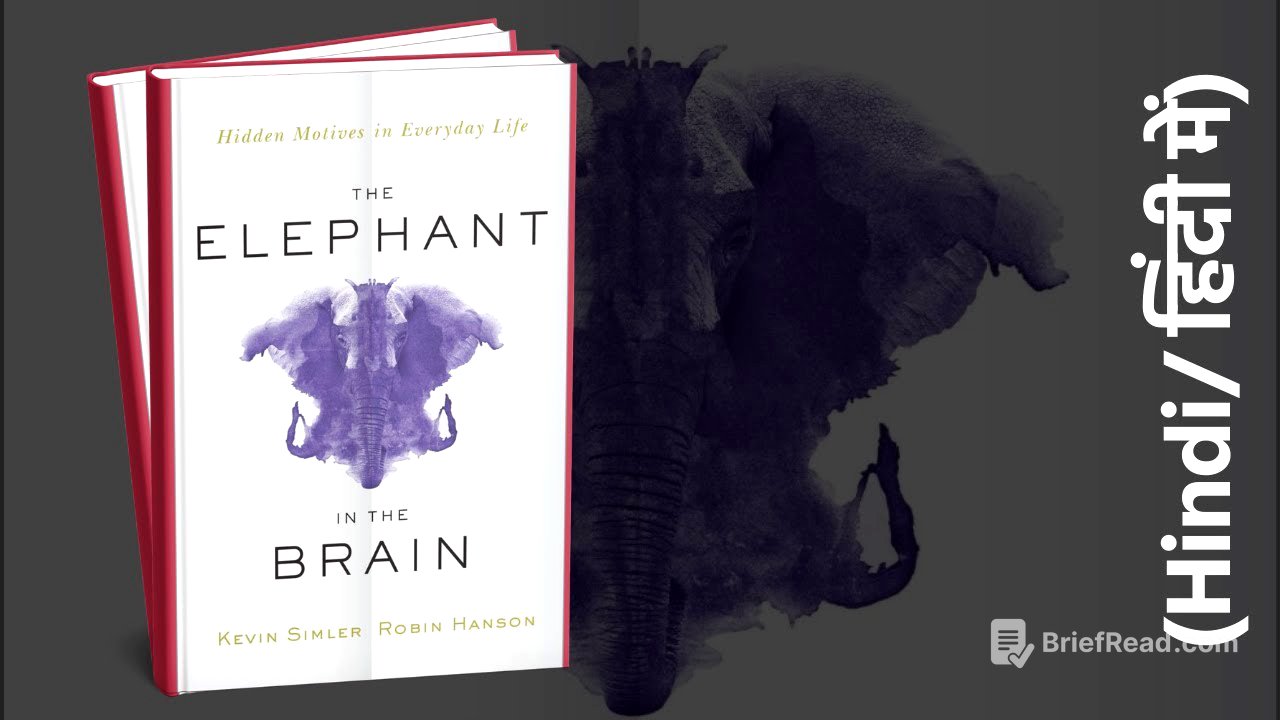
The book "The Elephant in the Brain" by Simer and Hassan explores how many of our actions are driven by hidden motives and the desire to appear a certain way to the world, even if those actions are not truly in our best interest. It reveals the secrets our brains hide from us, focusing on the "elephant in the room" concept, which refers to significant truths or problems that everyone knows but no one wants to discuss. The book introduces the idea of the "elephant in the brain," representing the truths about our own minds that we don't want to acknowledge.
The Discovery of the Elephant [1:03]
Robin was the first to recognize this "elephant," observing that people often consume excessive medication and fail to improve their health even when provided with free treatment. He noted that visiting a doctor is often more of a ritual, similar to a mother kissing a child's injury for comfort rather than actual healing. In wealthier countries, healthcare often serves as a display of care, termed "conspicuous caring," where expensive treatments are pursued to demonstrate concern for loved ones.
The Elephant in the Office [2:01]
Kevin observed this "elephant" in the office, where employees engage in social maneuvering to establish their status within the group, often disguising these actions as business matters. Instead of directly criticizing a colleague, an employee might claim the colleague lacks understanding, thereby protecting their own reputation and status. Humans are social animals constantly seeking to outdo others, a truth our brains often conceal, leading us to believe we are acting virtuously.
Core Ideas of the Book [3:25]
The book's core idea is that humans have hidden motives, a result of how our brains are designed. The brain works for its own benefit but avoids appearing selfish to others, concealing the truth even from ourselves to make it easier to hide unsavory intentions. Self-deception is a strategy that allows us to appear good even when we are not. Few people acknowledge this deception, and only by confronting the "elephant" can we understand the real truth, which includes selfishness, status, and power.
Hidden Motives in Behavior [4:33]
Human behavior is not always as it seems, with hidden motives often underlying even good deeds. The brain is designed to deceive others, starting with deceiving itself. People buy expensive items not for their utility but to flaunt their wealth. Institutions like schools, hospitals, and temples also have hidden agendas. Our laughter and body language reveal much, controlled by our brains, which are adept at concealing unsavory intentions with appealing stories.
The Matrix Analogy and Animal Behavior [6:12]
The book uses the analogy of the Matrix, offering the choice between the blue pill (a false, comfortable reality) and the red pill (the harsh truth). It advocates choosing the red pill to understand the complexities of human life. To understand humans, it suggests examining animals, as their behaviors, though seemingly straightforward, often have deeper, more complex motivations.
Social Grooming in Monkeys [7:32]
Monkeys spend a significant amount of time grooming each other, far more than necessary for mere hygiene. This behavior, known as social grooming, is a form of politics. By grooming each other, monkeys form alliances that provide support in difficult situations. The act of grooming signals trust and commitment, strengthening their team. Higher-status monkeys receive more grooming, as smaller monkeys groom them to gain benefits like food or support in fights.
Altruism in Arabian Babblers [10:08]
Arabian babblers, small birds living in the desert, live in groups and exhibit cooperative behaviors such as feeding each other and guarding against enemies. While this appears altruistic, there is competition among the birds to help, as helping others brings prestige and status. Higher status leads to more opportunities to mate and a lower risk of being expelled from the group. Thus, seemingly selfless acts are often driven by self-interest.
Lessons from Animal Behavior [12:32]
Animal behavior teaches us that actions are not always what they seem, with hidden motives often underlying surface reasons. While animals act on instinct without playing mind games, humans conceal their true motives because they are judged by others. This leads to self-deception, allowing us to better deceive others.
The Evolution of the Human Brain [13:43]
The human brain is exceptionally large compared to our body size, making us intelligent. Scientists often attribute this to cooperation, such as hunting together or making fire. However, competition, particularly among humans, may have driven brain development. This competition, though often disliked, is essential to understand the truth.
The Social Brain Hypothesis [15:11]
The Social Brain Hypothesis suggests that our intelligence evolved due to competition among humans for resources, love, and status. This competition manifests in three main areas: attracting partners through displays of art, music, and humor; gaining social status through dominance or prestige; and engaging in politics to build alliances and gain power within groups.
Politics and Signaling [18:18]
Humans are political animals, forming teams and engaging in complex social dynamics to increase their power. Politics involves both intimidation and charm, using honest signals that are difficult to fake to demonstrate trustworthiness. Like redwood trees competing for sunlight, humans engage in races for status, often wasting resources in the process.
Norms and Rules in Society [21:15]
Humans create norms and rules to mitigate wasteful competition and promote cooperation. These rules, ranging from social etiquette to laws, aim to benefit everyone. Early human societies were egalitarian, with strong norms against those who sought to dominate. The invention of weapons changed this dynamic, making politics more important than physical strength.
Gossip and Reputation [24:00]
Gossip and reputation are essential tools for enforcing social norms. Gossip serves as a weapon to control those who are difficult to manage directly, while the fear of losing reputation encourages good behavior. Societies often enforce meta-norms, punishing those who fail to enforce the rules, thereby creating a culture of compliance.
Selfish Intentions and Social Norms [25:15]
Humans often hide their selfish intentions, presenting themselves as pro-social. While norms reduce conflict, they also make our brains more cunning, leading us to break rules discreetly. Cheating is common, with people adhering to major rules but bending minor ones. The fear of shame and loss of status deters us from getting caught.
Common Knowledge and Pretexts [27:28]
People often rely on "common knowledge," where everyone is aware of a truth but pretends otherwise. This allows for plausible deniability, where individuals can claim ignorance to avoid consequences. We use body language and coded language to communicate hidden meanings, allowing us to navigate social situations discreetly.
Gray Areas and Hidden Agendas [29:01]
Humans exploit gray areas in rules to their advantage, often concealing selfish motives behind good intentions. To break norms requires a sharp mind, leading to a constant race between cheaters and those trying to catch them. Deception is a natural part of human behavior, offering benefits without effort.
Self-Deception as a Strategy [30:02]
Humans engage in self-deception, ignoring truths and forgetting unpleasant memories. While traditional thinking views this as a defense mechanism, a new school of thought sees it as a strategy for manipulating others. Self-deception is essential for deceiving others, making it the brain's most significant and rewarding game.
Why We Believe Our Own Lies [31:40]
Lying is mentally taxing, requiring us to remember past falsehoods. The best way to convince others is to convince ourselves, as people closely observe our eyes and faces. The brain conceals the truth from itself through methods like "the madman," "the loyalist," "the cheerleader," and "the cheater."
The Committee of the Mind [33:24]
The brain is not a single entity but a team of parts, with some parts knowing the truth and others maintaining the lie. This allows us to lie to ourselves, suppressing bad memories and focusing on positive aspects. The brain protects the ego, hiding unpleasant truths and emphasizing positive actions.
The Press Secretary of the Mind [35:10]
The brain is designed to win social games, concealing our true motives to avoid detection. Like a press secretary, our brain rationalizes our actions, creating plausible explanations even when the real reasons are hidden. This "interpreter module" generates stories to explain our behavior, often without knowing the true motives.
Strategic Ignorance [36:43]
The brain makes decisions first and creates justifications later, acting as a press secretary who conceals unpleasant secrets. This involves "strategic ignorance," where we deliberately remain unaware to avoid being held accountable. We are not the rulers of our minds but merely spokespersons defending the decisions made by our brains.
Examples of Hidden Motives in Everyday Life [39:41]
Even young children use pretexts to get what they want, such as a child claiming they need to use the potty to avoid going to bed. Adults are even more adept at creating believable excuses. We often present half-truths, highlighting good intentions while concealing selfish motives.
Body Language and Nonverbal Communication [42:13]
While schools teach verbal communication, they often neglect body language, which is crucial for understanding emotions and social dynamics. Body language reveals emotions like happiness, boredom, status, and loyalty. We communicate nonverbally through facial expressions, eye contact, tone of voice, and posture.
The Unconscious Language of the Body [43:22]
We communicate through body language without conscious thought, making gestures and maintaining eye contact automatically. This automatic communication is preferred, as deliberate gestures appear fake. We often fail to fully understand others' body language, sensing that someone dislikes us without knowing why.
Signals and Cues [44:05]
Conscious thought is slow, while the body needs to react quickly to threats. Our press secretary conceals the body's truths, as our animalistic nature and selfish motives are revealed through body language. Signals are used to influence others' behavior, while cues are the information we try to hide.
Flirting and Seduction [45:13]
Body language is more truthful than words, with direct functions and meanings. Honest signals are difficult to fake. In the game of love, body language is essential for flirting and seduction, often done discreetly to adhere to modesty norms. Eye contact, physical proximity, and touch are key signals of interest.
Politics and Body Language [47:37]
In politics, body language conveys trust and loyalty, strengthening teams. Gestures like grooming, hugging, handshakes, and shoulder pats signal loyalty. Posture and eye contact also communicate political messages, with leaders using specific gestures to assert dominance or build rapport.
Status and Body Language [49:13]
Every human action signals status, though we are often unaware of these signals. High-status individuals are more relaxed and confident, while low-status individuals are more guarded and defensive. High-status people seek attention, while low-status people try to avoid it.
Dominance and Prestige [51:56]
Status is conveyed through dominance (intimidation) and prestige (skill and respect). Eye contact differs in these contexts, with dominance involving a challenging gaze and prestige involving admiration. Visual dominance ratio, the balance of eye contact while speaking and listening, indicates status.
The Complexity of Body Language [53:48]
We often fail to understand body language due to the complex rules governing love, politics, and status. Our selfish motives can be harmful to others, leading us to act discreetly. Body language allows us to communicate what we cannot say, with plausible deniability providing an escape route if caught.
Laughter as a Social Behavior [55:18]
Laughter is a peculiar and universal human behavior, often involuntary and linked to social interaction. It serves to connect us with friends and mock enemies. Laughter is more frequent in groups, with the speaker laughing more than the listener. It signals playfulness and reassurance, indicating that we are not serious.
The Meaning of Laughter [57:30]
Laughter indicates that everything is okay, allowing us to joke about taboo topics and providing comfort in difficult situations. It reveals our relationships, with laughter at others' misfortunes indicating psychological distance. Teasing among friends strengthens bonds, while teasing strangers becomes bullying.
Laughter and Social Boundaries [1:00:19]
Laughter helps us understand social boundaries, revealing the limits that language cannot. It allows us to express truths in a non-committal way, providing an escape route if challenged. The brain conceals the true meaning of laughter, allowing us to express harsh truths in jest.
Language as a Form of Showing Off [1:02:03]
Language, which occupies a significant portion of our lives, is not just about sharing information but also about showing off. While listening is cheap, speaking has a cost, as it relinquishes control over information. However, speaking allows us to increase our status and impress others.
The Magic Bag Analogy [1:04:51]
The "magic bag" analogy illustrates that conversations are not just about trading information but about assessing the speaker's overall value as a potential partner or ally. Listeners evaluate the quality of the speaker's "bag" of knowledge and skills. Every conversation is a mini-interview, where we apply to be a friend, lover, or leader.
Hidden Meanings in Conversation [1:06:00]
Every statement has a literal meaning and a hidden meaning, with the hidden meaning often being more important. In job interviews, intelligence is valued more than specific knowledge. Good language is like beautiful plumage, attracting attention and increasing prestige.
The Importance of Relevance [1:07:04]
Relevance is crucial in conversation, as it demonstrates genuine intelligence. People want to see a full "showroom" in your bag of knowledge. Those who provide valuable information are respected and sought after as partners. Prestige, or the value as a partner, is enhanced by good speaking skills.
Status and Prestige in the Modern World [1:08:09]
In the modern world, the pursuit of status and prestige extends to news consumption and academic research. We consume news to appear smart and maintain status among friends. Academics seek to publish in prestigious journals and work at renowned institutions, often prioritizing name over substance.
Conspicuous Consumption and Status [1:09:53]
Despite predictions of reduced working hours, we work more than ever, trapped in a "rat race" driven by conspicuous consumption. We spend money not just for needs but to signal status. Eco-friendly purchases are often motivated by a desire to enhance status rather than genuine environmental concern.
The Alien Thought Experiment [1:11:39]
A thought experiment involving an alien who makes it impossible to see others' possessions reveals that much of our spending is driven by the desire to impress others. Without the ability to judge others based on their belongings, people would likely wear more comfortable clothes, live in smaller homes, and reduce spending on decorations.
Advertising and the Third-Person Effect [1:12:53]
Advertising persuades us to buy goods, with lifestyle advertisements selling feelings rather than products. The "third-person effect" suggests that we believe others are more susceptible to advertising than we are. Companies use advertising to create status around their products, even targeting those who cannot afford them to create envy.
Art as a Form of Showing Off [1:14:10]
Art, a universal human endeavor, serves as a form of showing off. It demonstrates that we have surplus time, energy, and skill. The bowerbird, which builds elaborate nests to attract mates, provides an animal example of this behavior. Humans create art to impress friends and partners, showcasing their intelligence.
Intrinsic and Extrinsic Properties of Art [1:16:01]
Art has intrinsic properties (how it looks) and extrinsic properties (who made it and how much effort was involved). We often value the extrinsic properties more, appreciating the artist's skill and effort. Originality is highly valued, as it demonstrates the artist's true talent.
The Value of Difficulty [1:17:31]
The value of art lies in the artist's skill, with more difficult creations being more highly prized. Artists often choose challenging methods to demonstrate their abilities. As technology changes, our preferences shift, with hand-made items becoming more valuable in a world of mass-produced goods.
The Impracticality of Art [1:19:54]
The impracticality of art is its defining feature. A beautiful cake is art because its decorations serve no practical purpose, signaling wealth and leisure. Fashion, often uncomfortable, signals a concern for style. These displays of effort and resources serve to enhance status.
The Hidden Motives of Schooling [1:21:05]
While school is ostensibly for learning, its true purpose is more complex. Free education without a degree is often ignored, as degrees are valued more than knowledge. Employers prioritize degrees, which signal intelligence, diligence, and compliance. Schooling is a signaling mechanism, demonstrating potential to employers.
The Spies-Skin Effect [1:21:53]
The "spies-skin effect" refers to the increased salary earned from the final year of schooling, regardless of new knowledge gained. Schools primarily distribute certificates, with grades signaling compliance rather than knowledge. Schools also serve as daycare, social hubs, and propaganda centers, instilling patriotism and obedience.
The Politics of Voting [1:24:22]
Voting, ostensibly for the welfare of the country, is often driven by other motives. The effort and time required to vote, combined with the low probability of a single vote making a difference, suggest that the true motive is something else. Voters often lack accurate information and are driven by emotion and loyalty to their team.
Loyalty and Sacrifice [1:25:38]
Loyalty requires sacrifice, with voting serving as a signal of commitment. We often praise our virtues while concealing our true motives. Recognizing this "elephant in the brain" is difficult, as we prefer to deceive ourselves to appear good to others.
The Benefits of Recognizing the Truth [1:26:11]
Recognizing the truth about our hidden motives brings awareness and a deeper understanding of the world. It allows us to identify the self-interest behind the actions of leaders and institutions. It also fosters humility, allowing us to become better people.
Practical Applications and Conclusion [1:27:04]
By understanding our true motives, we can make better choices, such as donating to causes where help is genuinely needed. Connecting self-interest with good deeds can lead to positive outcomes. Hypocrisy, in a way, is a tax on vice, preventing us from becoming entirely bad. Policymakers should understand these hidden motives to create more effective institutions. In conclusion, humans are complex, interesting, and somewhat selfish, with self-deception playing a key role in our social interactions.



![Digimon Adventure 2020 [Episodes 1-5] Discussion | Billiam](https://wm-img.halpindev.com/p-briefread_c-10_b-10/urlb/aHR0cDovL2ltZy55b3V0dWJlLmNvbS92aS93MXQ1Sno5NWdIay9ocWRlZmF1bHQuanBn.jpg)