TLDR;
The video discusses the evolution of money from its inception to the digital age, highlighting key milestones and innovations throughout history.
- Money began as a barter system where goods were directly exchanged.
- Commodity money emerged, utilizing items with intrinsic value like salt, cattle, and precious metals.
- The invention of coinage revolutionized trade, followed by the introduction of paper money.
- The development of banking systems and digital transactions transformed how money is managed and utilized today.
The Origins of Money [0:00]
Money is a foundational invention that has influenced humanity for thousands of years. In early societies, barter was the primary means of trade, where goods and services were exchanged directly. However, this system had limitations, particularly the need for a coincidence of wants, which paved the way for a more universal method of exchange.
Development of Commodity Money [1:10]
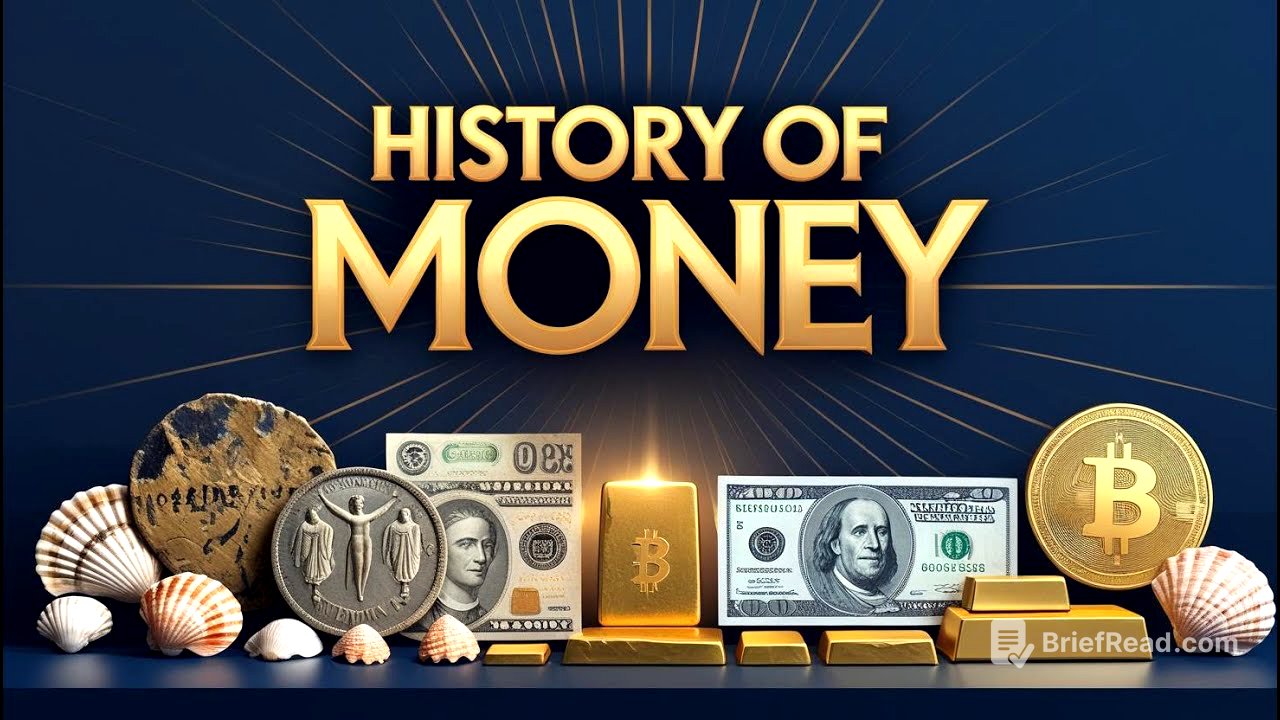
As societies evolved, different commodities became widely accepted as money due to their intrinsic value. Salt, for instance, became a medium of exchange in some cultures, while cattle represented wealth in others. Shells, particularly cowry shells, were widely used in various regions. Gold and silver also gained popularity in trade due to their rarity and beauty, providing a standard agreed upon for value.
The Birth of Coinage [2:23]
Around 600 BCE, the invention of coinage in Lydia marked a significant turning point in monetary history. Coins made of electrum were standardized and stamped, allowing for easier trade without the need for weighing or testing metals. This innovation spread throughout the Greek world and was adopted by various empires, including the Persians and Romans, enhancing the speed and security of trade.
The Introduction of Paper Money [3:39]
During the Tang Dynasty in China, merchants began using promissory notes, leading to the creation of paper money. This system, which gained traction during the Yuan Dynasty under Kublai Khan, was easier to transport than coins but required trust in the authority that issued it. Marco Polo noted the impact of paper currency, which allowed for transactions without the need for physical coins.
Emergence of Banking Systems [4:29]
In medieval Europe, banking systems began to form as merchants created bills of exchange, facilitating trade without physical gold. Goldsmiths in England issued receipts for stored precious metals, leading to modern banknotes. The Bank of England's founding in 1694 marked a shift where paper notes became state-guaranteed, a model that led to central banks issuing currencies worldwide.
Shifts in Currency Value [5:09]
Over time, the value of currency transitioned from being directly linked to precious metals, known as the gold standard, to being based on trust in the nation and its economic stability—this system is called fiat money. The 19th and 20th centuries saw the rise of checks for transactions, electronic fund transfers, and the introduction of credit cards, allowing for more convenient consumer spending.
The Digital Revolution in Money [6:03]
The late 20th and early 21st centuries brought about a digital revolution with online banking and mobile payment apps, making money transfer quick and easy. The emergence of cryptocurrencies like Bitcoin in 2009 introduced a new form of digital currency independent of government control, utilizing blockchain technology for security. This sparked discussions on regulation and the future stability of money.
The Future of Money [7:03]
Throughout its history, money has served as more than just a means of exchange. It has been integral in measuring value and symbolizing trust within societies. As technology continues to evolve, the future may hold programmable currencies and new forms of value exchange, ensuring that money stays central to human interaction and commerce.