TLDR;
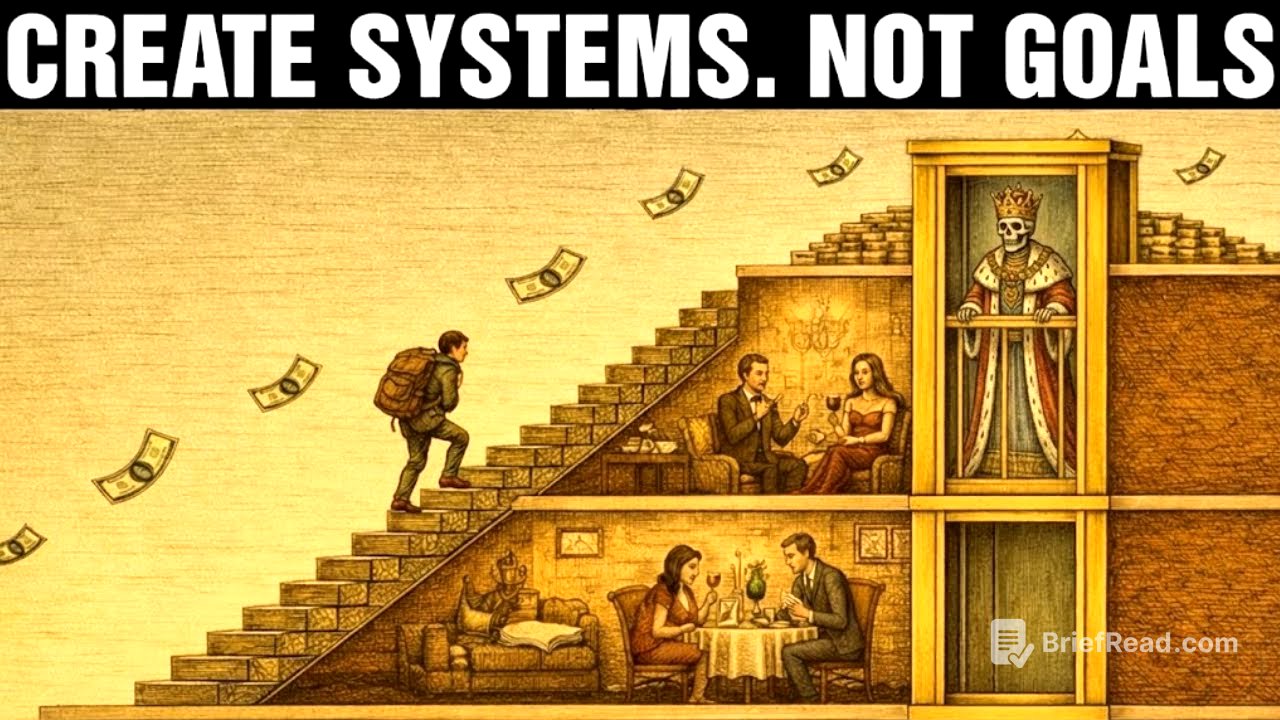
This video challenges the conventional understanding of goal setting and motivation, asserting that success is not a result of ambition or hope, but rather the product of well-designed systems. It argues that declaring goals can be self-deceptive due to the dopamine release associated with the declaration itself, which can trick the brain into feeling accomplished without actual work. The video advocates for building robust systems that automate desired behaviors, eliminate choices that lead to failure, and incorporate precise measurement to track progress and identify areas for improvement.
- Declaring goals can be self-deceptive due to premature dopamine release.
- Success is engineered through systems, not achieved through hope or motivation.
- Choice is a burden that depletes cognitive resources; systems should automate desired behaviors.
- Measurement is crucial for tracking progress, identifying system flaws, and ensuring accountability.
- Identity is transformed as systems produce consistent results, reinforcing desired behaviors.
The Illusion of Goals and the Power of Systems [0:49]
The video begins by stating that merely declaring goals leads to a premature release of dopamine, which gives a false sense of accomplishment. This can reduce the likelihood of achieving those goals because the brain already feels rewarded without the necessary effort. Research from New York University supports this, showing that individuals who publicly announce their goals are less likely to achieve them compared to those who focus on building systems privately. The speaker emphasizes that power comes from engineering outcomes through systems, not from hoping for them.
The Downfall of Plans Without Systems [2:15]
The speaker underscores that plans without systems are useless. The Roman Empire's decline is cited as an example, where the focus on glory overshadowed the decay of essential systems like road maintenance and governance. The core message is that one collapses to the level of their systems, not rises to the level of their goals. The video asserts that failures in life are reflections of inadequate systems, not personal character flaws.
The Mechanics of Failure and the Biology of Least Resistance [3:20]
The video explains that current failures are not due to personal shortcomings but are the logical outcomes of existing systems. Overweight, poverty, and stagnation are presented as results of systems designed to produce those outcomes. The speaker highlights that blaming oneself for poor operation is misguided if the underlying system is flawed. The nervous system is optimized for energy conservation, so it defaults to the easiest path, making well-designed systems crucial for success. Navy Seals prioritize systems over motivation, ensuring automatic function under duress.
The Myth of Motivation and the Reality of Chaos [5:05]
The speaker argues that motivation is unreliable because it is an emotional state influenced by uncontrollable factors like sleep, hormones, and external events. Relying on motivation is akin to handing control to random chance, leading to inconsistent effort and results. The video contrasts this with the consistency achieved through systems, which eliminate the need for constant decision-making and willpower.
Choice as a Burden and the Power of Elimination [7:54]
The video introduces the concept of decision fatigue, explaining that every choice depletes cognitive bandwidth. To combat this, systems should eliminate choices at the moment of action, making desired behaviors automatic. Examples like Barack Obama and Steve Jobs, who minimized daily decisions to conserve mental energy, illustrate this principle. The goal is to create conditions where the desired behavior is the default, removing the option to fail.
The Infrastructure of Excellence and the Surrender of Power [9:44]
The speaker emphasizes that successful individuals schedule their activities and eliminate negotiation with themselves. Professional athletes, for example, operate on rails with training, meals, and sleep meticulously planned. The video warns against treating commitments as mere suggestions, as this allows comfort to override achievement. The negotiation itself is the failure point; eliminating choice focuses energy and ensures consistent action.
Measurement: The Objective Witness [12:13]
The importance of measurement is highlighted, asserting that systems without measurement decay. Numbers provide an objective view of actual behavior versus claimed behavior, revealing the gap between the two. The video criticizes tracking emotions as progress, advocating instead for tracking concrete metrics like hours worked, words written, or money saved. This data-driven approach eliminates self-deception and allows for informed adjustments to the system.
From Personal Defeat to Design Problem [14:44]
The video encourages viewing failure as a design problem rather than a personal one. Instead of self-blame, the speaker advises analyzing the system to identify breakdowns, environmental factors, and decision points that exposed weaknesses. Thomas Edison's approach to failed light bulb prototypes is used as an example of iterating systems based on data. The video emphasizes that measurable data outweighs subjective feelings in determining progress.
Implementing Measurement and Choosing Metrics [16:15]
The speaker provides practical steps for implementing measurement, advising to choose three key metrics directly correlated to the desired outcome. Examples include tracking workout completion, protein intake, and sleep hours for fitness goals, or tracking deep work hours, customer conversations, and revenue for business goals. The video suggests using a simple spreadsheet or notebook to record daily numbers and reviewing the data weekly to identify patterns and adjust the system accordingly.
From External Structure to Internal Environment [17:04]
The video explains that initially, implementing a system feels forced, as it requires creating new neural pathways and fighting against existing patterns. This resistance phase typically lasts 3-6 weeks, during which many people quit. However, persisting through this phase leads to the system becoming automatic and integrated into one's identity. Neurological studies show that habitual behaviors reduce prefrontal cortex involvement and shift control to the basal ganglia, making execution automatic.
The Transformation of Identity Through Consistent Results [18:26]
The video outlines the sequence of transformation: first, the system produces small results, which then create proof of one's capabilities. This proof transforms identity as the brain believes what it repeatedly observes. Acting according to the system no longer requires willpower but becomes a natural part of one's identity. The internal dialogue shifts, and negative voices lose power as they argue against documented proof of who one has become.
Real Freedom Through Pre-Planned Decisions [20:27]
The speaker asserts that real freedom comes from having decisions made in advance by a clear-thinking version of oneself. Operating from system rather than choice eliminates internal debate and conserves energy. The video reiterates that the struggle ends when the system is installed and runs with smooth precision, freeing one to focus on higher-level strategy. Mastery is achieved by making hard things easy through architecture.
Six Steps to Building Systems for Dominance [21:31]
The video provides a six-step process for building effective systems:
- Identify the highest leverage outcome.
- Reverse engineer the daily behavior that produces this outcome.
- Remove every obstacle between you and the behavior.
- Install forcing functions to make the desired behavior unavoidable.
- Measure without mercy, tracking specific metrics of system execution.
- Protect the system from erosion, especially in the early stages.
Protecting the System and Embracing Engineering [24:37]
The speaker warns against backsliding once the system is working, emphasizing the need for vigilance and no exceptions for at least the first 90 days. New systems are fragile and require protection until they become embedded in identity. The video concludes by stating that success is not a miracle but engineering, the result of deliberate design, precise implementation, and data-driven adjustments.
The Choice Between Control and Victimhood [26:46]
The video reiterates that current results are outputs of existing systems, whether consciously designed or unconsciously adopted. The choice is between continuing with failing systems and hoping for different results (insanity) or dismantling and rebuilding them with clarity. The speaker issues a directive to identify and destroy one system that is producing unwanted results, then rebuild it using the six-step process. The ultimate choice is between being the architect of one's life or the victim of default patterns.