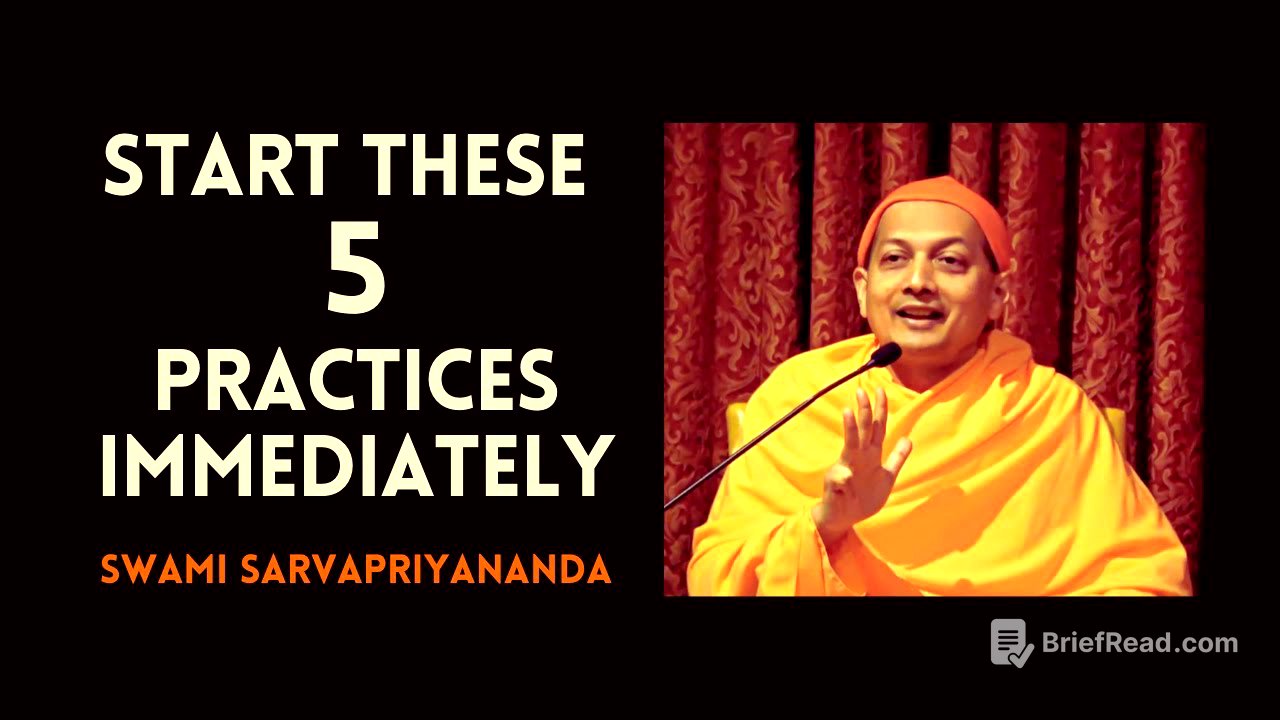
TLDR;
This video outlines the five Yamas, or restraints, which are foundational practices in spiritual life and yoga. These restraints include non-violence (ahimsa), truthfulness (satya), chastity/control (brahmacharya), non-stealing (asteya), and non-acceptance of gifts (aparigraha). The speaker explains each concept, emphasizing the importance of practicing them in thought, word, and deed, adjusted to one's position in society. The discussion includes real-life examples and stories to illustrate the practical application and subtleties of these principles.
- The five Yamas are foundational practices for spiritual growth.
- Non-violence, truthfulness, chastity, non-stealing, and non-acceptance of gifts are key restraints.
- These principles should be applied thoughtfully and appropriately in daily life.
Foundations of Spiritual Life [0:00]
The video introduces the five Yamas, which are essential restraints for anyone aspiring to be a yogi or meditator. These practices include non-violence (ahimsa), truthfulness (satya), chastity/control (brahmacharya), non-acceptance of gifts (aparigraha), and non-stealing (asteya). The speaker clarifies that these are practices to adopt, not avoid, such as practicing non-violence rather than committing violence, and embracing truth instead of falsehoods.
Non-violence adjusted to your situation [1:29]
Non-violence (ahimsa) should be practiced in thought, word, and deed, adjusted to one's societal role. For monks, it's an absolute practice, while for soldiers, it's moderated. The Yoga Sutras state that when non-violence is perfected, even natural enemies will live peacefully together. Recent studies in positive psychology suggest that we live in less violent times and that non-violent struggles are more successful than violent ones.
Story of the Karate Master who was mugged [3:30]
The speaker shares a story about a karate master who, when mugged, peacefully handed over his money instead of using his lethal skills. The teacher explained that he couldn't bring himself to use his hands, capable of smashing bricks, on another human being. This illustrates non-violence from a position of strength, highlighting that true non-violence requires inner power.
Truth - go around telling business truths to everyone? [5:00]
Truthfulness (satya) doesn't mean divulging all truths to everyone at all times, which could lead to unpopularity. Instead, it means not telling untruths and maintaining honesty. The speaker references a story of a yoga teacher who emphasized that moral practices like truthfulness and self-control are essential and cannot be skipped in favor of more glamorous meditation techniques.
Ashtanga Yoga or Vikalanga Yoga? [5:50]
The yoga teacher in the story used an analogy in Hindi, stating that skipping the initial moral practices would result in "Vikalanga Yoga," or handicapped yoga. The teacher emphasized that one cannot meditate effectively while harboring dishonesty or undeclared income.
Can't meditate sitting on black money [6:40]
The speaker emphasizes that honesty and truthfulness are essential for effective meditation. One cannot expect to meditate successfully while engaging in dishonest practices or harboring undeclared income.
Tell harsh truths in a sweet way [7:12]
The speaker advises that while truth should be told, it should be delivered sweetly and gently. Even harsh truths can be conveyed in a non-hurting way. Holy Mother Sarada Devi advised a disciple with a sharp tongue to speak more kindly, illustrating how to address sensitive topics with compassion.
Brutal Truth is more about Brutality - Mark Twain [7:56]
Mark Twain observed that those who claim to be fond of the "brutal truth" are often more fond of brutality than truth itself. The speaker introduces a Sanskrit saying that one should speak the truth, speak what is beneficial, speak limitedly, speak universally, and speak sweetly.
Think thrice before speaking [9:22]
A swami recommended thinking thrice before speaking, considering whether the words are true, useful, minimal, universal, and sweet. Even if not three times, one should at least run the words through one's mind once before uttering them.
Brahmacharya - Chaste brain is powerful [9:45]
Brahmacharya involves avoiding sexual impropriety, with the extent varying based on one's commitment to celibacy and station in life. Swami Vivekananda stated that a chaste brain is tremendously powerful, as a lot of energy is otherwise wasted. Spiritual power comes from sense control and chastity.
Accepting Gifts opens you to obligation [10:33]
Aparigraha, or non-acceptance of gifts, is crucial because accepting gifts opens one to obligations and affects the mind. There is an automatic need to give back. Salesmen use the principle of reciprocation, offering a small gift to soften the recipient before attempting to sell a product.
Reflex to give back - salesman technique [11:03]
The reflex to give back is a well-known sales technique. Salesmen often offer a small gift to create a sense of obligation, making the recipient more receptive to their sales pitch. Accepting a gift softens the recipient, making them more inclined to listen.
Incident of Premeshananda - gift of walking stick [12:05]
The speaker shares a story about Swami Premeshananda, who refused a walking stick offered as a gift. When the giver insisted he wanted nothing in return, the swami took the stick and broke it, revealing the giver's subtle expectation of how the gift should be treated. This illustrates the subtle attachment and obligation that come with accepting gifts.
Asteya - non-stealing [13:25]
Asteya, or non-stealing, means not taking what does not belong to one without permission. This principle extends beyond physical theft to include the subtle appropriation of resources.
Sri Ramakrishna incident - unable to accept lemons [13:55]
The speaker recounts an incident where Sri Ramakrishna couldn't accept lemons because the ownership of the land where they were sourced had changed. He insisted they be returned, as they were not rightfully his.
A Philosopher's observation - no right to even extra earnings [14:33]
A philosopher developed a philosophy of donating most of his earnings, believing he had no right to anything beyond bare subsistence. This illustrates a deeper understanding of non-stealing, questioning one's right to resources even if legitimately earned.
Question on accepting gifts during festivals etc. [15:28]
The speaker addresses the apparent contradiction of not accepting gifts while also advocating for charity. The key is that non-acceptance of gifts is a practice for yogis to avoid obligation, while giving to charity involves relinquishing ownership and entitlement. In social situations like festivals, one should give back more than they receive to avoid mental entanglement. The speaker encourages individual reflection on these practices.