TLDR;
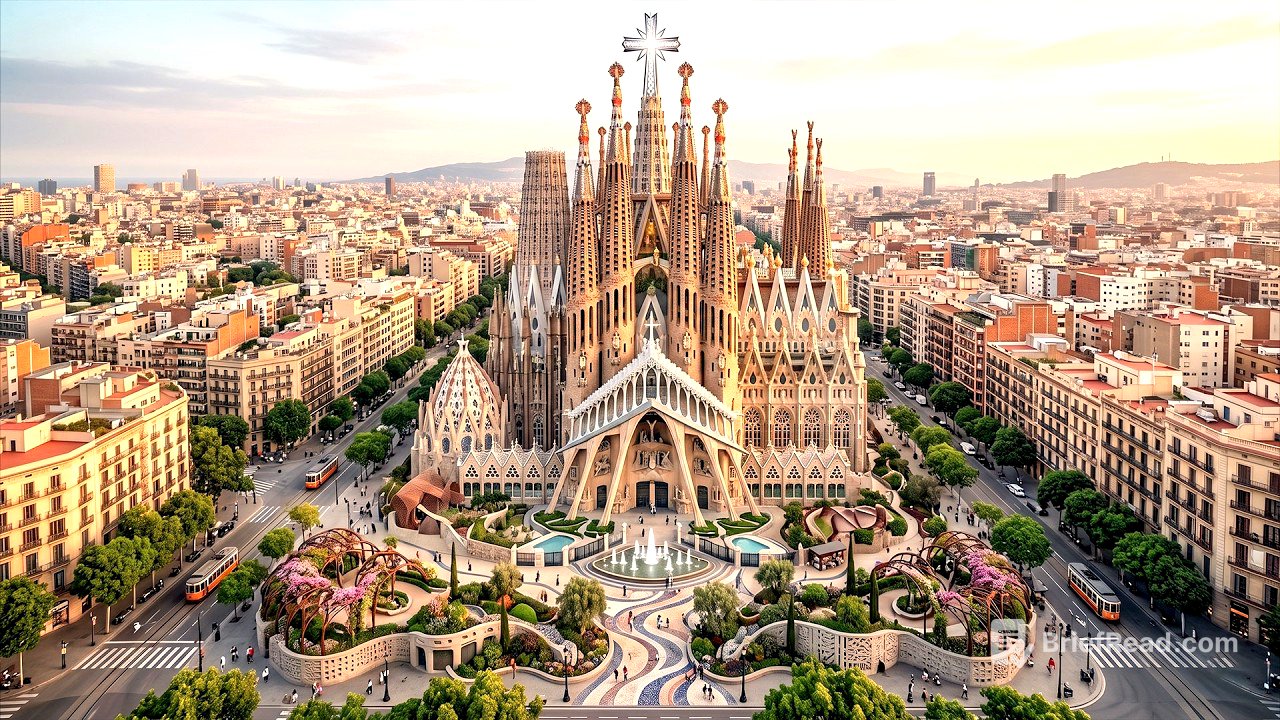
The video explores the history of the Sagrada Familia in Barcelona, highlighting its journey from a simple church design to becoming the tallest church in the world. It discusses the challenges faced during its construction, including wars, financial struggles, and the innovative vision brought by architect Antoni Gaudí.
- The Sagrada Familia began in 1882 as a modest project relying solely on public donations.
- Architect Antoni Gaudí transformed the design into a unique blend of nature and architecture, significantly changing its scope and ambition.
- The construction faced many setbacks, notably the Spanish Civil War, which threatened to destroy Gaudí's vision, but architects later reinvented and continued the work.
- Modern technology and new materials have played a crucial role in advancing the construction towards its completion, projected for around 2035.
A Church Begins [0:51]
The Sagrada Familia's history starts in 1882 when a group of Catholics in Barcelona decided to build an expiatory church funded solely through public donations. Initially, they aimed for a simple Gothic design, which slowly developed amid financial constraints. Despite these limitations, the project gradually took shape, and it remained locally focused without global interest. The ordinary appearance masked the deeper significance behind it, symbolizing the faith of ordinary people.
Gaudí Changes Everything [3:53]
In 1883, architect Antoni Gaudí took over and dramatically shifted the project. He abandoned the original Gothic style, drawing inspiration from nature to create a unique architectural vision. Gaudí designed columns resembling tree trunks and ceilings with natural geometry that enhanced the interior space's openness. He used plaster models for testing and ensured that each design choice held deeper meaning, as the structure began to evolve into a representation of ideas and innovation rather than just a place of worship.
War Destroys Vision [7:44]
The construction slowed significantly after Gaudí's death in 1926, when about a quarter of the church was completed. The Spanish Civil War further devastated progress by destroying many of Gaudí's original models and drawings, complicating future efforts to reconstruct his vision. However, subsequent generations of architects and engineers committed to understanding Gaudí’s fragmented designs and continued the work, treating the church as a symbol of resilience despite the challenges.
Building the Impossible [11:03]
After the war, builders faced immense challenges without complete plans. They carefully examined the surviving fragments of Gaudí's work and continued construction step-by-step. Strengthening the structure while ensuring safety became priorities, requiring detailed reports and official approvals from local authorities. Despite limited donations causing delays, architects, engineers, and workers collaborated effectively, organizing schedules and breaking the work into manageable parts to steadily push the project forward.
Machines Build Stone [15:00]
Modern machines played a pivotal role as the project progressed. CNC machines enabled precise stone cutting, enhancing speed and reducing errors, while detailed 3D models guided production. Instead of on-site construction, prefabricated panels were created in workshops and then transported for assembly, requiring careful coordination. Attention to safety and precision remained paramount, with engineers integrating steel reinforcements to enhance stability and prepare for the eventual completion of the structure.
The Final Tower [18:11]
As builders focused on completing the central tower dedicated to Jesus Christ, all safety protocols and modular construction methods were strictly followed. The completion of this tower marked a significant milestone, ultimately achieving its planned height of 172.5 meters. The historic moment occurred on February 20, 2026, when the final section was placed. Although the full completion is expected around 2033, this milestone showcased the dedication and endurance of multiple generations that contributed to the Sagrada Familia’s legacy.