TLDR;
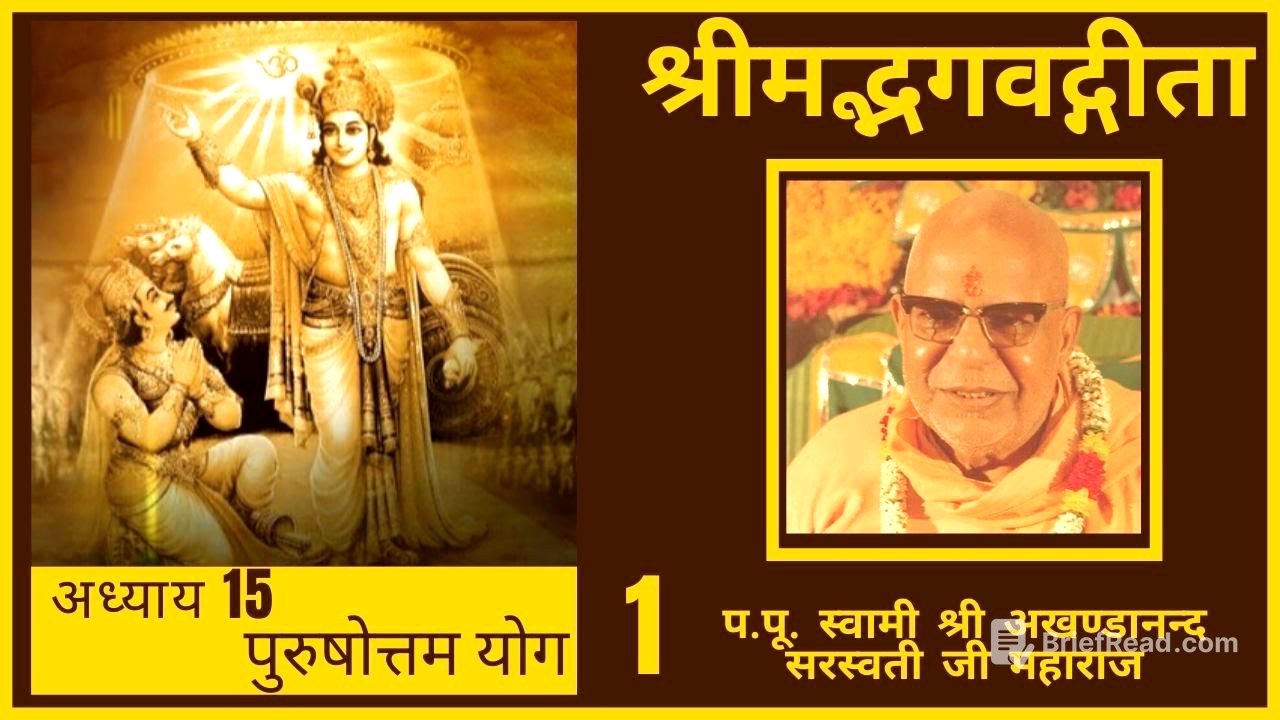
This video features a discourse by Swami Akhandanand Saraswati, focusing on the essence of the Gita and its accessibility to all, regardless of social standing. The discussion transitions into an analysis of the fifteenth chapter of the Gita, particularly the metaphor of the "Ashvattha" tree to explain the nature of the world and the means to understand reality.
- The Gita is accessible to everyone, unlike the Upanishads.
- The world is like an "Ashvattha" tree, with its roots upward and branches downward, symbolizing the creation and the cycle of life.
- Understanding the true nature of the world leads to bliss and detachment from worldly desires.
Opening Prayers and Salutations [0:01]
The video starts with devotional music and chants, setting a spiritual tone. The initial moments are filled with praises and musical offerings, creating an atmosphere of reverence.
Welcome and Introduction [2:23]
The speaker welcomes attendees and acknowledges the presence of esteemed guests, including those from the Akhil Bharat Varshiya Vikram University. He expresses gratitude towards individuals involved in organizing the event and highlights the significance of the gathering, emphasizing the pursuit of knowledge and understanding.
The Essence of Shivratri and Prayers for Well-being [3:57]
The discourse touches upon the essence of Shivratri, a significant festival. Prayers are offered for the good health and prosperity of all attendees, seeking blessings from the divine.
The Accessibility of the Gita [8:55]
The speaker contrasts the accessibility of the Gita with that of the Upanishads, noting that while the Upanishads may not be universally accessible, the Gita is open to all, irrespective of caste or background. The Gita is described as a melodious and universally accessible scripture, containing elements of attraction, essence, and fragrance that appeal to all beings, including animals and plants.
The Dialogue Between Krishna and Arjuna [11:32]
The speaker describes the unique setting of the Gita's teachings on the battlefield of Kurukshetra. Krishna imparts wisdom to Arjuna amidst the chaos of war, symbolizing a friend guiding another through a difficult situation. This dialogue exemplifies a perfect conversation, characterized by openness, simplicity, and the sharing of profound truths.
The Allure of Krishna [16:01]
The speaker explains that Lord Krishna uses attraction to draw people towards him, similar to how individuals adorn themselves to gain attention. Krishna reveals that all pleasures and essences reside within him, urging people to look towards him.
The Fourteenth Chapter and the Essence of Brahman [18:18]
The speaker references the fourteenth chapter of the Gita, highlighting Krishna's declaration that he is the foundation of Brahman, the immortal, and the eternal Dharma. He points out that while the Upanishads often discuss the Atman (soul), the Gita uniquely emphasizes the Paramatman (Supreme Soul) and equates it with the Atman, illustrating a profound unity.
Krishna as the Heart of the Gita [20:25]
The speaker emphasizes Krishna's statement that he is the heart of the Gita, signifying his central role and essence within the scripture. Krishna is portrayed as the ultimate source of immortality, righteousness, and happiness, embodying the highest form of bliss.
Introduction to the Fifteenth Chapter: Understanding the World [23:32]
The discourse transitions to the fifteenth chapter of the Gita, focusing on understanding the world and its nature. The speaker outlines the importance of recognizing the different forms of life and the means to achieve true understanding.
The World as a Manifestation of Divine Power [25:17]
The speaker asserts that the world is a manifestation of divine power, knowledge, and bliss. He emphasizes the underlying unity of all creation, urging individuals to recognize the interconnectedness of everything.
The Divine Creation and Human Perception [26:43]
The speaker elaborates on the divine creation, highlighting the elements provided by God for all beings, such as earth, water, and air. He contrasts this divine creation with human-made creations, pointing out that humans merely transform existing materials rather than creating them from scratch.
Two Types of Creation: Divine and Human [29:57]
The speaker distinguishes between two types of creation: divine and human. Divine creation aims to unite and harmonize, while human creation often dissects and fragments. The speaker suggests that recognizing the divine creation leads to detachment from worldly desires and a state of bliss.
The Nature of the World as a Tree [30:51]
The speaker introduces the metaphor of the world as a tree ("Ashvattha"), as described in the Gita. This tree has its roots upward and branches downward, symbolizing the cycle of life and the connection between the divine and the material world.
The "Ashvattha" Tree: Roots and Branches [36:11]
The speaker explains that the "Ashvattha" tree represents the human body, with its roots in the divine and its branches extending into the material world. He emphasizes the need to investigate this tree to understand its true nature and origin.
The Eternal Nature of the "Ashvattha" Tree [40:11]
The speaker describes the eternal nature of the "Ashvattha" tree, with its roots in the unmanifested Brahman and its branches representing the manifested world. He emphasizes that understanding this tree requires recognizing the divine presence within all creation.
The Ever-Changing World [42:55]
The speaker discusses the ever-changing nature of the world, emphasizing that everything is in constant flux. He encourages individuals to embrace this change and find joy in the dynamic nature of existence.
The Unattractiveness of Reality [47:24]
The speaker delves into the unattractive aspects of reality, suggesting that the true nature of the world is often hidden beneath layers of illusion. He encourages individuals to look beyond the surface and recognize the impermanence of all things.
The Role of the Vedas in Understanding the "Ashvattha" Tree [51:32]
The speaker emphasizes the role of the Vedas in understanding the "Ashvattha" tree, stating that the Vedas provide the knowledge and wisdom necessary to comprehend the true nature of reality. He asserts that those who understand the Vedas are able to transcend the limitations of the material world.
Krishna as the Knower of the Vedas [52:50]
The speaker highlights Krishna's declaration that he is the knower of the Vedas, emphasizing his supreme knowledge and authority. He explains that Krishna's self-praise is not arrogance but a truthful assertion of his divine nature.
The Uniqueness of Krishna's Teachings [55:33]
The speaker emphasizes the uniqueness of Krishna's teachings, stating that knowing Krishna is equivalent to knowing everything. He encourages individuals to seek knowledge of Krishna as the ultimate means to understand the world and attain liberation.
Arjuna's Potential and the Essence of Vedanta [57:05]
The speaker addresses Arjuna, acknowledging his potential and lineage, and encourages him to know Krishna to understand the essence of Vedanta. He concludes by noting that the discourse will continue in the next session, with further exploration of the fifteenth chapter of the Gita.