TLDR;
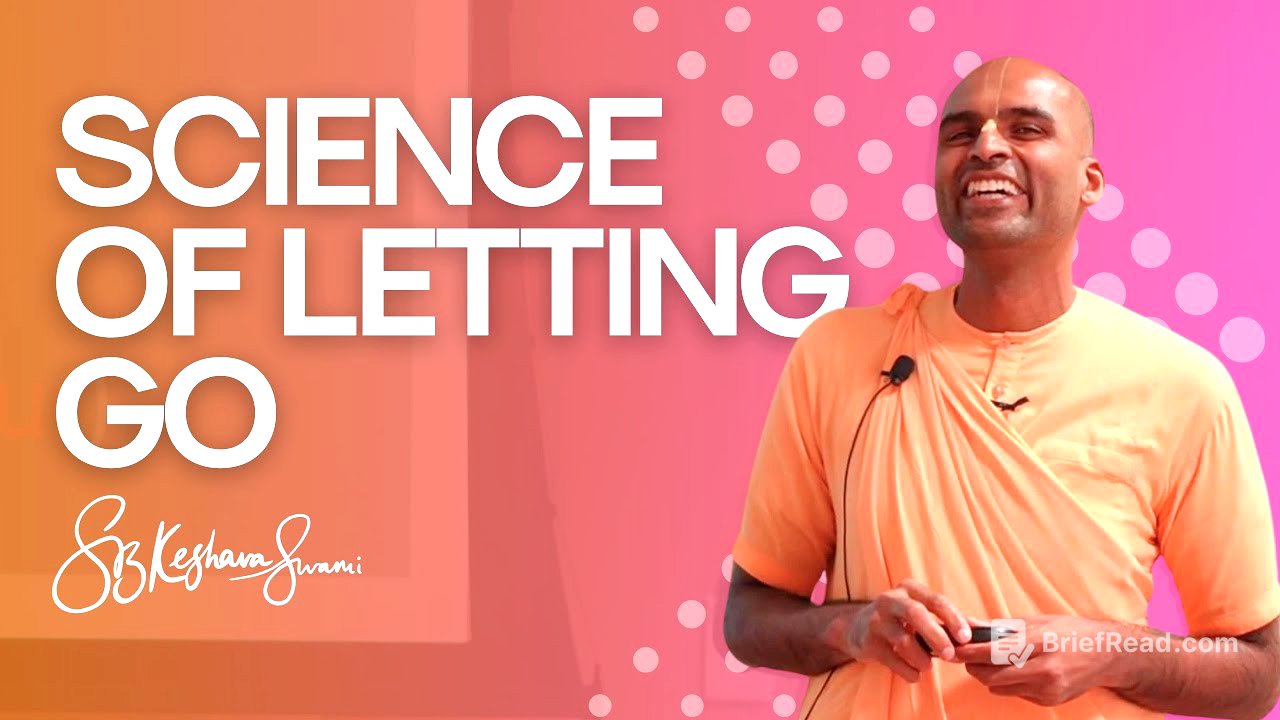
S.B. Keshava Swami discusses how our mentality towards obstacles, rather than the obstacles themselves, often hinders our ability to let go and grow. He outlines three key mentalities that need to be addressed: the belief that obstacles won't come, that they are inherently bad, and that they are insurmountable. By adjusting our expectations, embracing change, and aspiring for a deeper inner connection, we can develop the resilience to navigate life's challenges. The practice of disconnecting to connect, particularly through a daily solitude hour, is presented as a means to upgrade our vision and foster spiritual growth.
- Obstacles are a universal part of life, and our mentality determines how we handle them.
- Embracing change and looking for the good in difficult situations can lead to personal growth.
- Disconnecting to connect through practices like the 5am Club can upgrade our vision and resilience.
Introduction [0:00]
S.B. Keshava Swami introduces the topic of letting go and dealing with life's volatility and obstacles. He shares an anecdote about a conversation on a flight with a lawyer who admitted to struggling with letting go after the loss of her husband. This highlighted the universal challenge of letting go. The core message is that obstacles themselves are not the problem; rather, it's our mentality that obstacles won't come, that they are inherently bad, and that they are insurmountable.
'This too shall pass' [3:50]
S.B. Keshava Swami shares a story about a king who sought a gift that would make him happy when sad and sad when happy. The gift was a ring with the inscription "This too shall pass." This served as a reminder to not become too elated in happiness or too dejected in sadness, as all situations are temporary. He references the Bhagavad Gita, explaining that happiness and distress are like the changing seasons, arising from sense perception, and one must learn to tolerate them without being disturbed.
Glass Analogy [6:17]
S.B. Keshava Swami uses the analogy of a glass of water to illustrate how the heaviness of difficulties depends on how long we hold onto them. The water in the cup represents life's difficulties, disappointments, obstacles, and unexpected changes. The weight of the cup is determined not by the amount of water, but by how long we hold it. This leads to the problem of victim mentality, which can imprison us and dictate our sense of quality of life.
How can the victim mentality hinder growth? [7:59]
S.B. Keshava Swami discusses the detrimental effects of victim mentality, emphasizing that it takes away our agency to change. Feeling like a victim places more emphasis on external situations than on our internal power, leading us to surrender control and diminish our ability to direct our lives. Victim mentality makes us prisoners of the past, hindering our ability to move forward and blocking creative, progressive thinking.
Obstacles through the lens of Eastern spirituality [10:06]
S.B. Keshava Swami explains how spirituality helps us see external situations differently. In Eastern spiritual traditions, obstacles are a recurring theme, and the key teaching is that obstacles in our life are not the actual obstacle. The real obstacle is our mentality, specifically the beliefs that obstacles won't come, that they are inherently bad, and that they are insurmountable.
#1 Obstacles won't come in my life [11:57]
S.B. Keshava Swami emphasizes the need to let go of the mentality that obstacles won't come in our lives. Through a series of questions, he illustrates that obstacles are universal, including natural disasters, loss of loved ones, and health crises. He shares the story of Arthur Ashe, a tennis player who contracted AIDS through a blood transfusion, to highlight the importance of accepting difficulties as a natural part of life. Ashe's perspective was that he had already experienced great success and never questioned "why me?" then, so he shouldn't question it in times of pain.
Life quakes [16:33]
S.B. Keshava Swami introduces the concept of "life quakes," explaining that social science suggests every person will experience between three and seven major life-altering events. These can include relationship changes, natural disasters, career or financial issues, health crises, or existential crises. Accepting that these are a part of life is the first step to letting go and being prepared.
#2 Obstacles are inherently bad [18:16]
S.B. Keshava Swami addresses the mentality that obstacles are inherently bad by sharing the story of his friend Janaki Nath, a monk who was diagnosed with stage four colon cancer at age 31. Janaki Nath embraced his diagnosis as an adventure and went on to do amazing things in the remaining years of his life, including organizing retreats for cancer patients and founding a charity called the Smiling Monk. He demonstrated that life can still be beautiful even in the face of acute obstacles.
Embracing change [23:11]
S.B. Keshava Swami discusses how embracing change reveals new opportunities. He shares a story about a bird trainer who couldn't get a bird to fly until someone cut the branch it was clinging to, forcing it to fly. Change helps us build character, reorder our priorities, and become more creative. Turbulence helps us establish what's truly important and upgrades our gratitude.
#3 Obstacles cannot be overcome [27:48]
S.B. Keshava Swami addresses the mentality that obstacles cannot be overcome, emphasizing the importance of changing our vision. He introduces a mantra: look for the good around the bad, look for the good that comes from the bad, and look for the good that we are forced to develop in order to counteract the bad. This rewiring of vision is essential for turning pain and problems into purpose and progress.
Changing our vision [29:57]
S.B. Keshava Swami explains that changing our vision requires us to spend time upgrading it. He shares a tip he received from a spiritual practitioner: disconnect for one month every year, one day every month, and one hour every day. This disconnection allows us to reconnect with the world in a different way, digest what's going on, upgrade our vision, and connect with our deeper self.
The 5am Club [34:08]
S.B. Keshava Swami encourages everyone to join the 5am Club, dedicating one hour every day to solitude before life takes over. He suggests a 15-15-15-15 routine: 15 minutes of movement, 15 minutes of meditation, 15 minutes of reading wisdom literature, and 15 minutes of journaling. This practice capitalizes on the energy of the rising sun, energizes the body, focuses the mind, and provides a lens through which to decode the world.
Summary [36:42]
S.B. Keshava Swami summarizes the key points: obstacles are not the obstacles; the obstacle is the mentality that obstacles won't come, that obstacles are bad, and that obstacles are insurmountable. The great science of letting go involves letting go of these mentalities by adjusting our expectations, embracing the situation, and aspiring for a deeper inner connection.
Question 1 [39:22]
An audience member asks if S.B. Keshava Swami has faced any life situations where it was difficult to apply his wisdom. He shares that when he was 21 and decided to become a monk, he faced great opposition from his parents, which broke their hearts. This was a difficult time, but he realized that their opposition deepened his "why" and cemented his monastic conviction.
Question 2 [43:47]
An audience member raises the issue of victim mentality being weaponized by systems or those in power, asking how to balance enduring with changing systems that encumber people. S.B. Keshava Swami responds that absorbing spiritual mindsets shouldn't make us passive. We should still be active, conscious change-makers, realizing that there is an internal lesson and gift to be received in every situation.
Question 3 [46:39]
An audience member asks if someone who faces multiple obstacles in quick succession can still have faith and whether positive thinking can create positive outcomes. S.B. Keshava Swami responds that the human spirit is incredible and references Viktor Frankl's "Man's Search for Meaning," emphasizing the importance of enthusiasm for life. He also notes that the mind is powerful and has an effect on what we manifest in our lives.
Question 4 [51:30]
An audience member shares that her ability to let go and face obstacles differs in her various roles (employee, spouse, parent) and asks how to cope with obstacles when logic doesn't apply, particularly in the emotional state of being a parent. S.B. Keshava Swami responds that parents must balance their desires and hopes for their children with the acceptance that they are conscious entities with their own free will. He references the Serenity Prayer and emphasizes the importance of investing good intention, attention, and action, then letting go.
Question 5 [56:10]
An audience member asks for advice on releasing past traumas from life's challenges. S.B. Keshava Swami suggests journaling as a way to discover and edit one's thoughts, talking and sharing with others, and introducing another type of energy through meditation and yoga to transcend negativity.
Question 6 [1:00:13]
An audience member shares her thoughts on victim mentality and the inability to let go, connecting it to the idea that we come into the world with nothing and should focus on enjoying life. S.B. Keshava Swami responds that the questions have evolved to a deeper level, questioning why the world exists and why it is wired in this way. He references C.S. Lewis and suggests that obstacles and pain may be pointing us to higher dimensional realities.
Outro [1:04:38]
S.B. Keshava Swami concludes by encouraging everyone to ask themselves who they are, where they are, and what their ultimate goal is, suggesting that we may be spiritual beings having a human experience.