TLDR;
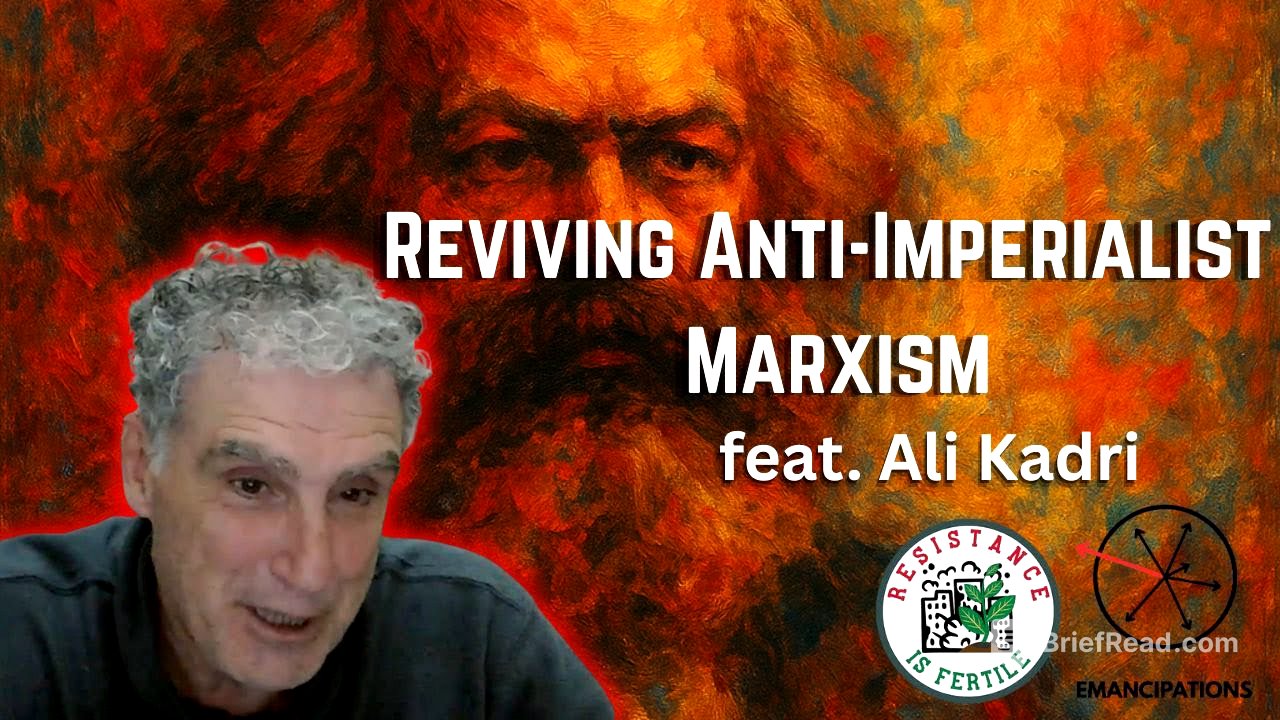
This discussion with Professor Ali Kadri, hosted by Daniel Tutt and featuring Benji Shoondorf, explores Kadri's critique of Western Marxism, the revolutionary potential in today's world, and the destructive nature of imperialism and accumulation of waste. Kadri argues for a return to basic Marxist principles, emphasizing the importance of anti-imperialism and class struggle in the face of global capitalism's inherent violence and exploitation.
- Critique of Western Marxism for its complicity with imperialism.
- Emphasis on the global South's struggle for sovereignty and survival.
- Analysis of capitalism's "death logic" and the commodification of life.
- Call for a new revolutionary consciousness based on radical equality and opposition to capital.
Introducing Ali Kadri [5:12]
Daniel Tutt introduces Professor Ali Kadri, highlighting his extensive work on Marxism and anti-imperialism, particularly his book "The Accumulation of Waste." Kadri's work is praised for its attention to anti-imperialism within a Marxist framework, drawing from thinkers like Lenin, Ho Chi Minh, Mao, Althusser, Mészáros, and Lukács, while also critiquing Western Marxism. The conversation aims to explore Kadri's understanding of Western Marxism, its shortcomings, and its relationship to revolutionary practice.
Ali Kadri's Critique of Western Marxism [5:12]
Ali Kadri explains that his critique of Western Marxism developed over time, stemming from its complicity with American and European aggression against the developing world. He argues that thought is inseparable from reality and is determined by material circumstances, including class and regional confinement. Kadri points out that Western Marxism often overlooks the chasm between the global South and North, leading to a logic that justifies aggression against countries like Vietnam and Cuba. He emphasizes that Marxism, for the developing world, is about establishing the sovereignty of the masses and that imperialism is a central issue.
Is There Revolutionary Potential Today? [27:00]
Kadri discusses the difficulties in achieving revolutionary consciousness and putting theory into practice, particularly in indebted countries in the developing world. He uses Ghana as an example, where dependence on dollar infusions from lending agencies influences political decisions like privatization. He notes that the absence of revolutionary politics in many countries is due to the defeat of socialist ideology after the collapse of the Soviet Union and the mirage created by Western Marxism that social democratic and electoral activities can resolve issues. Kadri argues that the working class in these countries is often dependent on rents and believes that debt is a monolithic entity.
Imperialism, the Accumulation of Waste & the Destruction of Life [49:30]
Kadri elaborates on the concept of capital's "death logic," where the destruction of resources and productive forces in the South leads to the transfer of value to the North. He argues that this destruction is the rule, not the exception, in the history of imperialism and colonialism. Kadri emphasizes that capital is not just an abstract social relation but has an army and that labor in the structural North often thinks like capital. He points out that commodity fetishism means the commodity runs people's lives, and death becomes a commodity that is fetishized.
Anti-Imperialism Today [1:06:48]
Benji Shoondorf discusses China's role in producing use value and providing infrastructure to developing countries, contrasting it with the West's focus on extracting value through violence. Kadri agrees, noting that China's investments in infrastructure contribute to international liberation movements. He criticizes the West's strategy of starving countries through debt and emphasizes that the globe is a single unit of production. Kadri also addresses the depressing nature of these realities, stating that the goal is to understand and act upon them, taking a principled stand against the capitalist order.
Ali Kadri's Influences in Contemporary Marxism [1:37:00]
Kadri discusses his influences and formation as a scholar, noting the difficulties Marxists face in academia. He mentions figures like Nicos Poulantzas and Arthur Davis, as well as his exposure to the works of André Gunder Frank. Kadri describes his utilitarian approach to Marxism, drawing from various thinkers while acknowledging their shortcomings. He emphasizes that the production of knowledge and the means of production are concentrated in the North, but not all Western Marxism is complicit with imperialism.
Against Empiricism [1:46:00]
Kadri critiques empiricism, stating that it presents a partial truth that is ultimately a falsity. He uses David Harvey's spatial fix as an example, arguing that capital's primary concern is maintaining power, even if it means destroying existing structures. Kadri emphasizes the importance of seeing the interrelatedness of things and recognizing that the world is a single totality structured in dominance. He argues that capital maintains its power through the power of the gun.
Psychological Effects of Capitalism and Imperialism [1:52:00]
Benji Shoondorf discusses the psychological effects of imperialism, drawing parallels to narcissistic group dynamics where reality is often veiled and distorted. He suggests that a new revolutionary class consciousness must be built on the radical equality of human worth. Kadri responds by highlighting the glorification of slavery in class societies and the internalization of capitalist norms. He concludes by emphasizing the need to target the principal contradiction between the global South and North through correct practice.