TLDR;
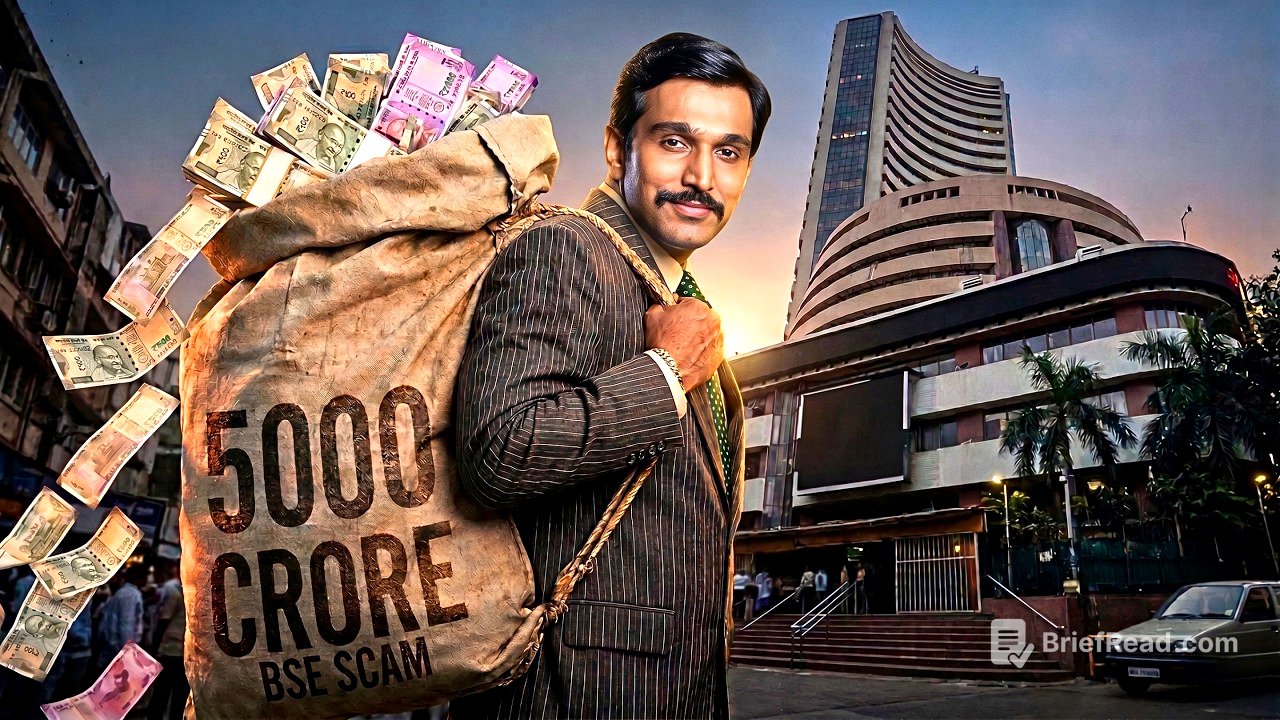
This video tells the story of Harshad Mehta, who rose from humble beginnings to become a major player in the Indian stock market before his downfall due to a massive financial scandal. The summary covers his early life, entry into the stock market, innovative trading strategies, the infamous scam involving bank receipts, and the eventual exposure and legal consequences.
- Harshad Mehta's journey from a clerk to the "Big Bull" of the Indian stock market.
- The innovative and often unethical strategies he employed, including insider trading and manipulating stock prices.
- The money market scam involving bank receipts (BRs) and its impact on the Indian financial system.
- The exposure of the scam by journalist Sucheta Dalal and the subsequent legal and financial repercussions for Mehta and others involved.
Harshad's Early Life and Entry into the Stock Market [0:00]
In 1980, Harshad Mehta entered the Bombay Stock Exchange (BSE), unaware of his future as a prominent figure in the Indian stock market. Born in 1973 in Raipur, Harshad, frustrated with his family's failing business, moved to Mumbai to pursue his dreams. He juggled college with various small jobs, including plastic scrap collection and cement trading. In 1977, he secured a clerk position at New India Assurance for Rs. 600 per month while his brother Ashwin worked at ICICI. After unsuccessful attempts at other businesses, they decided to try their luck in the stock market.
Becoming a Jobber and Early Trading Strategies [1:32]
Harshad became a jobber at the BSE after persuading a broker named P Ambalal. Despite an initial loss, he quickly developed his skills and became a proficient jobber. He understood the importance of inside information and built connections to obtain it, such as production data from labor union leaders. This allowed him to engage in insider trading, which was legal at the time, buying shares when production increased and selling when it decreased. By 1982, he had accumulated significant wealth and began using the "pump and dump" strategy to manipulate stock prices.
Black Thursday and the Formation of Grow More Consultants [3:49]
On March 18, 1982, the stock market crashed, resulting in a substantial loss for Harshad. He mortgaged his wife's jewelry to cover his debts. Despite this setback, Harshad and Ashwin decided to re-enter the market and establish their own stock broking firm, Grow More Consultants, in June 1982. The firm aimed to provide portfolio management services to wealthy individuals, investing their money in the stock market to generate high returns.
Grow More's Success and Conflict with Manu Manek [6:01]
Grow More Consultants gained popularity by investing in undervalued tea companies, leading to significant profits for their clients. By 1985, Harshad had become known as a stock market magician. However, his success drew the ire of Manu Manek, an experienced "bear" who profited from short selling. In 1986, when the stock market declined due to unfavorable budget announcements, Manu Manek short-sold shares of SPIC, a company in which Harshad had heavily invested.
Countering the Bears and Entering the Money Market [7:49]
To counter rumors of bankruptcy, Harshad cleared his dues ahead of schedule, enhancing his reputation. Despite incurring a loss of 1.5 crore rupees, he soon recovered and began working with institutional investors, becoming one of India's largest institutional brokers. Aspiring to become a major investor himself, Harshad sought to enter the money market to acquire the necessary capital.
Exploiting Loopholes in the Money Market [9:29]
Harshad entered the money market, which facilitated short-term loans between banks, typically secured by government securities or bonds. Instead of physically transferring collateral, banks issued Bank Receipts (BRs) as a promise of security. Harshad identified banks dissatisfied with the existing cartel and formed his own alliance, becoming a top money market broker. He then exploited loopholes by investing funds temporarily sitting in his account before deals were finalized and by using fake BRs obtained through bribing smaller banks like Bank Of Karad.
The Scam and Market Manipulation [12:00]
Between 1990 and 1992, Harshad used funds acquired through fake BRs to manipulate the stock market, driving the Sensex from 800 to 4500 points. His favorite stocks, such as ACC, saw massive price increases. He acquired a lavish penthouse and a collection of luxury cars, earning the moniker "The Big Bull." His influence grew to the point where any stock he invested in would see its price rise, sometimes even affecting companies with similar names.
Exposure and Downfall [15:17]
In 1991, the RBI began investigating the misuse of BRs, leading to stricter guidelines. Despite this, Harshad took 500 crores from SBI in December 1991, using the funds to further inflate stock prices. When he couldn't provide fake BRs, he bribed an SBI employee to manipulate records. However, the discrepancy was discovered in April 1992. Times of India reporter Sucheta Dalal exposed the 500-crore scam on April 23, 1992, leading to government investigations and a stock market crash.
Legal Consequences and Death [17:06]
The exposure of the scam led to panic in the stock market, significant losses for retail investors, and the collapse of banks involved in issuing fake BRs. The total scam amounted to over 4000 crores. Harshad and Ashwin Mehta were arrested on June 4, 1992, and their assets were seized. Harshad remained in and out of jail during the lengthy legal battle and died in police custody in December 2001 at the age of 47. His story remains controversial, with some viewing him as a scamster and others believing he was unfairly targeted for common market practices.