TLDR;
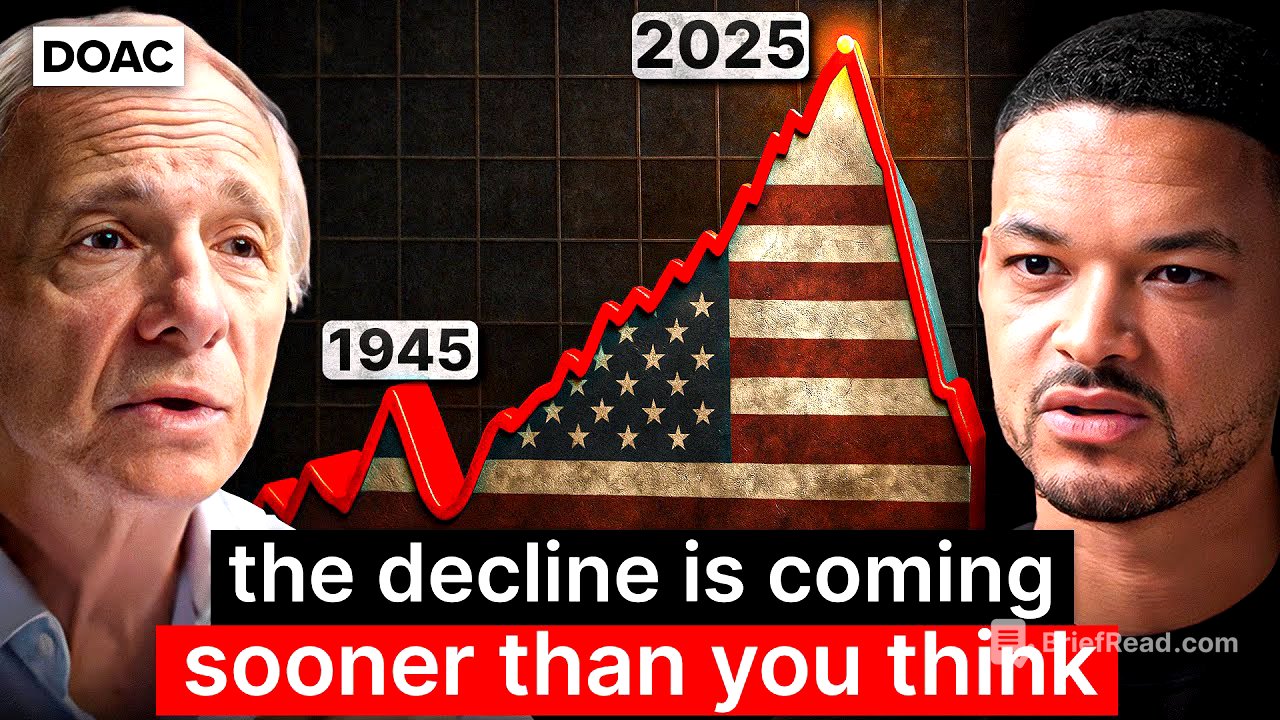
Ray Dalio discusses his principles for navigating life and the economy, emphasizing the importance of understanding historical cycles, being open-minded, and aligning one's work with their passion. He shares his perspectives on the UK and the US, the impact of technology, and the significance of community and meaningful relationships. Dalio also touches on personal experiences, including the loss of his son, and how meditation and reflection have shaped his approach to life and decision-making.
- Understanding life cycles and historical patterns is crucial for making informed decisions.
- Open-mindedness and continuous learning are essential for personal and professional growth.
- Aligning work with passion and building meaningful relationships are key to happiness and success.
Intro [0:00]
Ray Dalio introduces himself as an investor who studies the cycles of human history to predict financial crashes and warns about the future. He emphasizes the importance of understanding five big forces that create a cycle lasting about 80 years: money, debt, internal conflict, geopolitical conflict, acts of nature, and man's inventiveness, particularly new technologies. Dalio also highlights the significance of building financial strength, flexibility, and being open-minded to handle the future effectively.
Where Should I Be Living as an Entrepreneur? [5:21]
Ray Dalio advises entrepreneurs looking to build a technology company to consider the US over the UK due to its strong culture of entrepreneurship and inventiveness. He contrasts this with the UK's establishment culture, noting that the US provides a more conducive environment where talent and innovation are readily supported with resources.
What's Your Honest Perspective of the UK? [6:17]
Ray Dalio shares his perspective on the UK, highlighting its financial and debt problems, which lead to social clashes and a decline since World War II. He contrasts the UK with the US, noting that the UK's capital markets and ability to raise capital are significantly worse, contributing to internal political and social conflicts due to wealth and opportunity gaps.
Are You Optimistic About the Future of the UK? [11:33]
Ray Dalio expresses pessimism about the future of the UK due to its high debt, internal social conflict, geopolitical challenges, and a lack of a strong culture of inventiveness compared to countries like the US. He emphasizes that the UK's capital markets do not adequately support the scale of innovation needed to compete seriously in the global arena.
Are You Optimistic About the US? [12:59]
Ray Dalio expresses concern about the United States, citing its debt, internal conflict between the left and right due to wealth and values gaps, and its role in the great power conflict with China. He notes that while the US is a leader in technology, it also faces challenges related to climate and internal divisions, with a significant portion of the population lacking basic literacy skills.
How to Predict What's Coming [15:06]
Ray Dalio explains that to predict future events, he studies the last 500 years of history, noting recurring cycles across different empires. He emphasizes that these cycles are predictable and that understanding them is crucial for making informed decisions.
Will the US Dominate Global Power Soon? [16:51]
Ray Dalio believes it's conceivable that the US may no longer be the dominant global power in the next 50 to 100 years. He points out challenges such as internal conflicts and wealth gaps, and questions whether the system can effectively manage these issues without damaging future prospects.
How Would You Fix the UK? [21:53]
Ray Dalio suggests that fixing the UK involves addressing its debt, deficits, and disparities in education and opportunity. He emphasizes the need for a strong political middle to drive productivity and convey a sense of patriotism and collective effort.
What Happens Next in History? [25:14]
Ray Dalio explains that history typically involves a fight for control, political revolutions, and system breakdowns due to a lack of trust. He draws parallels to historical events, such as the decline of Rome and the rise of autocracies in the 1930s, suggesting that similar pressures could lead to autocratic tendencies in the UK and the US.
Where Are We in the Predictable Timeframes? [28:46]
Ray Dalio notes that historical transitions occur in long-term cycles, averaging about 80 years, similar to a human life cycle. He points out that the world is currently about 80 years from World War II, and the symptoms of a new cycle are evident.
How Should We Counteract These Risks? [30:20]
Ray Dalio advises individuals to be aware of the risks and build financial strength by managing their earning, spending, and saving habits. He also emphasizes the importance of flexibility, knowledge, and the ability to move to better locations, using the Chinese saying "a smart rabbit has three holes" to illustrate the need for options.
Most Valuable Skills to Learn Right Now [32:39]
Ray Dalio advises making work and passion the same thing, while also considering the financial implications of career choices. He highlights that meaningful work and meaningful relationships bring happiness, and that community is essential for well-being.
What Games to Play in Different Life Seasons [35:30]
Ray Dalio advises that the "game" changes throughout life, with learning and experiencing being most important early on, and transitioning and passing along knowledge becoming the focus later in life. He stresses the importance of being around the best people for mentorship and learning, rather than solely focusing on the highest-paying job.
The Most Important Strategic Decision I Made [37:42]
Ray Dalio recounts his early experiences with investing, starting at age 12, and how he became "hooked on the game." He shares stories from his time at Harvard Business School and his early career, emphasizing the importance of learning from failures and reflecting on pain to achieve progress.
The Best Way to Deal With Pain [44:58]
Ray Dalio emphasizes the importance of calming oneself and getting centered, noting that meditation has been beneficial in his life. He advises reflecting on experiences to understand how reality works and developing principles to deal with situations effectively.
How Do I Become a Principle Thinker? [48:48]
To become a principle thinker, Ray Dalio advises reflecting on decisions, understanding how life and various systems work, and writing down thoughts. He suggests considering the criteria used to make decisions and acknowledging the influence of emotions and subconscious factors.
The Power of Meditation [50:28]
Ray Dalio explains transcendental meditation as a process of sitting quietly and repeating a mantra to transcend into the subconscious mind, aligning conscious and subconscious states. He emphasizes that this practice helps calm the mind and improve decision-making.
Are You Religious? [55:48]
Ray Dalio identifies as spiritual rather than religious, agreeing with the Dalai Lama that religions often mix superstitions with spirituality. He believes in karma and the importance of treating others well, emphasizing that small acts of kindness can make a big difference.
How Important Is Hard Work? [58:07]
Ray Dalio emphasizes the importance of hard work for gaining power and strength, which ultimately makes things easier and better. He contrasts this with the concept of first and second-order consequences, where immediate gratification can lead to negative long-term outcomes.
The Importance of Being Open-Minded [59:47]
Ray Dalio stresses the importance of being open-minded and assertive, viewing differing opinions as opportunities for learning rather than fights. He highlights that holding onto wrong opinions is a tragedy that can be avoided by being open to new information and stress-testing one's thinking.
How to Be a Better Decision Maker [1:05:03]
Ray Dalio advises leveraging oneself by picking trustworthy and capable people, orchestrating them well, and focusing on getting more out of a minute rather than working harder. He emphasizes the importance of radical truthfulness and transparency in building a cohesive and effective team.
How Do You Find Honest People? [1:08:50]
Ray Dalio shares his approach to fostering honesty at Bridgewater, including a policy against talking critically behind others' backs and promoting radical transparency. He emphasizes creating a culture of meaningful relationships where people can communicate openly and honestly.
Why Companies Become Less Innovative [1:11:09]
Ray Dalio explains that companies often become less innovative as they grow due to increased bureaucracy and fragmentation. He notes that once a group exceeds 75 to 100 people, relationships weaken, and it becomes necessary to create cohesiveness through different areas and a common mission.
How Do You Find Exceptional People? [1:14:03]
Ray Dalio emphasizes the importance of systemizing the hiring process by identifying the personalities and backgrounds of successful people in specific roles. He advocates for maintaining data on employees, creating job specifications based on attributes, and continuously evaluating performance.
What's Your View on AI? [1:19:14]
Ray Dalio views AI as a fantastic leveraging tool, emphasizing its potential for managing and decision-making. However, he acknowledges that AI could exacerbate inequality and create greater polarity in society.
Top 3 Book Recommendations [1:28:28]
Ray Dalio recommends three books: "River Out of Eden" by Richard Dawkins for understanding evolution, "Lessons from History" by Will and Ariel Durant for historical insights, and "The Hero with a Thousand Faces" by Joseph Campbell for understanding human nature and the life journey.



![Digimon: The Movies | Teaser trailer (Movie Collection 1) [Discotek Media]](https://wm-img.halpindev.com/p-briefread_c-10_b-10/urlb/aHR0cDovL2ltZy55b3V0dWJlLmNvbS92aS9ReGV2NUhEX1pRRS9ocWRlZmF1bHQuanBn.jpg)