TLDR;
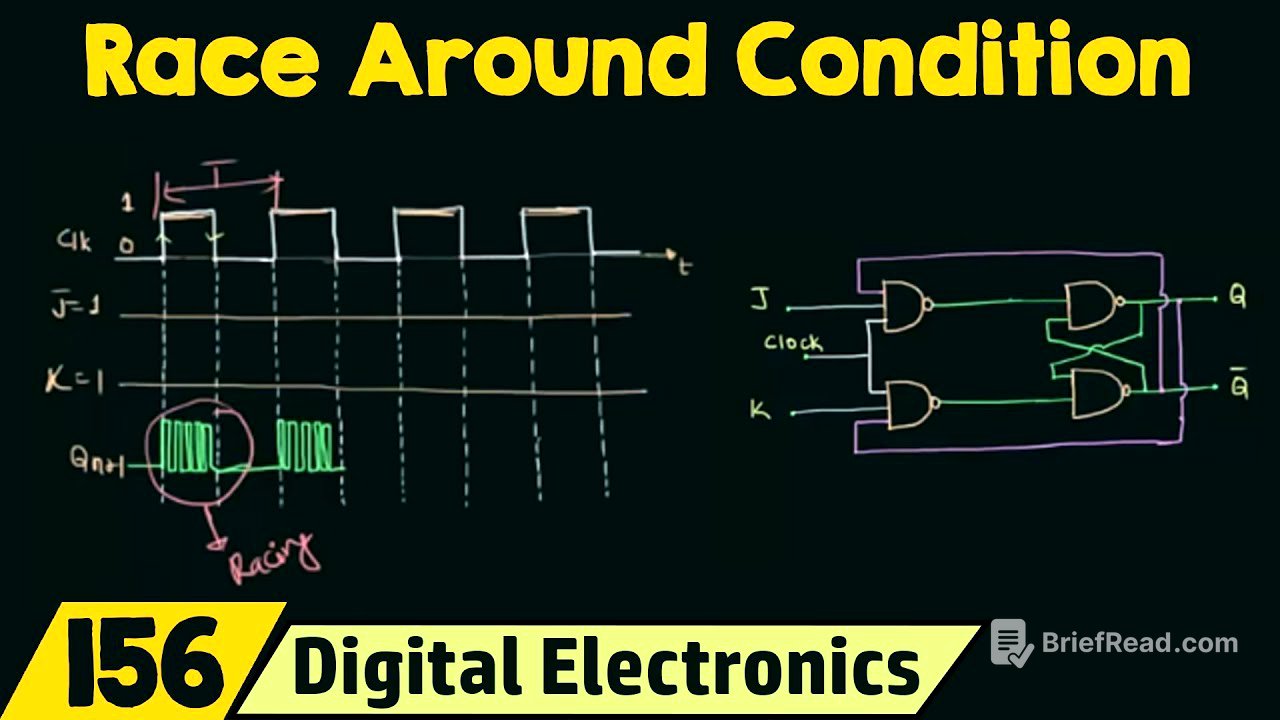
This video explains the race around condition in JK flip-flops and discusses methods to eliminate it. It begins by illustrating how the race around condition occurs when J=1, K=1, and the clock is high, causing the output to toggle uncontrollably. The video then details three methods to overcome this issue: reducing the clock's half-time period below the flip-flop's propagation delay, using edge triggering instead of level triggering, and employing a master-slave configuration.
- Race around condition occurs in JK flip-flops when J=1, K=1, and the clock is high, leading to uncontrolled output toggling.
- The clock's half-time period must be greater than the flip-flop's delay for racing to occur.
- Methods to eliminate racing include reducing the clock's half-time period, using edge triggering, and employing a master-slave configuration.
Introduction to Race Around Condition [0:05]
The video addresses the race around condition in JK flip-flops, a problem that arises when J=1, K=1, and the clock is high, causing the output to toggle rapidly and unpredictably. This issue stems from the feedback mechanism in the JK flip-flop, which is designed to overcome the SR flip-flop's undefined state when both S and R are 1. The presentation aims to explain the race around condition and explore methods to eliminate it, highlighting the importance of understanding master-slave flip-flops in this context.
Understanding the Race Around Condition [1:15]
The explanation begins with J=1, K=1, and the clock signal is high. Assuming Q=1 and Q complement=0, these values are fed into NAND gates within the flip-flop circuit. The outputs of these NAND gates then become inputs to an SR NAND latch. As the clock remains high, the outputs of the NAND gates continuously switch, causing the SR NAND latch to toggle rapidly. This uncontrolled switching between 1 and 0 is the race around condition. It is emphasized that this is different from controlled toggling, which is desirable for applications like counters. The race around condition occurs only when J and K are both 1 and the clock is high. Additionally, the clock's half-time period must be greater than the delay of the flip-flop for the race around condition to manifest.
Conditions to Overcome Racing [6:48]
Three methods to overcome the race around condition are presented. The first method involves ensuring that the half-time period of the clock is less than the propagation delay of the flip-flop. The second method involves using edge triggering (positive or negative) instead of level triggering. Edge triggering provides a very short window for the flip-flop to respond, preventing the rapid toggling associated with the race around condition. The third, and most popular, method is using a master-slave configuration. The master-slave configuration is widely used due to its advantages, which will be discussed in the next presentation.