TLDR;
This video explains the Schrodinger equation, a fundamental concept in quantum mechanics. It begins by discussing the wave-particle duality of matter, focusing on the electron as a circular standing wave. The video then introduces the Schrodinger equation as a mathematical model describing the behavior of quantum systems, emphasizing its probabilistic interpretation through the wave function.
- Matter exhibits wave-particle duality, especially relevant for electrons.
- Electrons in atoms can be viewed as circular standing waves with quantized energy levels.
- The Schrodinger equation describes the wave function of a quantum system, which represents the probability of finding an electron in a particular location.
Wave-Particle Duality and the Electron [0:10]
The concept of energy quantization and wave-particle duality, initially applied to light, extends to matter as well, as described by de Broglie. All matter possesses a wavelength inversely proportional to its mass. While this wavelength is negligible for macroscopic objects, it becomes significant for electrons due to their small size. Consequently, electrons must be viewed as both particles and waves. In an atom, an electron can be regarded as a circular standing wave around the nucleus. This explains why electrons in atoms occupy discrete energy levels, corresponding to integer numbers of wavelengths in the standing wave. When an electron absorbs a photon with specific energy, it transitions to a higher energy state, increasing the number of wavelengths in its standing wave.
The Schrodinger Equation [2:49]
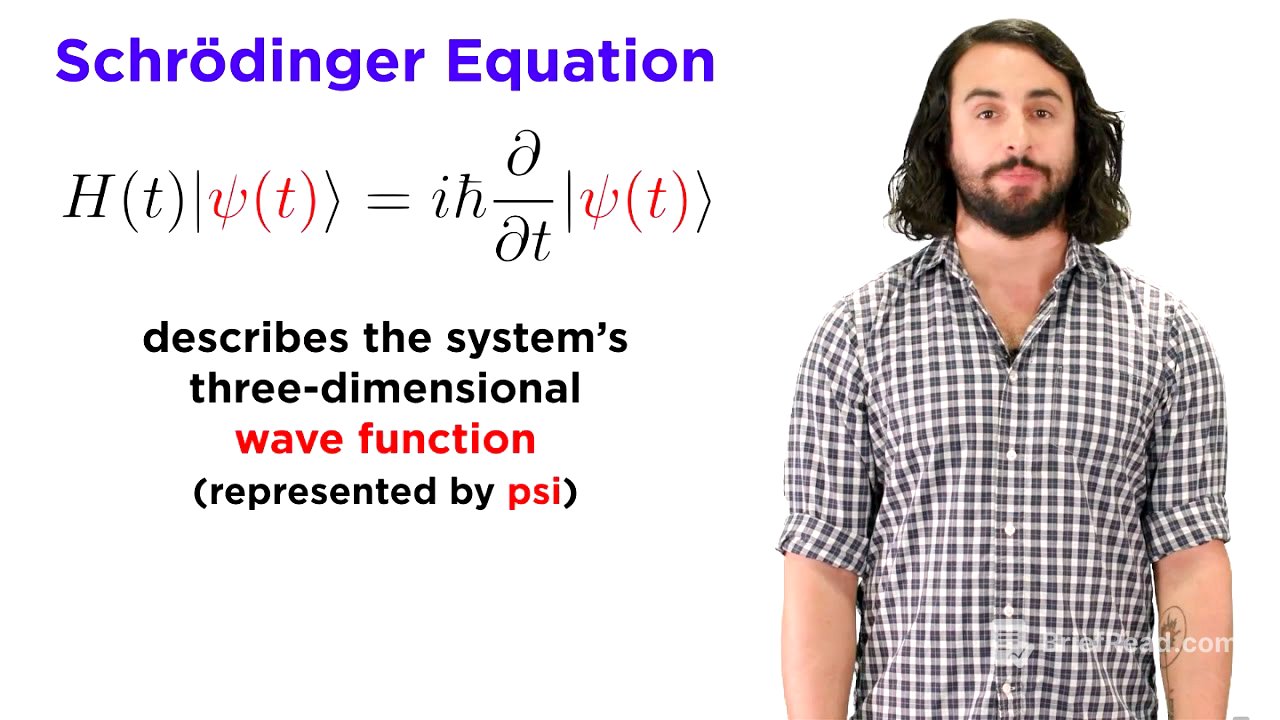
The physics community sought a mathematical model to describe the wave behavior of electrons, resulting in Erwin Schrodinger's development of the Schrodinger equation in 1925. This equation, incorporating the de Broglie relation, is a differential equation applicable to quantum systems, analogous to F = ma in Newtonian systems. It describes the system's three-dimensional wave function, denoted by the Greek letter psi, using the Hamiltonian operator, which represents the total energy of a particle. While the Schrodinger equation calculates the wave function, it doesn't explicitly reveal its nature.
Probabilistic Interpretation of the Wave Function [4:03]
Max Born proposed interpreting the wave function as a probability amplitude, where the square of its magnitude indicates the probability of finding an electron at a specific location. The double-slit experiment illustrates this wave of probability, showing that the diffraction pattern represents the likelihood of an electron arriving at different points on the screen. While the Schrodinger equation deterministically computes the wave function, the information it provides is probabilistic. This concept suggests that nature is probabilistic at a fundamental level. An electron can be viewed as a cloud of probability density, similar to how sound waves are mechanical waves and light waves are electromagnetic oscillations. Various interpretations of quantum mechanics exist, each offering different perspectives on the relationship between the wave function, experimental results, and the nature of reality, with no definitive consensus.