TLDR;
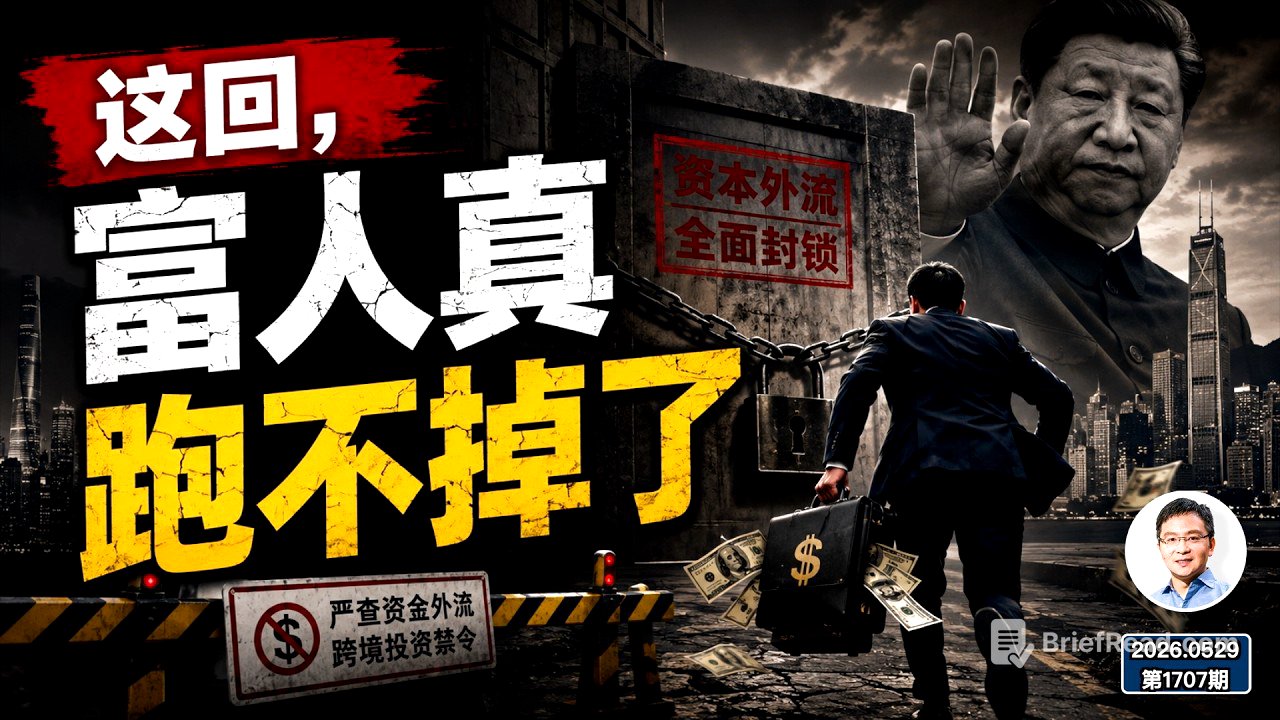
This video discusses the implications of China's crackdown on cross-border securities investments, particularly the penalties imposed on firms like Tiger Brokers, Futu Securities and Changqiao Securities. It explains the "关门狗" (close the door on the dog) effect, where the crackdown impacts different groups—investors, wealthy individuals, and foreign capital—in distinct ways. The analysis includes the reasons behind the crackdown, the scale of capital outflow, and the potential consequences for China's economy and Hong Kong's financial status.
- Crackdown on cross-border investments is not sudden and has long-term implications.
- The crackdown affects investors, wealthy individuals, and foreign capital differently.
- The action may further erode Hong Kong's financial independence.
Background of the Crackdown [0:00]
In May 2026, China's securities regulator penalized Tiger Brokers, Futu Securities, and Changqiao Securities for violating fund and futures regulations by facilitating cross-border investment, specifically enabling Chinese investors to trade in the U.S. stock market. This action contravenes Article 120 of China's "Securities Law" and Article 97 of the "证券投资基金法" (Securities Investment Fund Law), as these firms lack the necessary licenses to operate such services. Despite the claim of illegal operations, no entity in China possesses the required licenses to directly enable domestic investors to purchase foreign stocks or assets.
Legal Loopholes and Capital Control [2:19]
The only two legal avenues for investing in foreign stocks involve purchasing ETFs or funds linked to U.S. stocks through state-run entities like banks and official securities firms, or joining approved private equity funds. However, these private funds must borrow foreign exchange quotas from public funds or banks to trade in U.S. stocks, making them subordinate in the financial hierarchy. China's capital control, which restricts the free conversion of RMB to foreign currencies, is a critical factor. The existing legal framework is designed to monopolize and control the cross-border flow of wealth.
Scale of Capital Outflow [5:38]
The penalties imposed on Tiger Brokers and Futu Securities, totaling 1.85 billion RMB, suggest their "illegal income" was between 400 to 550 million RMB. This income represents only 0.3% to 0.5% of the total customer assets managed, indicating that these firms handled approximately 110 billion RMB in "违规" (irregular) funds. While this is a conservative estimate, a Bloomberg report indicates that in 2025, about one trillion USD left China without authorization. The funds moved through methods such as "蚂蚁搬家" (ant moving), "对敲" (offsetting transactions), purchasing overseas insurance, and, significantly, through electronic encrypted currencies like USDT.
The "关门狗" (Close the Door on the Dog) Philosophy [10:10]
The crackdown on cross-border brokers, who handled a relatively small portion of the total capital outflow, exemplifies China's "关门狗" (close the door on the dog) philosophy. This involves penalizing those with less power to signal larger players to exit quickly. The crackdown disproportionately affects about one million Chinese citizens with some economic means but limited political influence. This approach serves to warn major players to move their assets out of the country, often resulting in increased capital flight after each crackdown.
Impact on Hong Kong and Financial Scrutiny [11:47]
The crackdown extends to Hong Kong, with the Hong Kong Monetary Authority and Securities and Futures Commission tightening scrutiny on mainland clients, potentially restricting transactions or closing accounts. This move undermines Hong Kong's financial independence. The timing of the crackdown coincides with significant declines in China's A-shares market, suggesting a response to capital flight following stock sell-offs.
Escalating Measures and Tax Audits [14:12]
The crackdown on capital outflow is expected to intensify due to the widening interest rate gap between the U.S. and China, which encourages capital to leave China. Financial and tax oversight are merging, with tax authorities auditing high-net-worth individuals with over $30 million in assets, potentially imposing a 20% investment income tax. These measures primarily target wealthy Chinese individuals with foreign residency who manage assets through overseas trusts.
Economic Consequences and Capital Behavior [17:39]
These financial restrictions are unlikely to encourage domestic investment. Capital is driven by profit, and restricting its outflow can lead to investment stagnation. Closing the door on domestic capital also deters foreign investment, as it creates the impression that funds cannot be freely moved in and out of China. This "关门拦狗" (close the door to block the dog) effect stifles economic dynamism.
Underground Economy and Corruption [19:56]
Restricting capital outflow is likely to foster a black market for currency exchange and increase corruption within financial regulatory bodies responsible for quota approvals. Historical examples from Latin American countries in the 1970s and 1980s illustrate that prolonged capital controls can severely damage the national economy. China is currently at risk of repeating these mistakes.