TLDR;
The market experienced a slightly green close on Tuesday, but underlying tensions suggest a potential technical trap. Market makers are neutralizing exposures before the Fed announcement, leading to price stagnation at resistance levels. Internal divergences, such as energy sector strength versus financial sector weakness, highlight the fragility of the rally. Macroeconomic factors like a weaker dollar clashing with rising oil prices contribute to market uncertainty, impacting alternative assets like Bitcoin and metals. The key question is whether the upcoming FOMC presser will break resistance levels or signal a downward trend.
- Market gains may be a technical trap due to options market maker activity.
- Internal market divergences and macroeconomic tensions create uncertainty.
- The FOMC presser is a potential catalyst for market direction.
Market Overview and Technical Resistance [0:00]
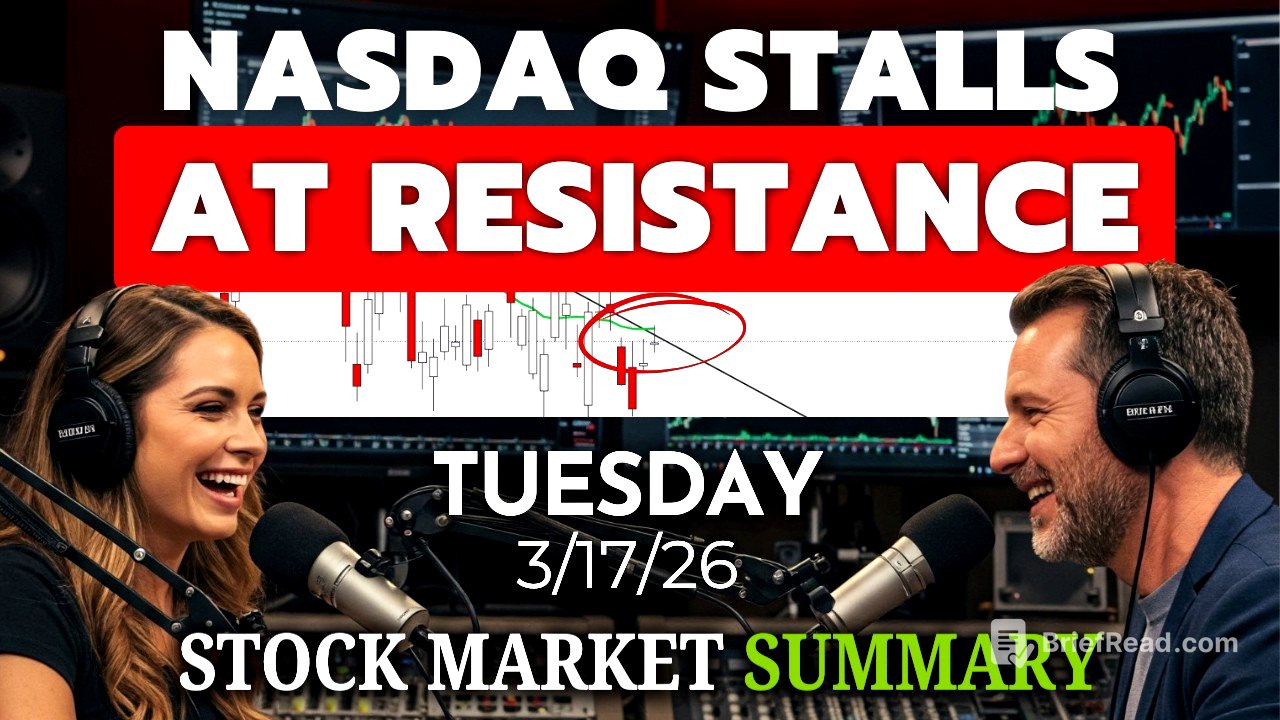
The stock market had a modestly positive day, but there's a sense that traders are being cautious. Key stock charts are meeting resistance, creating uncertainty ahead of Powell's upcoming statements. The modest gains in the S&P 500 (SPY) and Nasdaq 100 (QQQ) might be a technical trap. Options market makers are actively neutralizing their positions in anticipation of the Federal Reserve's announcements, which is causing price action to freeze at critical resistance points. The QQQ is encountering downward resistance, and the SPY is testing the upper boundary of its downward channel without breaking through.
Internal Divergences and Sector Performance [0:31]
Beneath the surface, there are significant divergences within the market. The energy sector (XLE) is performing strongly, reaching new swing highs, while the financial sector (XLF) is underperforming, trapped in a downward channel. The lack of participation from financials can undermine the foundation of a market rally. It's crucial to avoid impulsive buying based on superficial gains, as these can be deceptive. Institutional capital is currently hesitant, awaiting clarity from Wednesday's macroeconomic news to resolve cross-asset tensions.
Macroeconomic Factors and Market Impact [2:20]
The U.S. dollar weakened, which typically supports equities. However, rising Brent crude oil prices, exceeding $103 due to Middle East tensions, are acting as an inflationary anchor. Oil's role as a raw input cost for many goods is forcing the market to anticipate a more hawkish stance from Powell, suppressing broader market gains due to the threat of persistent inflation.
Alternative Assets and Algorithmic Trading [3:04]
Macroeconomic uncertainty is also affecting alternative assets. Bitcoin showed signs of a failed breakout, and metals are signaling caution, with silver declining sharply below its support trend line despite geopolitical tensions. The fear of higher interest rates is increasing the opportunity cost of holding non-yielding assets, pushing them below support levels. Navigating algorithmic trading requires precise technical analysis to identify and respect main and minor trend lines used by institutional algorithms, which helps in determining entry and exit points and avoiding forced trades during market chop.
FOMC Presser and Market Outlook [4:22]
The key question is whether the upcoming FOMC press conference will provide the catalyst needed to break through the current technical resistance levels. Alternatively, the charts may be indicating that the next major market move will be downward.