TLDR;
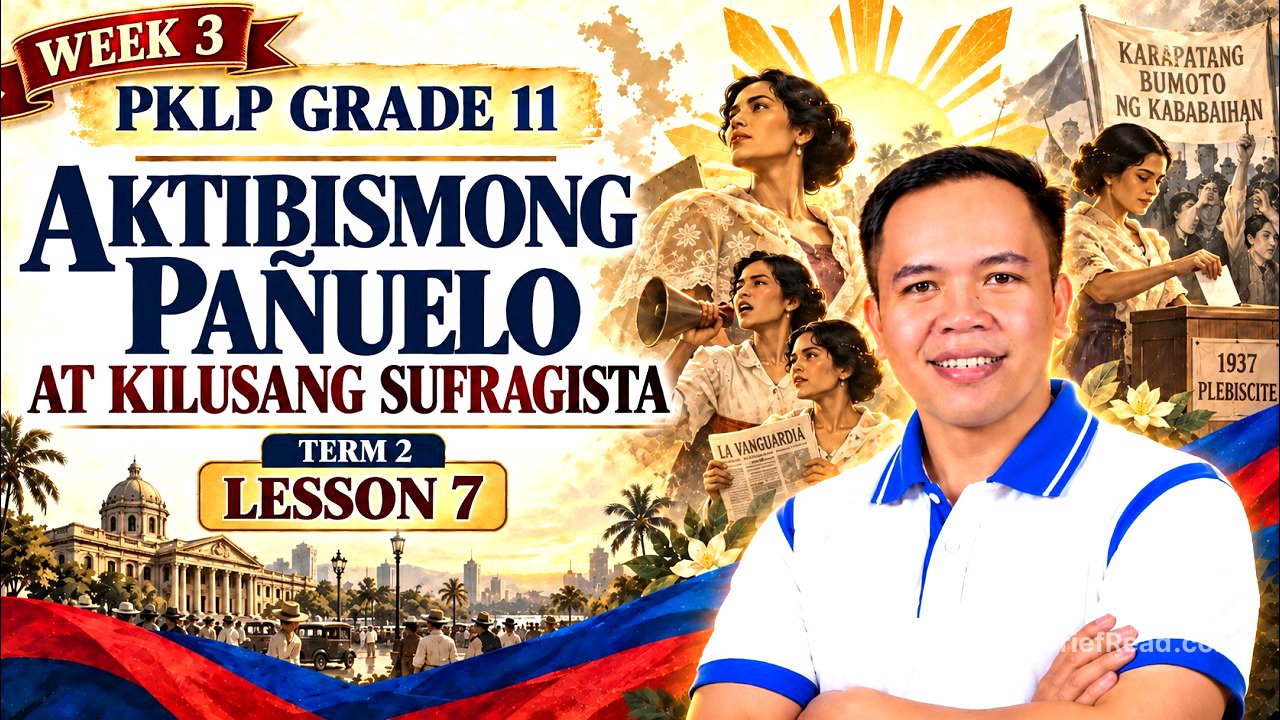
This lesson focuses on the role of clothing, specifically the panuelo (a traditional headscarf), as a tool for activism among Filipino women. It examines how women utilized their identity, symbols, and collective action to expand their role in society and fight for rights, particularly suffrage. The session emphasizes the collective experiences of women's struggles against foreign domination and the importance of participation in public life. Various historical contexts and movements, like the suffragist movement, are discussed to illustrate the evolution of women's activism.
- The panuelo is a significant symbol in activism.
- The lesson compares two movements: the panuelo and the suffragist movement.
Chapter Title: Introduction to the Lesson [0:00]
In this chapter, Sir Louis introduces the lesson as a continuation of previous discussions about various struggles in history. He poses a crucial question: Can clothing be an instrument of struggle? He outlines that the lesson will explore how Filipino women used their identity and symbolism through clothing to expand their societal roles. The focus is on collective action and the impact it has on societal change.
Chapter Title: Learning Skills [1:09]
This segment elaborates on the learning skills intended for the lesson. It highlights the examination of collective struggles against foreign forces, emphasizing not just individual stories but the actions of groups and communities. The specific focus will be on the experiences of Filipino women as they gradually entered public space and engaged in significant social and political issues.
Chapter Title: Objectives [2:01]
Three main objectives are outlined for students to achieve by the end of the lesson. First, students should be able to explain the goals of the panuelo activism and the suffragist movement. Second, they will compare these two movements based on key aspects: goals, methods, symbols, and contributions. Lastly, they are encouraged to reflect on the importance of equal participation of women in society and the implications of these movements on societal change.
Chapter Title: Pre-Lesson: Who Can Participate? [2:58]
Before the main discussion, a thought experiment is presented where students imagine a scenario where only half of the community can vote on a decision impacting their education and future. This hypothetical situation is linked to the historical context of Filipino women's lack of political rights, prompting students to consider the feelings of those excluded from the decision-making process and the actions they might take to change this system.
Chapter Title: Introductory Activity: What is the Message of Clothing? [3:49]
This chapter introduces an activity where students analyze four images of women in traditional Filipino outfits, public gatherings, and political campaigns. Focus is placed on what they observe in the clothing of these women and the messages conveyed through their attire. Students are challenged to think deeply about how clothing can carry social and political significance.
Chapter Title: Activity: Reading Images and Analyzing Actions [6:34]
Students are engaged in a main activity involving source cards where they must interpret not just texts but also images, looking into context, purpose, methods of action, and the contributions of women in their struggles. Questions about the challenges faced by women, their desires for change, strategies used, and outcomes are crucial in this analytical exercise.
Chapter Title: Analysis [13:22]
In this chapter, the focus is on putting together the evidence gathered from earlier activities. Students analyze why traditional attire and the respectful image of Filipinas functioned as effective strategies for women’s activism. They explore the similarities and differences between the panuelo activism and the suffragist movement, emphasizing the role of collective action in transforming perceptions of women's capabilities and roles.
Chapter Title: Abstraction [14:13]
Here, students consolidate their understanding of activism, recognizing that it can take many forms, including symbols, attire, writing, organization, and voting. The narrative underscores that the collective actions of women led to a gradual expansion of their political participation, reinforcing the notion that change is often a process rather than a single event.
Chapter Title: Application: Symbol and Voice for Equality [28:24]
Students are prompted to relate historical lessons to present-day situations involving inequality. They are tasked with identifying current instances of unequal treatment and considering ways to advocate for equal participation through responsible and peaceful methods. The goal is to apply historical insights to contemporary social advocacy.
Chapter Title: Assessment [30:46]
In this chapter, students evaluate their understanding of the differences between the panuelo activism and the suffragist movement. They must demonstrate their grasp of both concepts by comparing and contrasting them based on purpose, methods, symbols, and contributions to women's rights.
Chapter Title: Concluding Activity: Reflection No. 7 [34:18]
At the end of the lesson, students are invited to write reflections that encapsulate their learning experiences. They must express their most significant realizations regarding women's movements, the utilization of symbols for collective action, and connect these historical lessons to current situations necessitating equal participation.
Chapter Title: Extended Learning Opportunity [35:05]
Students are encouraged to explore ongoing campaigns that use clothing or visual symbols to convey social messages. They study the meanings behind these symbols and how they are applied to raise awareness, forming a comparative analysis with the panuelo concept covered in the lesson.
Chapter Title: Concluding Message [35:50]
In the conclusion, the essential question of whether clothing can serve as a tool for activism is revisited. The chapter summarizes the importance of clothing as a symbol of identity and its role in public engagement and political rights, underscoring that collective action amplifies the power of individual voices in advocating for change in society. Thanking students for their participation, the chapter highlights the significance of understanding history as more than just events, but as a reflection of collective human experiences.