TLDR;
This video provides an introduction to photosynthesis, explaining its two main stages: the light-dependent reactions and the light-independent reactions (Calvin cycle). It covers the key components involved, such as chlorophyll, chloroplasts, and the electron transport chain, as well as the inputs and outputs of each stage.
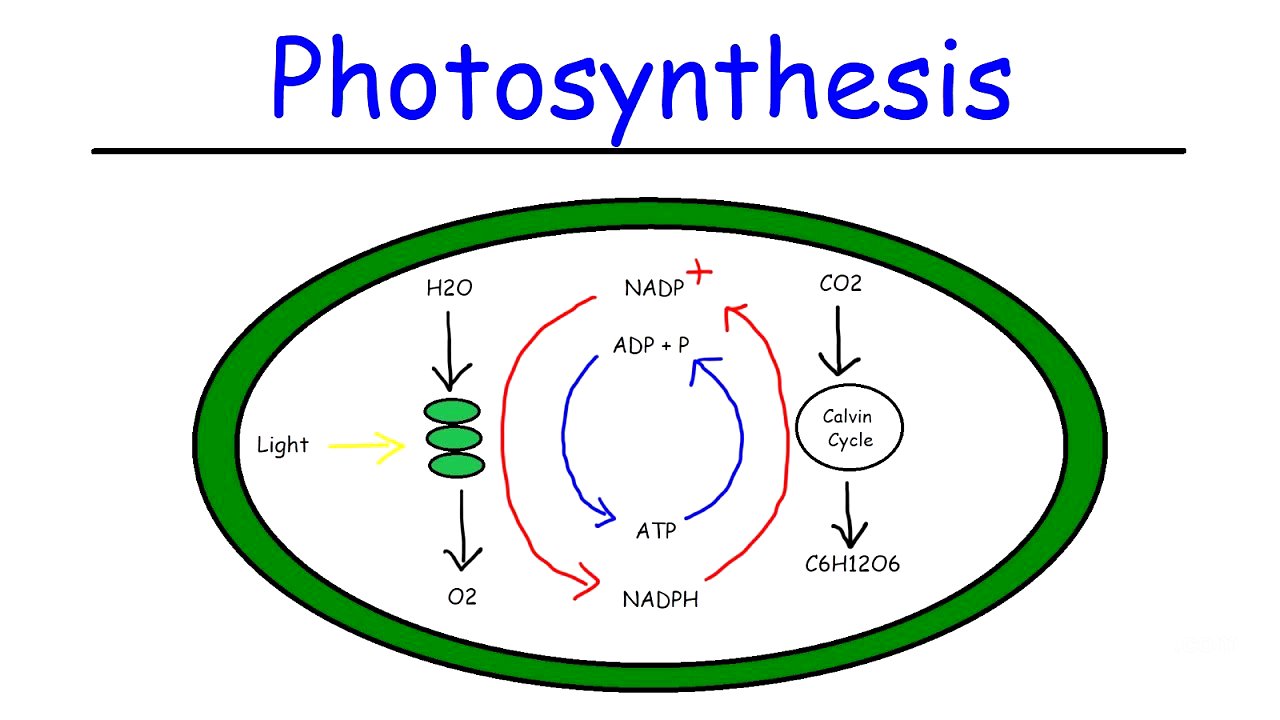
- Photosynthesis uses light energy to convert water and carbon dioxide into glucose and oxygen.
- The light-dependent reactions produce ATP and NADPH, which power the Calvin cycle.
- The Calvin cycle uses carbon dioxide, ATP, and NADPH to produce sugars like glucose.
Introduction to Photosynthesis [0:00]
Photosynthesis uses light to build carbohydrates by combining water and carbon dioxide to produce glucose and oxygen. Water enters the plant through the roots, while carbon dioxide enters the leaves through stomata, the same openings through which oxygen exits. The chloroplast is the organelle responsible for photosynthesis, while the mitochondria is responsible for cellular respiration, the reverse process. Chlorophyll, found in the thylakoids, absorbs light energy, specifically blue and red light, reflecting green light, which is why plants appear green.
Chloroplasts and Stages of Photosynthesis [1:18]
Photosynthesis is divided into two stages: light-dependent and light-independent reactions. The light-dependent reactions occur in the thylakoids and involve the oxidation of water into oxygen gas. During this process, NADP+ is reduced to NADPH, and ATP is produced from ADP and phosphate via chemiosmosis, using ATP synthase. The products of these reactions are oxygen gas, ATP, and NADPH, while the reactants are water, NADP+, ADP, and phosphate. The light-independent reactions, or the Calvin cycle, take place in the stroma, using carbon dioxide and reducing it into sugars like glucose. NADPH is oxidized back into NADP+, and ATP is converted into ADP and phosphate to power this process.
Light Dependent Reactions [6:28]
In the thylakoid membrane, light strikes photosystem II (P680), exciting electrons in chlorophyll, which then flow to plastoquinone. Chlorophyll replenishes these electrons by oxidizing water into oxygen gas, releasing hydrogen ions and electrons. Plastoquinone carries the electrons to the cytochrome b6f complex, which pumps protons from the stroma into the thylakoid lumen, creating a proton gradient. Electrons then move to plastocyanin, a copper-containing protein, which transfers them to photosystem I (P700). Here, electrons regain energy from another photon of light and are passed to ferredoxin, an iron-sulfur protein, which carries them to NADP reductase. This enzyme reduces NADP+ to NADPH, decreasing the hydrogen ion concentration in the stroma.
ATP Synthase and Products of Light Dependent Reactions [9:54]
Due to the high concentration of hydrogen ions in the thylakoid lumen and low concentration in the stroma, hydrogen ions flow through ATP synthase via chemiosmosis. This process rotates the protein, combining ADP and phosphate to produce ATP. The major products of the light-dependent reactions are oxygen gas (from the oxidation of water by photosystem II), NADPH (produced by NADP reductase), and ATP (produced by ATP synthase).
Calvin Cycle: Fixation of Carbon Dioxide [11:15]
The Calvin cycle consists of three phases: carbon dioxide fixation, reduction, and regeneration of RuBP (ribulose-1,5-bisphosphate). Carbon dioxide reacts with RuBP, catalyzed by the enzyme rubisco, to form 3-phosphoglycerate (PGA). RuBP, a five-carbon molecule with phosphate groups on carbons 1 and 5, reacts with carbon dioxide to initially form a six-carbon molecule, which is then broken down into two three-carbon molecules of PGA.
Calvin Cycle: Reduction and Regeneration [12:48]
The enzyme kinase uses six ATP molecules to phosphorylate 3-phosphoglycerate into 1,3-bisphosphoglycerate. PGA kinase catalyzes this conversion, transferring a phosphate group from ATP to the molecule. Next, six NADPH molecules reduce 1,3-bisphosphoglycerate into glyceraldehyde-3-phosphate (G3P), catalyzed by G3P dehydrogenase, which removes hydrogen from NADPH. One of the six G3P molecules is used to produce sugars like glucose and fructose, while the other five G3P molecules regenerate three RuBP molecules.
Summary of the Calvin Cycle [15:08]
The Calvin cycle converts three molecules of carbon dioxide into one molecule of G3P, requiring nine ATP molecules and six NADPH molecules. To produce one molecule of glucose, six molecules of carbon dioxide are needed, resulting in two molecules of G3P. This process requires doubling the resources to 18 ATP molecules and 12 NADPH molecules. The light-dependent reactions occur in the thylakoid membrane, and the light-independent reactions (Calvin cycle) occur in the stroma of the chloroplast.