TLDR;
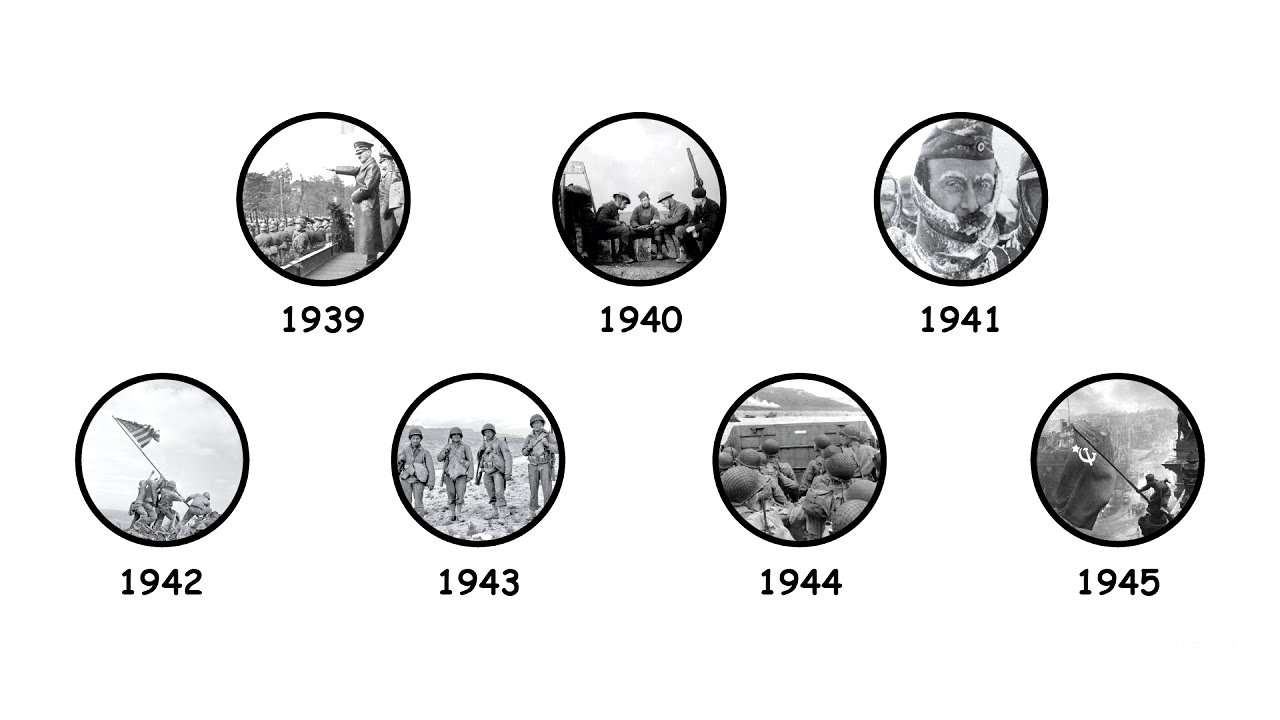
This video provides a chronological overview of World War II from 1939 to 1945, detailing key events, military strategies, and the shifting tides of the conflict. It covers Germany's initial Blitzkrieg tactics, the expansion of the war to the Eastern Front and the Pacific, the turning points that favored the Allies, and the ultimate defeat of the Axis powers.
- Germany's invasion of Poland in 1939 marked the beginning of the war, employing Blitzkrieg tactics.
- The war expanded globally by 1941, with Germany attacking the Soviet Union and Japan attacking Pearl Harbor, drawing the United States into the conflict.
- 1942 and 1943 saw critical turning points, such as the Battle of Midway and the Battle of Stalingrad, which shifted momentum towards the Allies.
- The D-Day invasion in 1944 was a pivotal moment, leading to the liberation of Western Europe.
- The war concluded in 1945 with Germany's surrender after the fall of Berlin and Japan's surrender after the atomic bombings of Hiroshima and Nagasaki.
1939: The Beginning of the War [0:00]
In 1939, Germany initiated World War II by invading Poland on September 1st, employing a "Blitzkrieg" strategy characterized by rapid and intense attacks using tanks, aircraft, and ground troops. This offensive overwhelmed Polish forces within weeks, leading to the fall of major cities like Warsaw. On September 3rd, Britain and France declared war on Germany in response to the invasion of Poland, but they were not yet prepared for a counter-attack, resulting in a period of relative calm on the Western Front known as the "Phony War." On September 17th, the Soviet Union, having a secret agreement with Germany through the Molotov-Ribbentrop Pact, invaded Poland from the east, dividing the country into German and Soviet-controlled territories. The Polish government collapsed, and its people suffered under oppressive rule. By the end of 1939, naval warfare intensified as German U-boats targeted Allied merchant ships in the Atlantic, threatening supplies to Britain, which responded by implementing a convoy system to protect its ships.
1940: German Expansion and the Battle of Britain [1:44]
The "Phony War" continued into early 1940, with both sides primarily focused on preparation. In April 1940, Germany invaded Denmark and Norway to secure strategic ports and sea lanes, as well as to protect iron ore supplies from Sweden. Denmark fell quickly, while Norway resisted more strongly but eventually succumbed to German forces within weeks. In May 1940, Germany attacked Belgium, the Netherlands, and France, again using Blitzkrieg tactics to swiftly breach Allied defenses. The Netherlands and Belgium fell within days, leading to the evacuation of Allied soldiers at Dunkirk. By June 1940, France had fallen, with Germany occupying most of the country and the southern region becoming Vichy France, a collaborationist state. In late 1940, Britain stood alone against Germany, enduring a massive aerial assault known as the Battle of Britain, which began in August. The British Royal Air Force (RAF) successfully defended against the German Luftwaffe, marking a crucial turning point as Germany failed to conquer Britain. By the end of 1940, Germany's extensive expansion had left Britain as the only major power in Western Europe not under German control, escalating global tensions.
1941: Escalation on the Eastern Front and Pearl Harbor [3:53]
In early 1941, tensions rose on the Eastern Front and in Africa. Germany focused on consolidating its position in Western Europe, while Britain fought to defend its colonies in North Africa against German and Italian forces. Under General Rommel, German forces in North Africa became increasingly aggressive. On June 22, 1941, Germany launched a massive surprise attack on the Soviet Union, codenamed Operation Barbarossa, violating the Molotov-Ribbentrop Pact. The goal was to seize vast territories in Russia, destroy Soviet forces, and control vital natural resources. Initially, Germany achieved significant success, capturing large areas and major cities. However, the harsh Russian winter and increasing Soviet resistance began to weaken the German offensive. On December 7, 1941, Japan, already engaged in conflict in Asia and the Pacific, attacked the U.S. naval base at Pearl Harbor in Hawaii. This surprise attack led to significant damage to American warships and prompted the United States to officially enter the war, joining the Allies against the Axis powers (Germany, Italy, and Japan). By the end of 1941, the war had expanded into Asia and the Pacific, with Japan aggressively seizing territories in Southeast Asia, including the Philippines, Malaya, and the Dutch East Indies (Indonesia), making the conflict truly global.
1942: Turning Points in the Pacific and Africa [5:38]
The beginning of 1942 presented a challenging situation for the Allies. Following the attack on Pearl Harbor in late 1941, Japan intensified its expansion in Asia and the Pacific, seizing strategic territories such as the Philippines, Malaya, and much of Indonesia. Allied forces, particularly British and American troops, struggled to counter Japanese advances in the Pacific and Southeast Asia. In North Africa, German forces under General Rommel, known as the "Desert Fox," continued to launch attacks against Allied positions. British and Allied forces fought to defend against these attacks, but Rommel's forces initially captured significant territory. The Battle of Midway in June 1942 marked a crucial turning point. In this major naval battle in the Pacific, the United States decisively defeated the Japanese navy, destroying several of their aircraft carriers. This victory halted Japanese expansion and is often regarded as a pivotal moment in the Pacific theater. Subsequently, the Allies began to mount a counter-offensive in North Africa, with stronger and better-organized British and American forces. The conflict in the North African desert intensified. On the Eastern Front, Soviet forces began to mount stronger resistance against the German invasion, despite facing immense pressure. The harsh winter conditions severely hampered German progress.
1943: Allied Advances in Africa, Italy, and the Eastern Front [7:23]
In early 1943, specifically January, Allied forces achieved a significant victory by defeating German and Italian troops in North Africa, particularly at the Battle of El Alamein. This victory was crucial as it paved the way for the Allies to invade Italy and Southern Europe. General Montgomery of Britain led the Allied forces in Africa with a well-organized and disciplined strategy. By July 1943, the Allies launched an invasion of Italy, starting with Sicily. This marked the Allies' initial entry into continental Europe following their success in North Africa. The invasion destabilized the Italian government, leading to the ousting of Italian leader Mussolini. The Battle of Stalingrad, which had begun in 1942, concluded in February 1943 with a decisive German defeat. This battle was one of the bloodiest and most critical on the Eastern Front. The German defeat at Stalingrad marked a turning point, initiating the Nazi retreat in Russia. Allied air forces also intensified their bombing campaigns against Germany, targeting industrial and urban areas to weaken German industry and morale. In the Pacific, the Allies continued their efforts, including the Battle of Guadalcanal, which lasted from 1942 to 1943. The Allied victory at Guadalcanal halted Japanese expansion and initiated the process of pushing back Japanese forces in the Pacific.
1944: D-Day and the Liberation of Europe [9:03]
In 1944, particularly in June, the D-Day invasion of Normandy took place, marking one of the most significant moments of World War II. Allied forces, primarily from America, Britain, and Canada, launched a massive amphibious assault on the beaches of Normandy in France. Thousands of warships and aircraft were involved in the operation, known as Operation Overlord, with the goal of opening a new front in Western Europe and initiating the pushback against German forces. Despite facing fierce resistance, the Allies successfully landed and began the liberation of Western Europe. Following the invasion of Normandy, Allied forces advanced rapidly into France. In August 1944, Paris was liberated from German occupation, symbolizing the resurgence of Europe and the weakening of Nazi power. On the Eastern Front, Soviet forces launched major offensives against German troops, reclaiming territories that had been seized by Germany since 1941. The Soviet advance brought increasing pressure on the Eastern Front. In the Pacific, American forces began retaking territories occupied by Japan, including the Philippines. The war in the Pacific intensified, marked by numerous fierce island battles. In September 1944, the Allies launched Operation Market Garden in the Netherlands, attempting to quickly enter Germany via airborne and ground assaults. Although the operation failed to achieve its objectives, it demonstrated Allied courage and initiative.
1945: The End of the War [10:53]
In early 1945, Allied forces launched a major offensive from the west into the heart of Germany, while Soviet forces advanced from the east, invading German territory. Major cities like Berlin became key battlegrounds. In April 1945, after intense fighting, Berlin was encircled by Soviet troops. Hitler committed suicide in his bunker as Germany faced imminent defeat. The fall of Berlin symbolized the collapse of Nazi power. On May 7, 1945, following Hitler's death, Germany surrendered unconditionally to the Allies. This day is known as V-E Day, or Victory in Europe Day, marking the official end of the war in Europe. However, the war in the Pacific continued. The United States launched major offensives against the Japanese islands, moving closer to the Japanese mainland. In August 1945, the United States dropped the first atomic bomb on Hiroshima on August 6 and the second on Nagasaki on August 9. These bombings caused immense destruction and mass casualties. On August 15, 1945, Japan officially surrendered to the Allies, marking V-J Day, or Victory over Japan Day. World War II officially ended after nearly six years of intense conflict. The year 1945 marked the end of the most devastating war in human history. The world underwent significant changes, including the establishment of the United Nations and the emergence of a new era of Cold War tensions between the United States and the Soviet Union. Millions of lives were lost, cities were destroyed, and the political map of the world was drastically altered.