
TLDR;
The discussion revolves around the complexities of fiscal federalism in India, particularly focusing on the Goods and Services Tax (GST) and the financial relationship between the Union government and the states. It covers the nuances of revenue distribution, the impact of centrally sponsored schemes, and the challenges faced by states in maintaining financial autonomy. Additionally, it touches upon Tamil Nadu's strategies for economic growth, especially in the IT sector, and suggests measures for improved coordination and autonomy for states within the federal structure.
- The Union government has been weaponizing the distribution of public money politically.
- GST is not truly federal and participative.
- Tamil Nadu is figuring out how to manage with limited avenues.
- The mindset to stop politics at the election and not go into governance is needed.
- Tamil Nadu was the pioneer state and Chennai probably city in IT.
Introduction and Context [0:00]
The discussion begins with an anecdote about a challenging task of speaking at an education summit and then being asked to speak about finance. The conversation transitions to a discussion on the disadvantages of a double-engine government, where the state doesn't think independently due to alignment with the central government. This is then related to the GST framework, questioning whether it's better for a state to be in a double-engine government or to maintain its independent stance, like Tamil Nadu.
Weaponization of Public Money and GST [1:04]
The speaker asserts that the current government has weaponized the distribution of public money for political gain, demanding compliance in exchange for funds, even those legally mandated. This abuse of authority is unprecedented. The funds from the Union government come in two forms: the share of taxes, determined by the Finance Commission, and discretionary grants and schemes, specifically centrally sponsored schemes. The speaker argues that these schemes undermine the constitutional principle of a finance commission by giving the Union government excessive discretion over state subjects. GST, theoretically governed by a council, has become an extension of the Union government, especially with instances where the Prime Minister preempts GST council decisions.
Double Engine Governments: Advantages and Disadvantages [4:10]
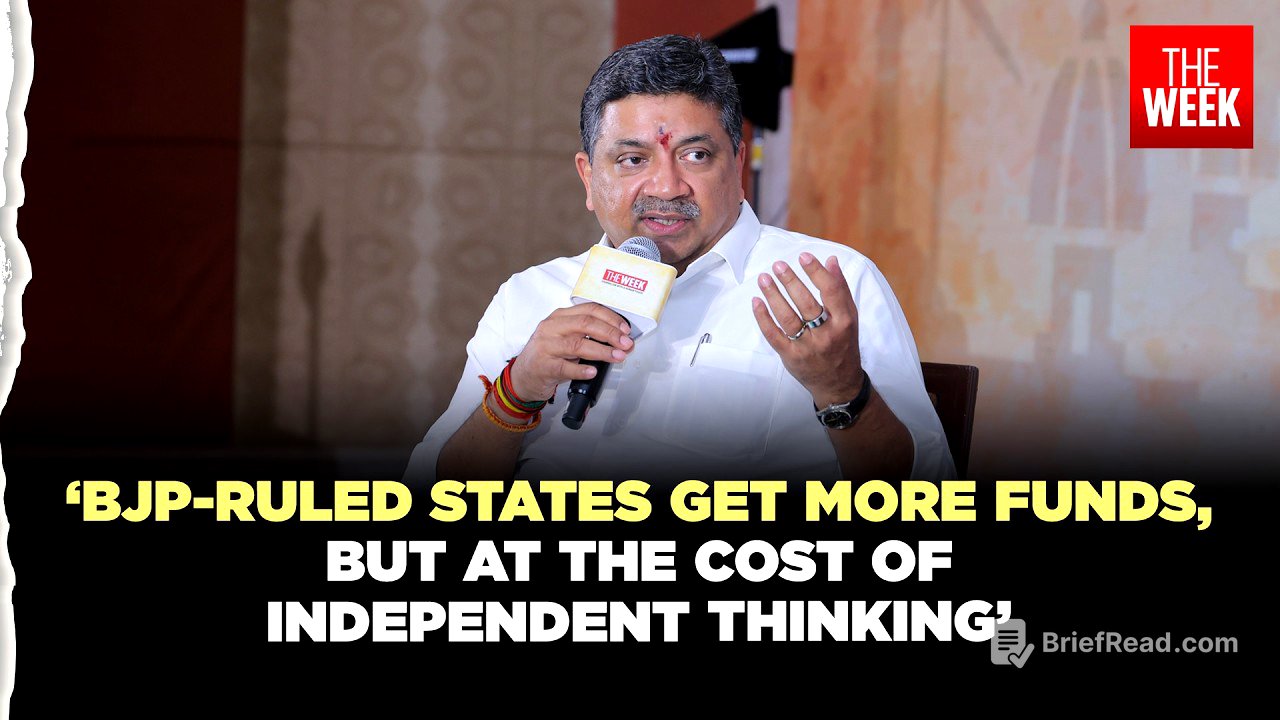
A double-engine government can be a boon because the central government may allocate more funds to states governed by the same party, hoping to boost re-election prospects. However, this comes at the cost of independent thinking, as these states are expected to align with the Union government's policies, which often lean towards centralization. The speaker shares that representatives from other states have admitted their inability to advocate for their state's interests due to the double-engine dynamic, relying on others to raise issues on their behalf.
GST Collections and State Revenue [6:30]
The speaker raises concerns about the GST surcharge, which amounts to a significant sum, approximately 4.25 lakh crores, and how states lose out on this revenue. With limited levers for generating income, states like Tamil Nadu face challenges in compensating for this loss, despite measures like property and liquor taxes. The speaker emphasizes that GST is essentially a Union government-directed tax due to its voting structure, where only a few states are net contributors. The GST collection system is also flawed, with the Union government controlling the timing and method of fund distribution to the states.
GST Council and Federalism [8:35]
The GST Council serves as a forum for dialogue between states and the Union government, but its work is not truly federal or participative. While the Union Finance Minister is credited for running the meetings collegially, the substance of the work is often dictated by the Union government's intent. The speaker agrees that being a BJP-run state provides more financial benefits but at the expense of independent thought. The proportion of funds received as share of taxes versus centrally sponsored schemes has shifted, granting the Union government greater flexibility in fund allocation.
State Autonomy and Revenue Generation [10:48]
The speaker discusses the limited avenues available to states for generating revenue and highlights Tamil Nadu's resistance to including petroleum products under GST. Despite these constraints, Tamil Nadu has managed to maintain a reasonable growth rate through effective execution, capability, and systemic thinking. The speaker points out the unfair targeting and illegal deprivation of funds to states, emphasizing the need for autonomy and accountability.
Coordination Between States and Union [14:13]
The speaker suggests that the primary requirement is a shift in the Union government's attitude, recognizing states as partners in governance, irrespective of political affiliations. Politics should cease after elections, focusing instead on administration, execution, and outcomes. Multiple active forums are needed for states to coordinate effectively, beyond ceremonial meetings. The speaker notes that Southern states generally work well together on a one-to-one basis and suggests formal mechanisms to enhance this coordination.
Ideal Autonomy and Accountability [18:47]
The speaker explains that coalition governments in the past served as a form of federalism, as regional players had to be included in the government, leading to a more moderate and federalist approach. The Chief Minister of Tamil Nadu has formed a committee to explore good federalism and state autonomy, addressing legislative changes and coordination mechanisms. The committee has submitted a report with recommendations for a better federal model, though the speaker believes further changes are needed.
Impact of GST on the Automobile Sector [21:01]
The speaker dismisses the idea that GST is solely responsible for the growth in the automobile sector in Tamil Nadu, emphasizing the state's existing leadership in the industry. While GST has advantages like a nationwide tax rate and standardization, it has also taken away the independence of states in managing their indirect taxation, subjugating them to the Union's directives. The speaker argues that GST has not been revenue neutral and has reduced the indirect tax revenues of states.
Limitations and Violations of GST [23:47]
The speaker points out that GST still has many limitations and violations, such as tweaking the computer system before a bill is passed, undermining the legislator's power. The GST Secretariat lacks adequate resources and is an afterthought in the revenue department. The agenda for GST Council meetings is often set without consulting the members, reducing their role to ceremonial rubber stamps.
Tamil Nadu's IT Sector and Future Plans [26:06]
The speaker acknowledges that Tamil Nadu was a pioneer in IT but has lost its dominant position over the years. However, the state can correct this in the age of AI. The number of registered startups has increased significantly, and the government is supporting them through various initiatives. The state is also focusing on AI-related education and providing laptops to college students. The speaker suggests creating an AI compute engine and rethinking education from elementary school to prepare for the future.







![Python Tutorial For Data Domain [Advanced Guide - Beyond Basics]](https://wm-img.halpindev.com/p-briefread_c-10_b-10/urlb/aHR0cDovL2ltZy55b3V0dWJlLmNvbS92aS9NLVV0S3hndEthZy9ocWRlZmF1bHQuanBn.jpg)